


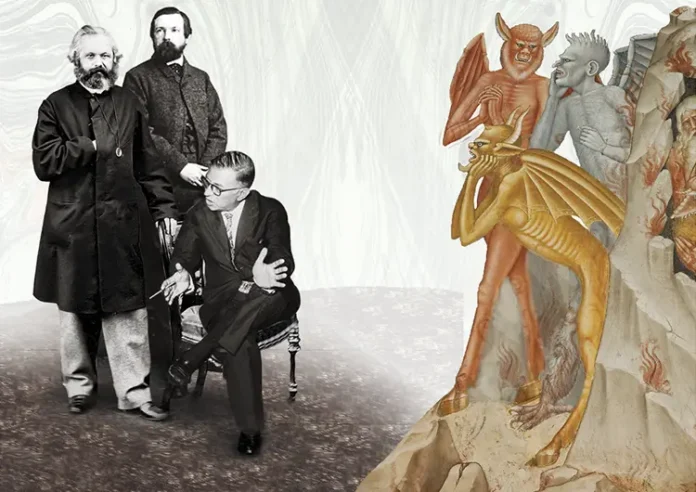
In classical antiquity, only a few philosophers – one named Diagoras, born in Melos, and another named Theodore, known as the Atheist – declared themselves atheists, and those who did so never gained the support of their contemporaries. It was only with the marked moral and religious decline of humanity between the 17th and 18th centuries that atheism gained numerous adherents.
Indeed, a significant historical turning point came about with the Enlightenment, whose followers, some atheists, others agnostics, and most deists, deified reason to the detriment of the dogmas of the Catholic Faith. The spread of these ideas paved the way for the emergence of so-called scientific socialism in the 19th century. Its theorists – Marx, Engels and Feuerbach, manifestly atheists – profoundly influenced the religious, political, social and economic events of the 20th century.
Following the same path, in a new historical milestone, were the ideologues of the 1968 Sorbonne anarchist movement, Herbert Marcuse, Jean Paul Sartre, and Louis Althusser, to name but a few. In this 21st century, to list all the atheist philosophers and thinkers would needlessly extend this article…
However, where can we find the key to unravel the core of this problem? What is the fundamental cause of the error of atheist ideologues?
The perennial thought of St. Thomas offers us an illuminating answer to these questions. Indeed, we human beings are incapable of seeing God directly; therefore, His existence is not evident to us. However, based on observation of the world and everyday life, and through logical reasoning and deduction, the Angelic Doctor demonstrated the existence of God without resorting to faith and theology (cf. Summa Theologiæ, I, q.2, a.3).
Thus, using simple human intellect, he achieved a very high understanding of the Creator.
From this perspective, in which the virtue of faith is not a prerequisite for believing in the existence of God, a question discussed by Aquinas is surprising: Do the demons have faith (cf. II-II, q.5, a.2)?
St. Thomas resolves the question by quoting Scripture: “Even the demons believe – and shudder” (Jas 2:19). Aware that this sentence could raise perplexities, he clarifies it. “To believe is an act of the intellect inasmuch as the will moves it to assent” (II-II, q.4, a.2), and the so-called faith of demons does not correspond to “the will being directed to the good” by which “to believe is a praiseworthy action” (II-II, q.5, a.2), as is the case with the faithful of Christ. On the contrary, in demons it is a faith “in a way, compelled to believe” (II-II, q.5, a.2, ad 1), for they recognize the existence of God because of the evidence of the signs they perceive.
Furthermore, this perception, sharpened by their natural intellectual acuity, does not give demons the opportunity to deny the aforementioned signs, a fact that deeply displeases them (cf. II-II, q.5, a.2, ad 2-3). Consequently, fallen angels have never been and never will be atheists. Their extremely high intelligence does not allow them to be ensnared by such mental folly, such deception, such idiocy. This is the error into which atheists fall.
Scripture rightly asserts: “fools die for lack of sense” (Prv 10:21), “but a man of understanding walks aright” (Prv 15:21). ◊

