There are certain “coincidences” that science cannot explain; miracles and supernatural interventions are beyond its scope. And in some cases, the divine manifestations and unexpected aid received are difficult for even people of great faith to comprehend.
One such cases is reported by Dr. Gianne Donato Costa Veloso, a haematologist at the Pope St. John Paul II Transplant Service of the Holy House of Mercy in the Brazilian city of Montes Claros.
She tells us of a series of events involving two delicate bone marrow transplants which would have ended in disaster if it were not for the intervention of Dona Lucilia, obtaining from God a whole sequence of highly improbable occurrences.
A delicate procedure
Dr. Gianne writes:
“For some years I have been working with diseases that affect the blood system, and for me this is a sublime art, in which every detail makes the difference between life or death, the end or a new beginning.
“In some situations, to treat specific types of haematological cancers, high-dose chemotherapy is necessary, which destroys the disease, but also does away with all the cells responsible for the production of blood and the body’s defence system. This eliminates the disease, but it can also kill the patient.
“The only viable way to perform this efficacious treatment for the disease is to separate the cells capable of rebuilding the blood and defence system, storing them and maintaining them fully alive outside the patients while the chemotherapy destroys the disease. Once patients become disease-free and lacking bone marrow, the preserved cells are infused back into their bodies to reconstitute the destroyed blood system. This is the essence of bone marrow transplant.”
The steps of a complex procedure
Dr. Gianne provides further clinical explanations to help us understand how the facts unfolded:
“To perform a bone marrow transplant, doctors must reach the correct diagnosis and determine the procedure’s suitability for the patient. Preparations involve administering medication to mobilize stem cells from the organized bone marrow environment into the vascular system that circulates blood through our vessels to our entire body. Then, using a catheter in a large vein, the doctor collects the desired cells, passing them through a machine that identifies them by their size and the absence or presence of granules within them.
“These selected cells are stored in plastic bags for future evaluation regarding quantity and vitality, to reach a conclusion as to their suitability to act as very special seeds with a specific destination — to settle, repopulate and restore proper functioning to the entire bone marrow, beginning from a single type of infused mother cell capable of generating thousands of daughter cells, with varied functions. These new cells offer the body a fresh start without disease and boost the immune system, fully restoring it and making it newly competent.
“The harvested cells are frozen in an appropriate solution and stored in this state, which is something akin to hibernation, potentially for years. What guarantees the survival of these cells is freezing them in this specific solution, which slows, and later halts the metabolic activity of the cells. Stored in this way, the cells cease to consume oxygen and energy, and remain alive during the whole period in which they are apart from the patient’s body.
“Similarly, the cell’s reawakening to fully resume activity is triggered by thawing and rapid infusion into the body, through a major vein. This very process soon furnishes new sources of oxygen and energy to aid at such a critical moment. The cells, now awakened from hibernation and nourished by the patient’s bloodstream, begin to circulate throughout the blood and, by a beautiful mechanism of recognition of their new home, begin to repopulate the bone marrow environment that had been prepared to receive them.
“This preparation involves destroying the patient’s entire blood system and immune system through high-dose chemotherapy, so that all malignant cells are eliminated. It is a treatment that would be impossible to tolerate if the cells capable of rebuilding these systems were not reserved in safekeeping outside the body. If the stem cells are not reinfused, various complications will arise that will almost invariably lead to the sick person’s death.”
A traffic accident leads to crisis
Given this explanation of the treatment’s complexity and the need to follow the exact sequence preestablished by the medical team, Dr. Gianne now describes the unusual situation she experienced:
“Two patients with multiple myeloma were prepared to receive their new bone marrow. After confirming the viability of the cells priorly harvested, chemotherapy treatments were performed twenty-four hours before the scheduled time for the infusion of the stem cells. It happens that that these cells are manipulated at the Biological Tissue Centre, four hundred kilometres away from where the patients would receive them.
“The cells are transported in plastic bags, protected by thin metal plates and immersed in containers with liquid nitrogen, which maintains the temperature at 195 ºC. The position and inclination of the container, inside the vehicle that transports this sensitive material, are monitored to ensure that there will be no loss of energy or increase in temperature during the journey to the medical centre in Montes Claros where the transplants are performed.
“At the time the cells were supposed to arrive – six o’clock in the evening, one day previous to their infusion – we were informed of a transport delay, with a new estimated arrival time of nine o’clock. At nine o’clock, the nurse at the transplant centre received word from the transport company that the driver of the car had been in an accident: the vehicle had overturned and was suspended on a slope next to the Jequitinhonha River, near the municipality of Olhos D’água. The driver was rescued by SAMU (Mobile Emergency Care Service), but no one knew the location or condition of the plates containing the stem cells to be used for the two patients’ transplant procedure.
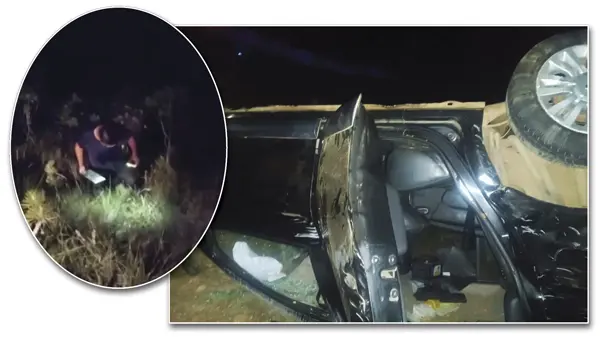
Vehicle transporting stem cells after the accident; highlighted, search for bags containing the material
“I immediately requested the assistance of the doctor responsible for the Transplant Unit, my husband, Dr. Luiz Fernando Veloso, who contacted the hospital superintendent. Together they got in touch with the SAMU to obtain detailed information about the accident, in order to mobilize police and rescue workers, so that they could provide the necessary manpower to locate the plates containing the cells, in time for their infusion.
“We soon learned that the car was badly damaged, suspended by a steel cable, and that the container was no longer inside. Furthermore, the container lid had been located, but the rest was missing – most importantly the precious plates containing the ‘lives’ of the two patients.”
Prayer: the solution to an “unsolvable” problem
Seeing all the natural possibilities and recourses fall through, Dr. Gianne did not hesitate for a single instant:
“Faced with this occurrence, and in complete darkness and hopelessness, I was taken by an inspiration to offer prayer and supplication. I went to my oratory and prayed the mysteries of light – the luminous mysteries of the Holy Rosary – asking for Our Lady’s intercession, since that is what came to mind. It also occurred to me to ask a good lady I had heard about, with a reputation for holiness.
“This lady, now deceased, is invoked as “Dona Lucilia,” and as soon as her name came to mind, I began to pray and ask, amidst tears of despair, for her help in the search for the cells, so that they could be found suitable for infusion, in the right quantity and quality and in the quickest way possible, because time was a critical factor in that unusual and worrisome situation.
“The cells were among the trees and bushes, or at the bottom of the river – somewhere near the road leading to Olhos D’água. They were the ‘life’ of two hospitalized patients, whose bone marrow had been adequately destroyed by chemotherapy and was ready to receive the cells that had gone missing.
“For about four hours I prayed, cried, pleaded and asked God for the solution to this extremely serious and difficult problem. Each advance of the clock hand meant the heating of the cells, energy consumption and loss of vitality. If transport had been carried out at the normal time and the accident had occurred during the day, the impact of the temperature would certainly have been greater.”
Racing against the clock in the struggle to save two lives
“At 2:20 in the morning, we were informed that three of the four plates had just been found. The discovery of those small metal plates in a wooded area by the river, at night, and considering the searchers’ total lack of familiarity with the object being sought, was the first act of God’s providence.
“Immediately, the entire team responsible for the infusion went to the hospital, keenly anxious to determine the condition in which the bone marrows would arrive. Furthermore, I still didn’t know which of the two patients would receive one less plate.
“At 3:15 in the morning, the three plates were delivered to me in a cardboard box by an officer of the military police who had been cured of acute leukaemia about eighteen months earlier. I later learned that at some point during the search for the cells, it was suggested that they give up the search, but he and other good people who were there insisted on continuing the work, as they had an idea of the importance of that search to save the two lives awaiting rescue. I see this as a second act of God’s providence.
“The plastic bags were duly examined and sanitized; the contents of each of the three were then infused: two bags holding a total of 3.6 million cells for one patient, and the other bag containing 5 million cells for the second patient. The bags arrived thawed, and at that point we did not know if the cells were still alive and able to perform their role, since the thawing process reactivates the cells, causing them to start consuming energy and oxygen and reducing their survival time outside the body.
“The infusion of the three bags containing the cells was carried out between 3:30 and 4:20 in the morning, without any complications and with excellent tolerance on the part of the patients. They were tranquil and still unaware of what had happened.”
A vital detail
One highly important detail, which Dr. Gianne makes a point of mentioning in her account, is the fact that, for the bone marrow to be properly reestablished in its function, the minimum number of cells that must be infused is two million. Aware of this, she had prayed that the right amount would be found. Her narration continues:
“The third intervention of God was that the two bags arrived for the patient who only had a total of 3.6 million cells stored. The loss of one of her bags would have been very serious. But the missing bag belonged to the patient who had, in the single bag found, more than double the minimum number of cells required.
“At five o’clock in the morning, I was given the fourth bag which, found late, was breached, torn, and with all its cellular content lost.
“At seven in the morning, this news was already on television, with images of a policeman rummaging through the undergrowth by the light of a flashlight in an incredible search for something of which he only had remote and second-hand knowledge. We informed the patients about all that had happened and the implications and risks. They remained extraordinarily calm and confident.”
Sure of Dona Lucilia’s intercession
“In ideal situations, signs of recovery of the transplanted bone marrow – whose minimum restoration we call ‘engraftment’ – are usually perceived between the tenth and fourteenth day after the infusion of stem cells. In some patients, this ‘engraftment’ can take thirty days or even longer to occur.
“This implies that, in that entirely abnormal situation, the ordeal of the wait could be extremely prolonged and stressful. The risk that the ‘engraftment,’ might fail, that is, that the marrow might simply not function, was preponderant. Success depended on how viable those cells were after the harm to which they were subjected as a result of the accident.
“The fifth day after the infusion was a Sunday. I went to Mass at Our Lady of the Clearest Mountains, a church of the Heralds of the Gospel. It was the first Sunday of June, the month of the Sacred Heart of Jesus. In his homily, the Herald priest mentioned, among several examples of devotion to the Sacred Heart, Dona Lucilia, mother of Dr. Plinio Corrêa de Oliveira, the same lady, famous for her sanctity, whom I had invoked on that difficult night. Simply hearing that was a type of relief for my anguish.
“At a certain point in his sermon, the priest made reference to Dona Lucilia as a ‘lamp’ that led to the Sacred Heart of Jesus! I was overcome with intense emotion as I remembered a series of events: my prayers for the patients, the luminous mysteries, the flashlights of the police who found the altogether unfamiliar cell pouches in the dark… It was impossible not to associate the events of the bone marrow, my prayers, and the request for intercession that I made to that lady known for her holiness.
“I was overwhelmed with the certainty that this entire occurrence had been blessed, protected, guided, and illuminated by the intercession of Dona Lucilia.”
Finally, two patients completely cured
The hope Dr. Gianne had hinged on the help of such a kind mother would not be disappointed regarding the most important issue in play: the lives of the two patients. Let us follow this impressive story to its outcome.
“On the tenth day of the infusion, the patient who received both bags of bone marrow showed unequivocal evidence of bone marrow ‘engraftment,’ and was discharged from the hospital four days later in excellent condition, as if the marrow had been unaffected by all the abuse it had suffered.
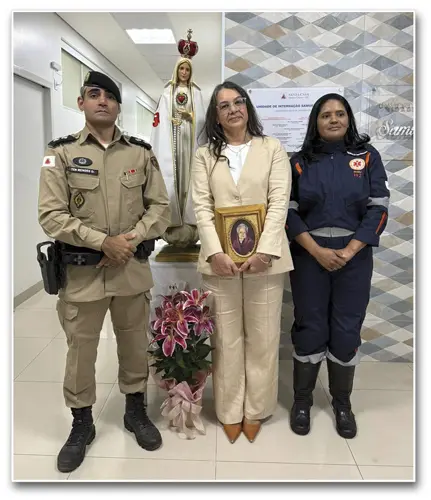
In the centre, Dr Gianne holding a picture of Dona Lucilia alongside two professionals involved in the case
“On the eleventh day, the patient who had received only one bag showed signs of an inflammatory reaction which, although not frequent, can occur during bone marrow ‘engraftment.’ This manifested itself by fever, decreased arterial oxygen saturation, tachycardia, and malaise. She received appropriate treatment and twenty-four hours later was in good clinical condition.
“I want to clarify that the intensity of this reaction would have been much greater and graver if the patient had received both bags. God acted with utmost perfection, delivering a completely empty bag of bone marrow to me, because, otherwise, it would have been infused. This patient was released from the hospital on the fifteenth day, also in excellent condition, as if nothing negative had acted on her bone marrow.
“On June 11th, the day one of the patients was discharged, we decided to thank Our Lady for the maternal care She had shown in relation to the search teams, the doctors and paramedics involved in these events. We received a visit from the Pilgrim Statue of Our Lady of Fatima, with the blessing of Fr. Wagner Morato, EP. It was an important moment for the faith of many people there in the hospital.
“We took a beautiful photo for posterity, with everyone involved, and I made a point of holding a photo of Dona Lucilia, in gratitude for this great blessing that was granted to us.”◊