
“If one morning you find me dead, do not be sad: it is simply that the Good God the Father has come to take me. Without a doubt, it is a great grace to receive the Sacraments; but, when God does not permit it, it is good as well. Everything is grace.”1 These words of St. Therese of the Child Jesus, spoken four months before her death, shed light on one of the greatest mysteries of Christian life. Indeed, for the baptized person there is no destiny, no omens, no luck or misfortune. There is, rather, the Providence of God, which guides us in all things, great or small, with His omnipotent hand.
In the Christian life “everything is grace,” because everything is providential. But also “everything is grace” because the divine aids we receive are greater and more numerous than we imagine… We would be astonished if we could see the graces that God grants us day and night: these are the so-called actual graces.
Energy that moves the supernatural organism
First of all, it is necessary to establish a distinction: although actual grace is intimately united with habitual or sanctifying grace, one should not be confused with the other.
Actual graces are momentary illuminations or dispositions that are able to set the supernatural organism of the soul in motion
The latter, as seen in the preceding articles, is a divine gift that makes man participate in divine life itself. Through sanctifying grace, we become members of God’s family, His children and intimate friends, and we receive as a benefit all the infused gifts and virtues. But these gifts and virtues need to be set in motion, and for this, there are actual graces: momentary illuminations or dispositions that set the supernatural organism of the soul in motion. Their role is similar to the electric current that illuminates the light bulbs of a beautiful crystal chandelier.
Habitual grace is static and ordered to being; actual grace is dynamic and relates to the operation of that same being. Fr. Antonio Royo Marín, OP, defines the latter as follows: it is “a supernatural, interior, and transitory aid, by which God illuminates our understanding and strengthens our will to perform supernatural acts.”2
But, as previously stated, actual graces are varied. Therefore, they do not operate in the soul in a univocal manner.
By sailing or by rowing?
Actual graces can be divided into cooperative and operative graces, according to their mode of action.
Cooperative graces are those in which the soul is moved by God, but also moves itself to the practice of good, cooperating with the divine aid. Operative graces, on the other hand, are those whose action proceeds exclusively from God: the soul is thus moved to perform good without any effort other than that of allowing itself to be led.
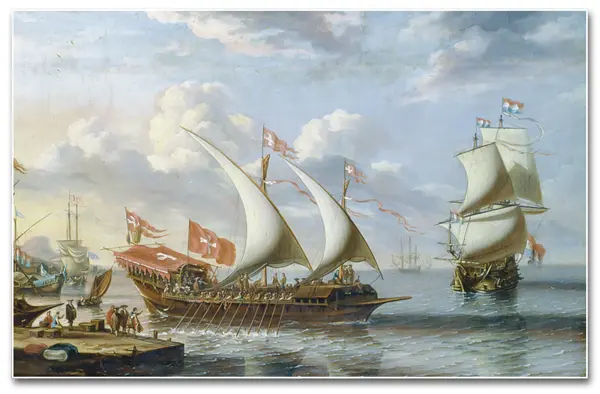
Cooperative grace is like a boat that needs the use of oars to set it in motion, while operative grace is like one propelled by the wind filling its sails
An example given by Msgr. João illustrates this division well. Cooperative actual grace is like a ship that, on a completely calm sea, needs to be propelled forward by the use of oars. Operative grace resembles the same vessel, but gliding across the ocean with its sails billowing in a strong wind; it moves along without any effort on the part of the crew.
That is why Msgr. João always urged his spiritual children to pray fervently, although always docile to the Lord’s designs, asking for Him to guide them through abundant operative graces. If God is our Father, why would He not give us such graces from His infinite treasure? It is good, and even indispensable, to ask for graces; it is a condition for obtaining them in greater abundance.
Moreover, the more frequently we receive the Sacraments and the deeper our prayer life – and this is already a grace that we should ask for – the more numerous and greater graces we will receive, not because we deserve them, but by the pure gratuitousness of God who, exalting our merits, crowns His own gifts in us.3 Catholic doctrine teaches that in no way do we deserve any grace; however, we can obtain them through humble and confident prayer, as Our Lord Himself promises: “Ask, and it will be given you” (Mt 7:7).
Actual graces: why and how to receive them?
We often receive abundant graces without realizing it. This is because our pride leads us to attribute to ourselves a role that, in reality, is minimal or non-existent compared to the action of grace. We overcome a defect, perform an act of charity, suppress our impatience, begin to pray more frequently and devoutly… and we think that everything is due to our generous efforts. We do not perceive that an invisible hand sustains us in the practice of good, often without us even asking.
In fact, receiving actual graces does not necessarily require that the soul be in a state of grace. If that were the case, we would never be able to rise again after committing a serious sin.
Yes, the conversion of the sinner is an outstanding grace. For St. Thomas,4 the greatest work of God.
We are once again face to face with the awe-inspiring mystery of the mercy of God, who hates sin but loves the sinner and wants him to repent and have life (cf. Jn 3:16).
Between laxism and rigorism
But then, if grace does everything… where do our efforts fit in?
This was a problem that the Church had to address from very early on. Regarding the role of grace in human life, two heretical positions emerged, in broad terms.
The first affirmed the total or relative uselessness of grace compared to human efforts. This current included the Pelagians, for example, who considered grace only as an aid that makes virtue easier, and believed that without it man could fulfil all the Divine Commandments. Against these, St. Augustine had to wage fierce battles.
Others, however, falling into the opposite extreme, ended up dispensing with the role of effort and asceticism, in order to cast themselves without remorse of conscience into the mire of sin. For Luther, for example, justification would occur through faith, independent of works, through the merits of the Passion of Christ. Hence the Protestant leader even went so far as to say: “Be a sinner, and sin boldly, but even more firmly trust and rejoice in Christ, the victor over sin, death, and the world. We must sin while we live here. […] It is enough that through the riches of glory we have known the Lamb of God who takes away the sins of the world. Sin will not separate us from Him, even if we commit a thousand murders and a thousand adulteries a day.”5
Without grace, it is impossible for us to do good integrally; if we are docile to its inspirations, we will be raised to unimaginable heights
Obviously, neither position represents the Church’s view.
St. Augustine6 affirms that, without grace, it is not possible for us to do good integrally, whether by thought, desire, or action. But how can we explain that evil men, on certain occasions, perform good works, even from a natural point of view? St. Thomas Aquinas explains: “even in the state of corrupted nature it [human nature] can, by virtue of its natural endowments, work some particular good, as to build dwellings, plant vineyards, and the like; yet it cannot do all the good natural to it, so as to fall short in nothing; just as a sick man can of himself make some movements, yet he cannot be perfectly moved with the movements of one in health, unless by the help of medicine he be cured.”7
How much less can man, by his natural powers, perform acts that surpass his corrupted nature, such as the practice of virtues and the observance of the Divine Commandments. We cannot, therefore, even pronounce the name of Jesus devoutly without the aid of an actual grace.8
The solution, therefore, seems to be summarized in the Ignatian adage: “Pray as if everything depended on God and work as if everything depended on you.”9
Allowing oneself to be guided by divine grace
If we know how to listen to God’s voice in the silence of our interior, we will realize how at every moment we are inspired, by actual graces, to a greater union with Him. St. Maravillas of Jesus used to repeat: “Si tú le dejas… – If you let Him act…” Let us be docile to the inspirations of grace, He will raise us to heights we never dared to imagine we could reach.
“I believe,” the Spanish Saint also said, “that our nothingness and our misery do not matter at all to the Lord; He takes care of fixing, cleaning, and changing; the point is that we love Him and make His divine will so much our own […], that it alone may govern our lives, in great and small things, external and internal, and that we occupy ourselves only with fulfilling it and, above all, with letting it be fulfilled in us.”10 ◊
Notes
1 ST. THERESE OF LISIEUX. Derniers entretiens, 5 juin. In: Œuvres complètes. Paris: Cerf; Desclée de Brouwer, 2006, p.1009.
2 ROYO MARÍN, OP, Antonio. Somos hijos de Dios. Misterio de la divina gracia. Madrid: BAC, 1977, p.59.
3 Cf. ORDINARY OF THE MASS. Preface of the Saints. In: ROMAN MISSAL. Third Typical Edition, 2011, USCCB, p. 599
4 Cf. ST. THOMAS AQUINAS. Summa Theologiæ. I-II, q.113, a.9.
5 MARTIN LUTHER. Carta a Melanchthon, 1/8/1521. In: Obras. 4.ed. Salamanca: Sígueme, 2006, p.387.
6 Cf. ST. AUGUSTINE. De correptione et gratia, c.II, n.3.
7 ST. THOMAS AQUINAS, op. cit., q.109, a.2.
8 Cf. ROYO MARÍN, op. cit., p.60-61.
9 CCC 2834.
10 ST. MARAVILLAS DE JESUS. Carta 6241, de 17/6/1950. In: Cartas. Antología epistolar. 2.ed. Madrid: Edibesa, 2007, p.282.