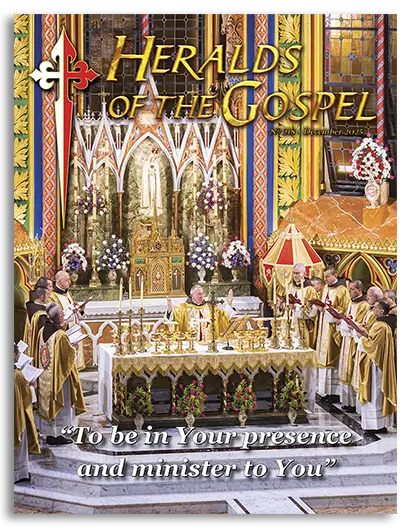
The Holy Trinity encompasses the most sublime of liturgies, in which the Father begets the Son and from Both proceeds the Holy Spirit. Through the Incarnation, the Son, as Priest, glorifies the Father by offering the prayers and oblations of His entire Mystical Body, to which even the Angels belong, as St. Thomas Aquinas affirms (cf. Summa Theologiæ, III, q.8, a.4).
On earth, Holy Mass is the prayer par excellence, celebrated in the person of Christ Himself – in persona Christi – by the ordained minister. The latter’s role is to be a mediator – pontiff – between God and men, offering them sacred things, as suggested by the etymology of the Latin word for priest: sacra dans.
In contrast to certain functionalist conceptions of the priesthood, Sacred Scripture defines it as a calling “to stand and minister in the name of the Lord, […] for ever” (Dt 18:5). This concept is transmitted by the Rite of Ordination, in which the one to be ordained responds to the convocation: “Adsum! – Here I am!” From the beginning, there is a total willingness to be before the Lord, “to see Him and be seen by Him,” as in the Curé of Ars’ definition of prayer.
Apostolic tradition summarized this essence of the priesthood in an expression from Eucharistic Prayer II, which dates back to the second century: “Astare coram te et tibi ministrare – To be in your presence and minister to You.” The earthly Liturgy is a participation in the heavenly liturgy, in which myriads of Angels are constantly standing (cf. Dn 7:10; 12:1) in the presence of the Lord (cf. Tb 12:15; Lk 1:19), in contemplation and adoration (cf. Rv 4:4-11).
In fact, through the exclusivity of their service – diakonía – priests participate in the function of “spirits sent forth to serve” (Heb 1:14). According to St. Ambrose (cf. Expositio Psalmi. In Psalmum CXVIII. Sermo 10, n.14: PL 15, 1334), the “standing” of the Angels means nothing other than service, and so too the sacred ministers were ordained to minister, that is, to serve in a total consecration of themselves “as a living sacrifice”, and “holy” (Rom 12:1).
In addition to this angelic note, it can be seen that the priesthood has an intrinsically Marian root. In fact, St. Gabriel announced to the Virgin: “The Lord is with You!” (Lk 1:28), manifesting her constant union with the Most High. The jubilant soul of Our Lady joined the Angels who sang in the presence of the Most High the Gloria (cf. Lk 2:14), which inaugurates all solemnities. Finally, always standing (cf. Jn 19:25), She joined in the liturgical act par excellence, the redemptive sacrifice of the Eternal Priest on Calvary.
In her response to the Archangel, Mary Most Holy also revealed her unconditional conformity to the divine will: “Behold, I am the handmaid of the Lord” (Lk 1:38). Likewise, at the Wedding at Cana, “the Mother of Jesus was there” (Jn 2:1) to serve and intercede with her Son in every need. Finally, at the foot of the Cross, Christ entrusted to her an ordained minister, John, who received her as his Mother, prophesying her in Revelation as the “great portent” (Rv 12:1).
Amidst contemporary hyper-activism and the lamentably lackluster Liturgy prevalent in some milieus, it is opportune to emphasize these angelic and Marian keynotes of the priesthood, in order to return to its essence: to live for Christ, in His presence, in that of Mary and of the Angels, and abnegated in their service.