With what devotion we should attend Holy Mass! In this sublime Sacrament, the Sacrifice of Calvary is renewed and Jesus makes Himself present every day in the Sacred Species, wherever in the world a priest pronounces the words: “This is my Body,” “This is the chalice of my Blood.” Thus, after living in this world, the Divine Redeemer ascended to the heavenly abode, but remained among His own, vivifying the Church through the Eucharist.
However, in addition to His sacramental presence, Our Lord wanted to make Himself visible to us through certain chosen souls in whom He vividly represents His suffering face, women and men in whom He imprints His wounds, making their existence a kind of memorial of His own immolation.
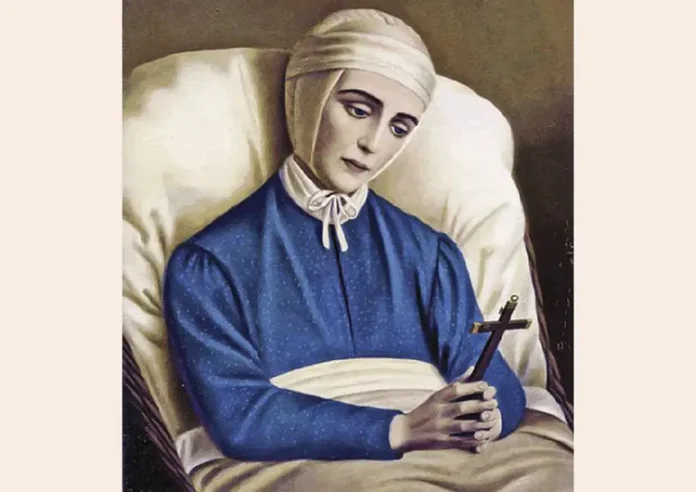
Bl. Anne Catherine Emmerich was one of those souls chosen by God to unite herself to the Passion of the Immolated Lamb.1
A childhood permeated with mystical phenomena
Born in 1774 near Dülmen, Germany, Anne Catherine shared her birthday with Our Lady, September 8. Her childhood was so penetrated by the supernatural that her ordinary childhood life was intertwined with an intense mystical life.
In addition to His sacramental presence, Our Lord wishes to make Himself visible through certain souls who represent His suffering face
Her family, however, did not notice anything unusual until the child learned to speak. From then on, they had many surprises because every afternoon, when her father returned from the fields and sat by the fireplace, he would put little Anna Kathrinchen on his lap, and she would candidly recount the stories she had “seen” that day, the great majority of which were scenes from the Old Testament or the life of the Holy Family.
When she was six years old, St. Joan of Valois appeared to her with an enchanting Boy, the same height as Anne Catherine, at her side. The Saint said to her: “Look at this Boy. Would you like to marry Him?” When she answered in the affirmative, the Saint assured her that she would become a nun and that one day that Boy would espouse her. From that moment on, even at such a tender age, the child decided that she would enter the convent.
Anne Catherine spent her days in the countryside tending sheep. It was there that the Infant Jesus appeared to her, to play with her and keep her company. Through Him, she learned, without anyone in her family telling her, that she would soon have a little brother. She wanted to prepare him a gift to give him as soon as he was born, but she did not know how to sew. So the “Little Boy”, as she called the Divine Infant, taught her how to sew a cap and other clothes for the baby, which astonished her mother, as she had not yet taught her such skills.
One day, her Guardian Angel took her to visit Queen Marie Antoinette, who was in prison at the time, and often transported her to Jerusalem and Bethlehem, which is why she claimed that these places were more familiar to her than her own home. Blessed with the gift of hierognosis, that is, sensitivity to the sacred, she felt the presence of Our Lord Jesus Christ in the Eucharist, discerned the authenticity of the relics of the Saints, discerned the presence of a priest from afar by virtue of his anointing, and could distinguish holy water from ordinary water.
Betrothal to Our Lord marked by tribulation
However, her mystical life exceeded even these impressive phenomena. Providence had chosen her to carry out a mysterious and sublime mission: to live in herself, as an expiatory victim, the espousal that Christ has with His Church.
Anne Catherine ardently aspired to be a religious, but she needed a dowry to enter any convent, and her family, besides not having the financial means, did not want to help her because they disagreed with her desire. But she understood that the purpose of consecrated life is union with the Heavenly Bridegroom, and that her sufferings, efforts, and mortifications would contribute to the realization of this mystical marriage.
She also realized that she had not received her religious vocation solely for her own benefit, but with a view to the needs of the Holy Church. She was to be a sort of receptacle of the treasures of grace related to the religious state, in order to keep it intact in the Church at a time when the Lord’s vineyard was being so devastated.
From that moment on, she began to prepare everything she would need for the betrothal. She worked as a seamstress for three years, with the hope of earning the necessary sum for the dowry, but in vain. Almost always, on the same day she earned something, that amount would be given to the first poor person she met.
Finally, at the age of twenty-eight, she was accepted into the Augustinian convent of Agnetenburg in Dülmen, much to the dismay of the community, whose charity and religious spirit were in a deplorable state, and who did not wish to take in a poor and sick girl who would only cause them trouble.
Suffering in the convent of Agnetenburg
The mediocrity of the nuns of Agnetenburg soon created an atmosphere of vexation, envy, and misunderstanding around the new sister. She suffered when she considered that, unintentionally, she was a cause of sin for the others.
She also saw the breaking of silence and the vow of poverty, as well as the ruinous spiritual effects of inobservance of the rule, and wept for hours in the chapel in sorrow for the imperfections of her sisters in vocation and for the sufferings of the Church.
God chose Anne Catherine for a mysterious and sublime mission: to live within herself the espousal that Christ has with His Church
Anne Catherine suffered from stomach hemorrhages, which caused her to cough up blood. She once fell and broke her hip in several places, which forced her to remain in bed for almost four months. She was the bell ringer of the convent, but after this accident it was very difficult for her to climb the stairs to perform her duties, and for this reason the community accused her of being lazy and useless. To make her reputation among the sisters even worse, she came down with a very high fever for another two months, during which time she was bedridden again.
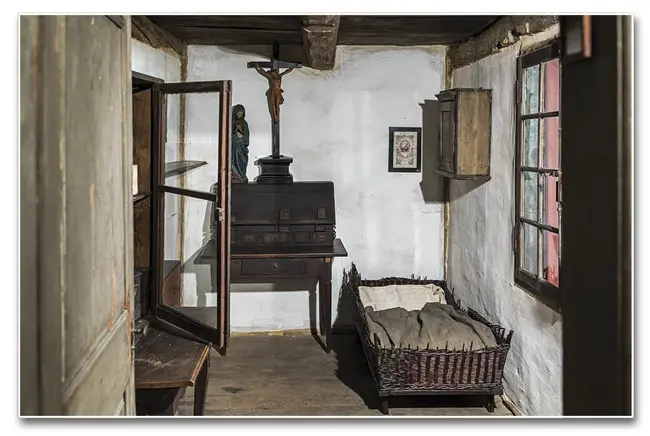
In that convent, each sister was required to provide her own breakfast. As Sister Anne Catherine had no means to buy anything for herself, she waited for all the sisters to have their breakfast, then collected any grains that might have fallen on the floor in the kitchen and ground them for herself. Several times she found nothing to eat. On some of these occasions, however, when she returned to her cell, which she had locked before leaving, she inexplicably found a few coins on the windowsill.
A sister who lived with her at that time testified that her greatest satisfaction was to give to the needy. This nun asked her why she did not take care of herself. And she replied, “Oh, I always receive much more than I give!” She thus gave a remarkable example of unpretentiousness.
She saw Sacred History in visions countless times, from the fall of the Angels from Heaven to the Life and Passion of Our Lord Jesus Christ
There were countless occasions when there were misunderstandings between her and the other nuns. As Sister Anne Catherine never justified herself, she was once unjustly accused of theft, among other offences. Without complaining, she knelt before each sister and asked for forgiveness for the offence she had not committed. When, after some time, the opportunity arose to clarify the alleged theft, she sought out the superior, who replied that she would say nothing to the others, as she did not want to think any more about what had been “forgotten”, thus leaving Sister Anne Catherine’s honour tarnished.
“Am I not enough for you?”
One of her most painful deprivations was the lack of a spiritual director. She begged God to send her someone with whom she could open her heart, for she was very afraid of being deceived by the devil. Fr. Lambert2 could not fulfil this role with the necessary ease, as he did not speak German. He tried to reassure her, but her affliction soon returned. One day, while the Blessed was in church, praying for a confessor, she heard a voice ask her: “Am I not enough for you?” It was her Divine Spouse pleading with her to suffer, like the Church, the lack of spiritual assistance, that is, the lack of holy pastors.
One of the most striking aspects of her life was her recurrent ecstasies. Upon consideration of God’s mercy towards sinners or how much He is offended, whether she was in the garden, the cloister, the church or her cell, she would immediately fall to the ground, enraptured. Sometimes, while meditating, she would look up and see God. Other times, her Guardian Angel would order her to exhort the nuns to return to observance. Then, still in ecstasy, she would go among the sisters quoting parts of the rule on silence, obedience, the Divine Office, or the cloister, which so many transgressed. The tepidity of the clergy caused her interior suffering, and she sorrowfully exclaimed: “The consecrated fingers of priests will be recognizable in Purgatory. Yes, even in hell they will be known and will burn with a particular fire. Everyone will see their priestly character and cover the priest with scorn.”3
On countless occasions, Sister Anne Catherine saw in visions Sacred History in its entirety, beginning with the fall of the Angels from Heaven, the creation and the deluge, passing through the patriarchs, reaching the life and Passion of Our Lord Jesus Christ, and penetrating the future by contemplating scenes from the Apocalypse. It was thanks to her visions that archaeologists discovered the remains of the city of Ur in Chaldea and found the house of Our Lady in Ephesus.

Dissolution of the convent
In December 1811, destructive influences from the French Revolution had penetrated Germany, and due to secularization and rationalism the civil authorities dissolved the convent of Agnetenburg.
Thanks to her visions, archaeologists uncovered the remains of the city of Ur, in Chaldea, and found the house of Our Lady in Ephesus
The nuns gradually left the monastery, without any regret, but Sister Anne Catherine did not want to abandon it, and remained there alone, totally helpless, since she was so ill that she was bedridden. It was only the following spring that Father Lambert came to her aid and transferred her to the home of a widow.
Leaving Agnetenburg was extremely painful for her because, faithful to her vow of cloister, she had decided at all costs not to abandon it. On one occasion she said: “When I had to leave the convent, I thought that every stone on the road was about to rise up against me.”
She would spend the remaining years of her life practically invalid, amid extraordinary visions and atrocious suffering.
“Suffer as I have suffered”
At the age of thirty-eight, she received the stigmata of the Passion on her hands, feet and side. Two crosses were also imprinted on her chest. Previously, at the age of twenty-four, while praying in the Jesuit church in Coesfeld, she had been favoured with the crown of thorns. She was often unable to get out of bed because her feet were mystically nailed to the cross.
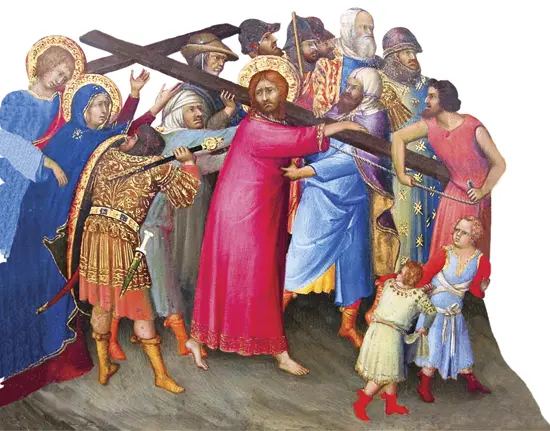
If Our Lord Jesus Christ consummated His sacrifice amid contradictions and persecutions, the sufferings of His spouse would be no different, for He desired to configure her entirely to Himself. The Blessed felt her body mutilated, burned, gangrenous and in decay; she felt that her fingers had been cut off, and she writhed in pain. The Divine Redeemer showed her more than once that this was the current state of His Mystical Body.
Between February 1818 and April 1823, she dictated her visions to the writer Clement Brentano. He wanted to meet her out of curiosity, having heard stories about her mystical gifts and stigmata, but he was deeply impressed from their very first encounter on.
For her part, she discerned in him the person to whom she should dictate all her visions, confiding after a few weeks: “I am surprised at myself, for I speak to you with such confidence, communicating so many things that I cannot reveal to others. From the first glance, you were no stranger to me.” Thanks to the writings of Clement Brentano, the visions of Anne Catherine Emmerich have come down to us.
The extraordinary phenomena that occurred with her, the stigmata, the bleeding, the marks that appeared on her body, the ecstasies, her discernment of spirits, all of this attracted the attention of many doctors and scholars and, against her will, numerous ecclesiastical and scientific investigations were carried out.
In the last year of her life, her pains had intensified to an unimaginable degree. She moaned constantly. On January 15, the Child Jesus appeared and said to her: “You are mine; you are my spouse. Suffer as I have suffered, and do not ask why.”
A little less than a month after this vision, on February 9, 1824, Anne Catherine Emmerich gave her soul to God, leaving us, in addition to the accounts of her revelations, an extraordinary example of life. ◊
Notes
1 The biographical data contained in this article were extracted from the work: SCHMÖGER, CSsR, Karl Erhard. Life of Anne Catherine Emmerich. Fresno: Academy Library Guild, 1867, v.I.
2 Father Jean Martin Lambert refused to sign the Civil Constitution of the Clergy during the French Revolution and for this reason took refuge in Germany. He was appointed confessor to Duke von Croy in Dülmen and chaplain to the Augustinian convent in Agnetenburg. Sister Anne Catherine met him while working as a sacristan and came to have great confidence in him.
3 SCHMÖGER, op. cit., p.391.