



With divine pedagogy, the Lord often raises up examples of virtue that we might almost call extreme, in order to, through the existence of an outstanding model, moderate in men the disordered passions that oppose it and encourage them to embark on a path that they would otherwise never embrace. This was the case, for example, with the Poverello of Assisi, whose radical betrothal to Lady Poverty has inspired countless souls throughout the centuries to use the goods of this world with moderation and to desire those of Heaven.
From this perspective, I invite the reader to also consider the life of Blessed Henry Suso. While many employ all their efforts to escape suffering, this German Dominican seemed to seek after it, always thirsting to suffer more for the love of Our Lord Jesus Christ. Moreover, certain misfortunes that would not befall ordinary men seemed to pursue him, making his existence a series of apparent contradictions, accepted with serenity.
The recollection of his life may cause astonishment and even perplexity in our days, so averse to any suffering, but it will nonetheless be a salutary invitation to face the difficulties of daily life with joy and courage, as faithful disciples of the Crucified Lord.
At the dawn of life, the choice of penance
Born around 1295 on the shores of Lake Constance, on the border between Germany and Switzerland, Henry Suso would prove to be an unusual person even within his own family. Son of Count von Berg, he nevertheless took his mother’s name: Seuss.1
Little or almost nothing is known of his childhood. It is known, however, that his father had wanted him to become a soldier, but, upon realizing that his inclination was not towards the weapons of this world, sent him to the Dominican monastery in Constance when he was only thirteen years old. The young man enjoyed a carefree life there until he was eighteen, at which age a grace would impel him to take another path.
One day, sitting in the monastery chapel, he realized how frivolous his conduct had been until then, little inclined to religious observance, and decided to embark on the path of penance in reparation for his faults.
This resolution would accompany him throughout his life, in his various occupations: as a student in Cologne and disciple of Meister Eckhart; as professor, prior and prolific writer of spiritual works; as a preacher and spiritual director.
Voluntary bodily mortifications
Numerous were the means employed by the saints throughout the centuries to mortify themselves, whether in reparation for their own sins or those of others, or for pure love for Our Lord Jesus Christ. In the case of Henry Suso, he understood that only those who kiss, embrace, and carry their cross with love reach Heaven, and he wanted to do this literally.
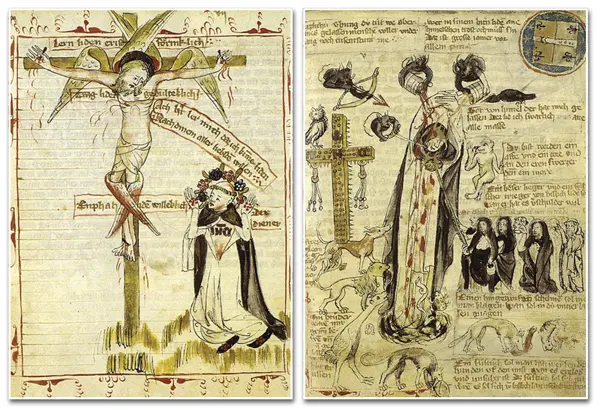
He made himself a wooden cross, with thirty nails and seven needles, and tied it to his back, carrying it day and night, so that the nails pierced his flesh without ever leaving him free from pain.
He hardly drank water, regulating with a small cup he had made for himself the exact amount he allowed himself to ingest during the day. Sometimes he felt so thirsty that, during the sprinkling of holy water, he would open his lips wishing that some drop would refresh his dry tongue, but not even that was granted to him. He offered everything to relieve Our Lord on the Cross, who had only vinegar and gall as refreshment.
This voluntary penance would bring tears to his eyes, as he felt he could not maintain the sacrifices that God had inspired him to practise. To comfort him – that is, to give him strength to endure suffering– Our Lady appeared to him with the Child Jesus, who held a small chalice full of fresh water. She then gave it to Henry to drink, and his thirst was quenched.
His greatest suffering would be not finding anyone who shared the same ideal, leading him to increasingly seek refuge in the supernatural
As a bed he used an old door on which he had placed a mat made of reeds that only reached until his knees, and he did not use a blanket. He wore a hair shirt under his clothing and performed many other mortifications at night, too numerous to enumerate here. Any movement during his sleep caused tremendous discomfort, as he also tied his hands so that he could not even swat away mosquitoes.
His greatest suffering, however, would be not finding anyone who shared the same ideal, leading him to increasingly seek refuge in the supernatural.
Fortified by intense mystical graces
Providence, however, did not delay in making the fervent religious sense the great predilection He had for him, sending abundant mystical graces. The first he recounts consisted of an ecstasy in which he experienced the delights of God’s love, after which he seemed like a different man.
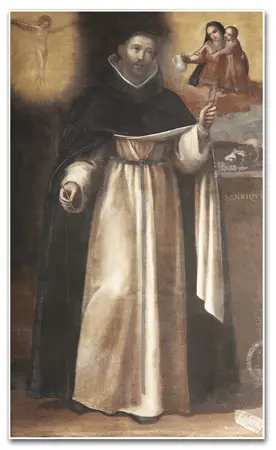
On another occasion he saw his Guardian Angel, embraced him and begged him never to abandon him. The celestial protector replied that that he would never leave him, since God had so united Himself to him. The souls in Purgatory – including his own father – as well as the saints in Heaven, among whom was his mother, appeared to him frequently, describing both the torments of the purifying flames, and the joys of eternity. He also had several revelations about the future, which unfortunately were not recorded.
Once, in an ecstasy of love, Henry traced on his chest, with a stylus, the sweet Name of Jesus, which remained indelibly engraved there. After some time, a small golden cross, as if studded with precious stones, appeared above his heart. From it also emanated the Most Holy Name of the Saviour, amidst an intense light.
The culmination of such graces, however, occurred in connection with his betrothal to Eternal Wisdom, presented in the Scriptures as a beautiful maiden. Upon hearing the reading of the Wisdom Books, Henry felt enraptured with love and understood that he should surrender himself entirely to Wisdom, as her servant. Having begged for the good fortune to see Her, She appeared to him among clouds, shining like the morning star and radiant as the dawn, and said to him sweetly: “Give Me your heart, my son!” (cf. Prv 23:26).
Near the end of his life, Henry had a vision in which, surrounded by Angels, he asked one of them how the indwelling of God in his soul occurred. The celestial spirit told him to look within himself, and the Blessed saw his heart as if through a clear crystal; within it was Eternal Wisdom, beside his own soul, which God enveloped in His arms.
Knighted to confront interior suffering
After sixteen years of terrible bodily penances, another Angel appeared to him in the form of a young man, stating that a phase of his life had ended.
Some time later, the same celestial spirit returned, bringing with him a knight’s armour. He said that only at that time would Henry begin his spiritual combat; all that he had suffered was nothing compared to what was to come. Until then he had fought only as a common soldier, but God wished to knight him. Astonished, he asked to know how many sufferings awaited him, and the Angel answered him: “If you can count these innumerable stars, you can also count the number of tribulations that are reserved for you.”
Incomparably more severe than the many bodily penances he inflicted upon himself would be the interior tribulations that lay in store for him
He then begged to know what these sufferings would consist of, and only three were revealed to him: he would lose his good name and reputation, which would hurt him much more than the bodily penances he inflicted upon himself; He would find neither friendship nor loyalty from those who had always given them to him, and those who were loyal to him would suffer along with him; he would no longer be comforted by God or by men, and any attempt to obtain any delight for himself would be frustrated.
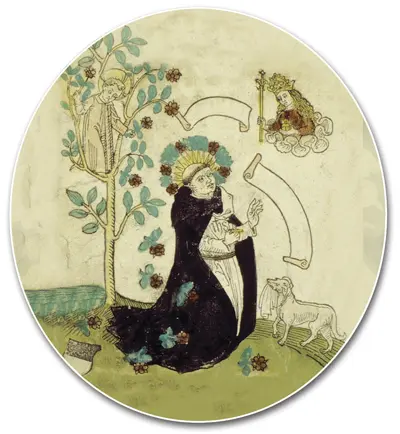
Feeling that his strength would fail him, Henry fell prostrate in anguish, but pleaded that the divine will be done in him. Through an inner voice, the Lord assured him that He would always be by his side, helping him to bear all the tribulations. The next morning, looking out the window, he saw a dog tearing apart a piece of cloth, and God had him understand that this was how he should be in the hands of others, suffering all in silence, without ever complaining. The religious took the cloth and kept it with him as a reminder of this episode.
On the feast of Our Lady of Candelaria, the Child Jesus appeared to him, stating that He wished to teach him the attitude he should have in the midst of his sufferings, a lesson that can undoubtedly be useful to any Christian: not to think about when the suffering would end, but to be ready to joyfully accept the next one that would surely come.
A whirlwind of persecutions and slander
During his travels throughout Europe, countless misfortunes befell him, fulfilling exactly what had been revealed to him by the Angel. It seemed that everything happened to Henry Suso that would never happen to anyone else, even the most absurd and unimaginable things…
Arriving at a city church, he knelt before a pious crucifix, prayed, and then left. That same night, there was a robbery in that church, and all the candles and wax figures offered by the faithful with their requests were stolen. Now, a seven-year-old girl saw him praying there and accused him of the theft, and so Henry had to flee in haste, under pain of death.
On a trip to the Netherlands, stirred by a summons to participate in a chapter of the Dominicans, two members of his own Order came to meet him, accusing him of having written books containing heretical doctrines that had contaminated the entire country. They therefore took him to the tribunal, where he was harshly reprimanded and threatened with severe punishment if he did not amend his errors. While he returned to his monastery, a terrible illness befell him, confining him to bed with a fever and nearly causing his death.
Persecution was such a constant in his life that, after four weeks had passed without him being attacked, he was astonished by the fact. He commented that he was so convinced that God visits his friends with trials that, seeing himself free from difficulties, he feared that the Lord had forgotten him. He had not finished speaking when a Dominican brother came, warning him that the lord of a nearby castle was searching for him in all the monasteries in order to kill him, on the accusation of having stolen his daughter, who had decided to embrace religious life. Another man accused him of having led his wife astray, as she had become more modest, and said Henry would have to pay for this. Rejoicing to find that God had not forgotten him, he fled immediately.
There was, in a certain village, a malevolent woman who feigned to repent for her sins and would go to Confession to Henry. However, seeing that she did not amend her ways and led a life of sin, he decided not to attend to her anymore. The woman, furious and wanting to damage the one who had only done her good, accused him of being the father of the child she had out of wedlock. The scandalous lie spread further than his reputation for holiness, reaching even the superior of the Order of Preachers in the German province. Many, including those closest to him, believed the calumny, and mistreated him. After a long period of suffering and terrible anguish, fearing the worst, his innocence was recognized, and the woman who had contrived against him died suddenly.
Saved from death by his virtue
This, however, was not the last time he escaped death. During a journey, his companion – young and agile – went ahead on the road, leaving him alone. Before entering a forest that he had to traverse, Henry suddenly came across a young woman accompanied by a tall man of terrifying appearance, carrying a spear and a dagger. Faced with this scene, the religious made the sign of the cross and, trembling, risked advancing, with the aforementioned couple behind him.
At a certain point, in the middle of the dense forest, the young woman approached him and asked if he would hear her Confession. He agreed, and the young woman then told him her sad fate: the man who accompanied her was a murderer, who robbed and killed everyone he met, and she had been forced to become his wife. Even more terrified, seeing his fears confirmed, the Blessed gave her absolution, and the three continued their dreadful journey.
At one point, the murderer himself approached Henry, also asking that he hear his Confession. His heart pounded, and, feeling helpless but unable to refuse the Sacrament, he heard his Confession. The account was astonishing. The evildoer recounted the numerous crimes he had committed and, with lavish detail, described one in particular: “I once came to these woods to rob and kill, as I did today, and, finding a venerable priest, I confessed to him while we were walking in this very spot. When the Confession was over, I took this dagger and stabbed him with it, and then threw his body into the Rhine.” Terrified, realizing that the same fate awaited him, the priest felt faint.
Seeing him turn pale and about to collapse, the young girl ran to him and exclaimed: “Don’t be afraid, he won’t kill you!” The murderer then added: “I have heard many good things about you, and you will have your reward today, for I will let you live. Pray to God that, for your sake, He may help and favour me, a poor criminal, in my last hour.”
The example of a friend of the Cross
Henry often felt himself to be weak and incapable, but he learned from Our Lord Jesus Christ Himself that strength would come to him from above
The facts to be told would be countless, but the entire life of Henry Suso could be summarized in these few words: friend of the Cross. If he was not being persecuted, he was troubled by illnesses; and when he was in perfect health, some other disgrace would befall him, and so he was never free of suffering. He often felt weak and incapable, but he learned from Our Lord Jesus Christ Himself that strength would come to him from on high.
Despite so many sufferings and vicissitudes that almost led to his death, Henry reached a venerable age and died on January 25, 1366, in the city of Ulm, where he had spent the last eighteen years of his life. More than two centuries later, his body remained incorrupt and exuded a sweet perfume. However, years later the relics disappeared completely.
Let us, then, ask Blessed Henry Suso to also make us lovers of the Cross. We do not need to make a wooden cross for ourselves and tie it to our shoulders, but simply bear serenely – and joyfully! – the crosses that God sends us each day, trusting that, if we do so, we will one day receive our reward in Heaven. ◊
Notes
1 The biographical information contained in this article was taken from the works: BLESSED HENRY SUSO. The Life of Blessed Henry Suso by Himself. London: Methuen and Company, 1913; DORCY, OP, Mary Jean. St. Dominic’s Family. Lives of over 300 Famous Dominicans. Rockford: TAN, 1983.


