


…that the world’s smallest basilica is in Brazil?
Yes, and at an altitude of 1,746 metres! Serra da Piedade, a mountainous region located between the capital of Minas Gerais and the municipality of Caeté, is best known for the small sanctuary built on its summit, which, despite its simplicity, makes the splendid natural panorama even lovelier, especially because of the protection of the most beautiful of all creatures, Mary Most Holy.
The unassuming shrine, dedicated to Our Lady of Mercy, has its origin in an apparition of the Blessed Virgin to a mute girl, whom She cured. Construction began in 1767 at the initiative of the Portuguese-born Antônio da Silva Bracarena, aided by Manuel Coelho Santiago. Built on the site of the apparition, the chapel soon began to attract large numbers of pilgrims. In 2017, after numerous renovations and improvements, it was elevated to the status of minor basilica.
Typically Baroque in style, the tiny church boasts an image of the Virgin of Mercy on the main altar sculpted by Antônio Francisco Lisboa, known as Aleijadinho (the Little Crippled Man). Legend has it that the mountain on which it stands is rich in gold and silver, which served as a geographical reference for 17th-century explorers. Whether or not this is true remains a mystery, but one thing is certain: as Patroness of Minas Gerais, Our Lady chose that peak to show that, far more valuable than any worldly possession is her maternal love, poured out on her children who beg for her mercy. ◊
…why one of the liturgical vestments is rose?
Among the many elements that make up the Catholic Liturgy, the variety of colours of the vestments plays a symbolic and expressive role. With extreme zeal and dedication, Holy Church uses these colours to more effectively convey the meaning of the mysteries it celebrates.
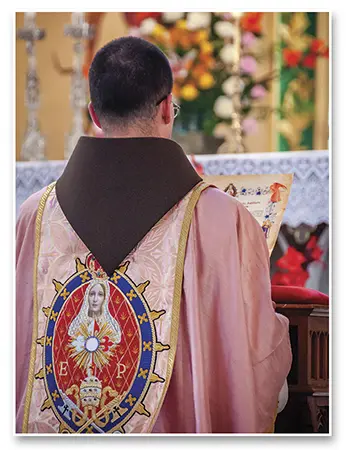
The symbolism of many of the colours used throughout the Liturgical Year is self-evident. When we encounter the red vestment, for example, we immediately think of the fertile blood of the martyrs or the ardent flames of the Holy Spirit. But why rose-coloured?
Amidst the sober purple of Lent or Advent, the Church surprises us by clothing her ministers in a lighter hue. With its shade between scarlet and violet, rose is used on the third Sunday of Advent and on the fourth Sunday of Lent, called Gaudete and Lætare, respectively, because of the initial words of the entrance antiphons of the Masses on these days. At first glance, due to its vibrance, this colour would seem not very appropriate for a penitential period… However, its use has a highly pastoral purpose, representing the joy that the Church experiences at Christmas and Easter, symbolized by three properties of the rose: its scent, its colour and its flavour, which reflect charity, joy and spiritual satisfaction.
Both during Lent and Advent, we eagerly await the most important episodes in the life of Our Lord Jesus Christ: His birth and His Resurrection. In hopeful anticipation of these solemnities – always celebrated with white vestments – and as if already anticipating them, the Church uses rose-coloured vestments to express her joy at reaching the threshold of such long-awaited events. Furthermore, having accompanied her children in their penitential sacrifice during the two periods of preparation, symbolized by the purple vestments, the Mystical Bride of Christ sympathizes with them and softens her rigour a little with this pleasant hue. ◊

