


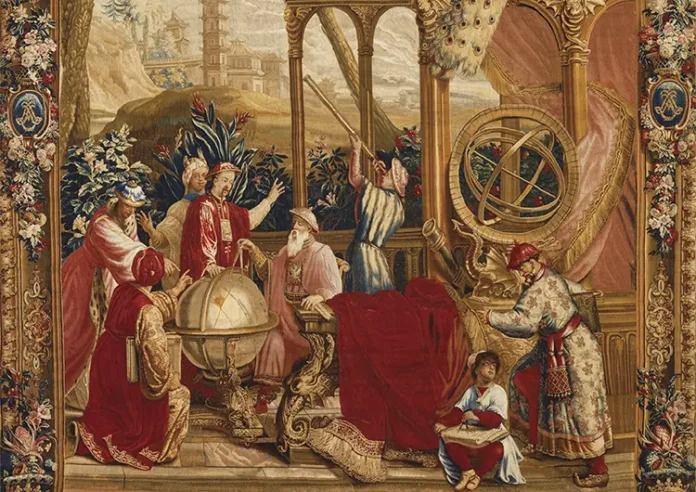
…that we owe many scientific advances to the Society of Jesus?
Intrepid missionaries, eminent theologians, and skilled diplomats: with the founding of his work, St. Ignatius of Loyola provided the Church with a truly elite squadron, teeming with saints! Moreover, the history of the Society of Jesus is pervaded by remarkable scientists. It would be too lengthy to name them all, as well as their respective contributions in the most varied areas of the scientific field. We will, therefore, mention only a few.
In the field of astronomy, Father Christopher Clavius (1538-1612), director of the commission that developed the Gregorian calendar – still in use today – and Father Niccolò Zucchi (1586-1670), to whom the invention and construction of the first reflecting telescope is attributed, stand out.
Also noteworthy are Father Giovanni Battista Riccoli (1598-1671), the first scholar to determine the acceleration index of a body in free fall, and Father Francesco Maria Grimaldi (1613-1663), Isaac Newton’s precursor in the study of light diffraction. Together, the two managed to make a detailed map of the lunar topography. An interesting fact to highlight is that at least thirty-five lunar craters are named after Jesuit astronomers and mathematicians…
Others, such as Fathers Ruđer Boškovik (1711-1787) and Athanasius Kircher (1602-1680), although they played a significant role as astronomers, shone especially in other disciplines: the former is known as the creator of atomic physics, while the latter is called the father of Egyptology, due to the initial impetus they gave to these sciences. For the same reason, seismology, that is, the study of earthquakes and the earth’s internal structure, became known in certain circles as the Jesuit science. ◊
…that Lourdes has an owner?
Anyone who has visited the town of Lourdes in France will certainly have had their attention drawn to a medieval castle that dominates the entire region. However, few are familiar with its history and its feudal lady. This lady conquered it from a pagan named Mirat in the early 9th century, with the help of a virtuous bishop and a great emperor.
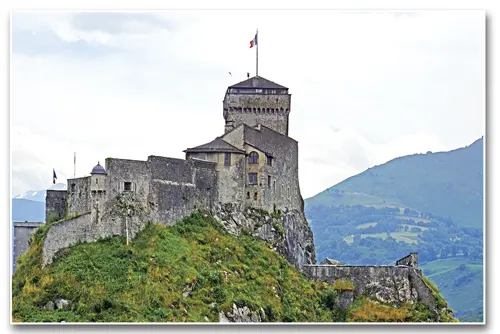
Charlemagne was with his army in the County of Horre. He had already besieged several citadels, whose feeble attempts at resistance did little or nothing against his implacable assaults. The only stronghold that still held out against an endless siege was Mirambel, because, in addition to being in a strategic location, it belonged to Mirat, an experienced and valiant warrior.
The emperor was about to lift the siege, considering it useless, but the Bishop of Puy-en-Velay intervened, saying he would convince Mirat to surrender the fortress.
With Charlemagne’s consent, the bishop set out as an ambassador to begin negotiations. After lengthy discussions, the hardened heart of the pagan warrior began to soften, and the prelate then made the proposal he had wanted to present from the beginning:
“Since you do not want to surrender your castle to the emperor, surrender it to a Lady who is incomparably superior and more generous, the Queen of Heaven and Earth, Mary Most Holy, Lady of Puy!”
Mirat, taken by grace, agreed and asked for Baptism, which soon took place in the cathedral of Puy. On the same occasion, he was knighted and chose the name Lorus, which later gave the name Lourdes to his fiefdom, or rather, to that of Our Lady.
From then on, until the French Revolution, all the counts of Horre paid an annual tribute to Mary Most Holy in the same cathedral.
So, when Our Lady revealed herself as the Immaculate Conception, She deigned to do so in a place where She was officially the feudal Lady! ◊

