From the very beginning of creation, to be like God was a profound longing of man, made in His image and likeness. However, pride blinded our first parents – and, in them, all of humanity – distorting this salutary yearning in their souls. Their first movements to imitate the Lord, with a view to union with Him, degenerated into the pretension of equalling themselves to divinity in order to emancipate themselves from it. Then the Serpent came on the scene and fascinated them with the invitation: “You will be like God” (Gn 3:5).
In His unfathomable designs, however, the Heavenly Father once again placed at our disposal, by virtue of the infinite merits of the Redemption wrought by Our Lord Jesus Christ, effective and superabundant means to attain true deification. This begins in us at the moment of Baptism, when an authentic supernatural organism is infused into our soul.
A new life corresponds to a new mode of action
To better understand such a sublime reality, let us consider man’s own natural life, for although supernatural life is infinitely superior to it, “it is not simply superimposed on it, but rather completely penetrates, transforms, and divinizes it.”1 We can thus identify a profound analogy between the two.
In the natural order, the soul is the source of life. However, it is not immediately operative, that is, it does not perform acts by itself; to act, it makes use of its faculties – understanding, will, and sensibility. Something similar can be said of the spiritual order: to develop, sanctifying grace needs operative habits – the virtues and gifts of the Holy Spirit – which, together with it, constitute the foundation of our supernatural organism.2
To use an image, just as a healthy person possesses, in addition to a head and torso, limbs that allow them to move and act, the soul divinized by grace possesses virtues and gifts, which are like arms and legs that impart to it the possibility of acting, in due proportion, like God Himself.
In short, while we receive through sanctifying grace a new way of being, through virtues and gifts we acquire a new way of acting, that is, the capacity to produce supernatural and meritorious acts before the Lord.
The infused virtues: the path to holiness
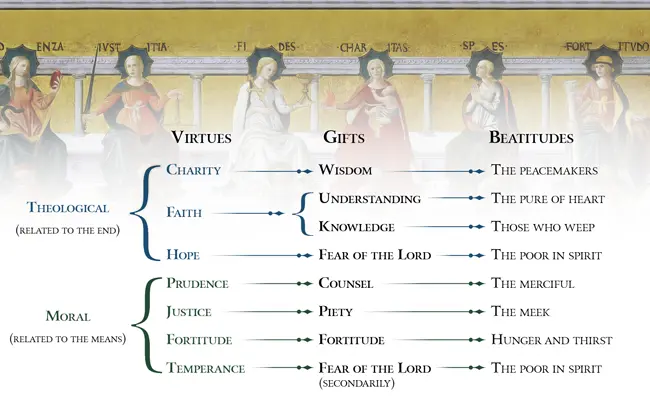
“All good things came to me along with her, and in her hands uncounted wealth” (Wis 7:11). This statement from Scripture, referring to wisdom, can well be applied to sanctifying grace, through which we receive the magnificent treasure of the virtues. Catholic doctrine divides them into two categories: theological and moral.
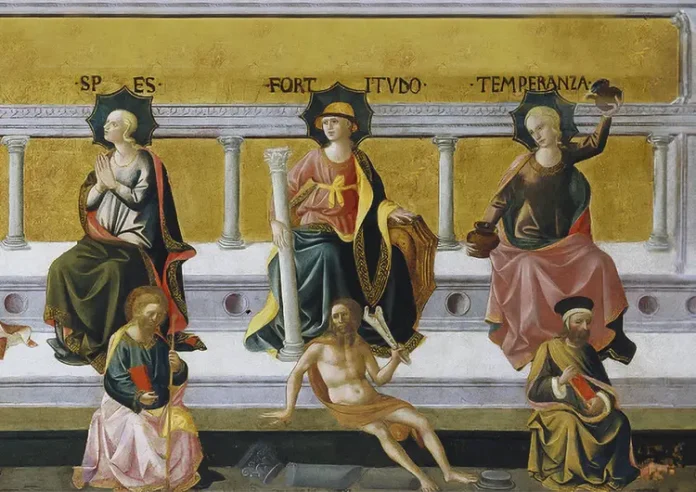
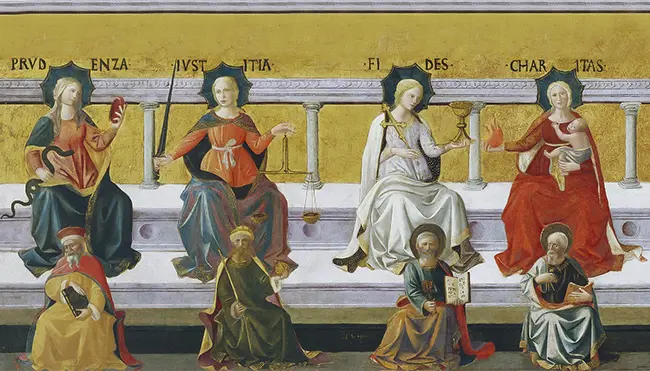
The theological virtues, which give life to all the others, are three: faith, hope, and charity. They concern union with God, our ultimate supernatural end, and place us in constant relationship with the Holy Trinity.
As for our relationship with our neighbour, the beautiful moral virtues come into play, which Theology summarizes into four main ones, called the cardinal virtues: prudence, justice, fortitude, and temperance. They allow us to live in this world in accordance with our highest condition as children of God, heirs of the heavenly Kingdom.
Now, the way virtues are exercised is not yet the most excellent, for what governs and regulates their practice is human reason illuminated by faith;3 and the contribution of this faculty of ours is not sufficient to manifest all the splendour of the divine life we have received. This perfection, therefore, must be brought about by the infused gifts.
A “harp” played by the Holy Spirit
Unlike the virtues, in the case of the gifts it is the Holy Spirit who acts4 leaving man with only a secondary role. Thus, the acts resulting from these supernatural powers have a much more divine than human quality.
Contrary to what many think, the most excellent actions are not those derived from the ascetic practice of virtues, but rather those proceeding from gifts, for these are the work of God, and holiness consists in allowing oneself to be guided by these divine promptings. Whoever lives in this way is perfect in everything just as the Heavenly Father is perfect (cf. Mt 5:48), and could well repeat like St. Paul: “it is no longer I who live, but Christ who lives in me” (Gal 2:20).
An example given by Fr. Antonio Royo Marín, OP, well illustrates the superiority of gifts and how they perfect and complete virtues. According to the eminent theologian, these latter virtues resemble a harp given to the soul so that it may play harmonious compositions, which would be supernatural acts. He explains:
“Since the artist who wields it – natural reason – is very clumsy and shortsighted, even under the light of faith, the result is a discordant and imperfect melody. […] Until the moment arrives when the Holy Spirit himself plays the harp of infused virtues, through the gifts of the same Holy Spirit, and from the soul emanates a most beautiful, absolutely divine melody, which is nothing other than the acts of perfect and heroic virtue of the true saints.”5
Infused habits and beatitudes
As a result, when the soul is docile to the promptings of the Paraclete, it produces acts of exquisite virtue, like sweet and gentle fruits.6 Some of these are mentioned by St. Paul in his Letter to the Galatians: love, joy, peace, patience, kindness, goodness, faithfulness, gentleness, and self-control (cf. Gal 5:22-23).
Through these fruits we also attain the beatitudes mentioned by Our Lord Jesus Christ in the Sermon on the Mount. These crown the supernatural life and, “by virtue of the ineffable rewards that accompany them, are already in this life an anticipation of eternal blessedness.”7
St. Thomas Aquinas establishes an interesting correspondence between the infused virtues, the gifts of the Holy Spirit, and the evangelical beatitudes. The virtue of charity, for example, is perfected by the gift of wisdom, which includes us among the peacemakers, worthy of being called children of God (cf. Mt 5:9). Hope, in turn, is refined by the gift of fear, which makes us poor in spirit, possessors of the Kingdom of Heaven (cf. Mt 5:3). And so on.
Love is repaid with love
A careful look at the wonders God works in our favour at the moment of our Baptism is enough to leave us astonished with joy, rapture, and gratitude.
For love is repaid with love. The Lord expects no other gratitude from us than that we love Him with all our hearts. And to love Him means to develop our supernatural life to the fullest and to become ever more godlike.
May Mary Most Holy, Mother of Divine Grace, intercede for us on this journey towards eternity and obtain for us a crystalline holiness. ◊
Notes
1 TANQUEREY, Adolphe. Compêndio de Teologia Ascética e Mística. 6.ed. Porto: Apostolado da Imprensa, 1961, p.53.
2 Cf. GARRIGOU-LAGRANGE, OP, Réginald. Las tres edades de la vida interior. 3.ed. Buenos Aires: Desclée de Brouwer, 1944, p.58.
3 Cf. ROYO MARÍN, OP, Antonio. Teología de la perfección cristiana. Madrid: BAC, 2012, p.97.
4 Cf. ST. THOMAS AQUINAS. Summa Theologiæ. I-II, q.68, a.1.
5 ROYO MARÍN, OP, Antonio. Jesucristo y la vida cristiana. Madrid: BAC, 1961, p.424.
6 Cf. SÃO TOMÁS DE AQUINO, op. cit., q.70, a.1, ad 1.
7 ROYO MARÍN, Jesucristo y la vida cristiana, op. cit., p.157.