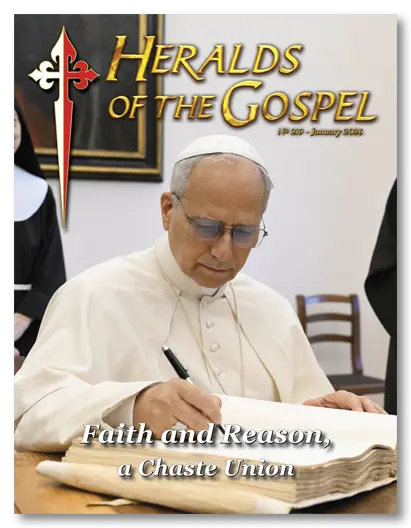
The harmony between faith and reason is one of the pivotal elements of Catholic theology. As early as the second century, St. Justin proclaimed that Christianity was “the only safe and profitable philosophy” (Dialogus cum Tryphone judæo, c.VIII, n.1), and Clement of Alexandria called the Gospel “the true philosophy” (Stromata. L.I, c.18, 90, 1).
St. Thomas Aquinas elaborated the best synopsis of this interrelationship. Without faith, few would attain the knowledge of God, because the purely rational path is arduous and difficult, rarely immune to doubts and even falsehoods. Meanwhile, reason is indispensable for demonstrating the premises of faith, clarifying its truths, and refuting its opponents.
Luther opened a schism not only in the Church, but also in the very union between faith and reason. Deeply anti-Thomistic, for him reason is a “prostitute of the devil” and faith a mere subjective confidence. It would suffice to believe – sola fides – to be saved. The Protestant Revolution, by excluding the element of reason from faith, deprived it of its very essence. In fact, faith is a habit of the mind, so that every authentic act of belief is also an intellectual act.
Under the arrogance of the Enlightenment, the French Revolution persecuted the Church and the clergy in order to subvert religiosity into a false worship of the “goddess of reason.” In honour of this deity, represented by a prostitute, blasphemous feasts were held in various cathedrals converted into preposterous “temples of reason”.
The Communist Revolution proclaimed itself omnipotent, while at the same time inserting religion and men of faith into the dialectic of oppressor-oppressed. Ultimately, in the Marxist view, faith, reason and the state would be identified, since the people would need to believe unconditionally in the Leviathan-State that would provide the standard of “reason” for all things.
The 20th century spawned several revolutions, such as the student revolution of May 1968, the tribalist and cultural revolutions of various kinds, all of which had a common denominator: they placed special emphasis on influencing human sensibilities, thus promoting blind faith in irrationality, sometimes under the guise of defending “science” and “enlightenment.”
A genuinely Catholic solution would involve the restoration of authentic harmony between faith and reason. However, it is necessary to go further. Faith is dead if it is not clothed in charity (cf. Jas 2:17), and all wisdom that does not come from above “is earthly, unspiritual, devilish” (Jas 3:15). Therefore, it is also essential to mould our minds in uniformity with the things of Heaven (cf. Col 3:1), where true wisdom resides. In the words of Pope Leo XIV: “Only in a life conformed to the Gospel can we achieve adherence to the divine truth we profess, making our witness and the mission of the Church credible” (Speech, 26/11/25).
Faith is merely a foretaste of the beatific vision, in which syllogistic reason will give way to pure intuition of the Holy Trinity. In our homeland, we will contemplate God “as He is” (1 Jn 3:2), through the light of glory – lumen gloriæ – infused into our spirit or, as theologians say, through a loan made to us from divine intelligence itself. There will be no more faith, only intellection resulting from a complete metanoia, that is, a radical change of mentality. This will not be produced by revolutions that distort human rationality, but infused by the Holy Spirit. ◊