

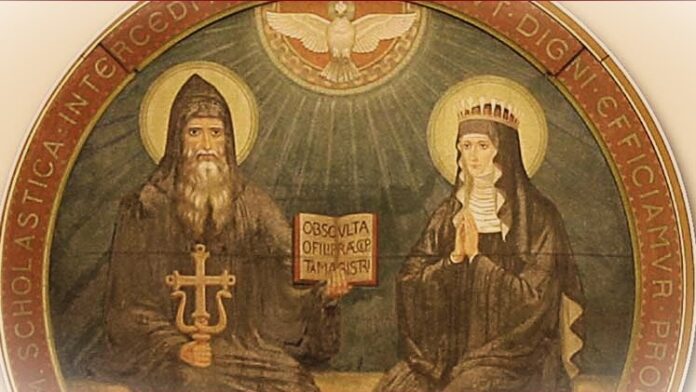
Memorial of St. Scholastica
St. Scholastica, twin sister of St. Benedict of Nursia who consecrated herself to God from childhood. Following the example of her brother, she founded a feminine community close to Monte Cassino which became the first monastery of Benedictine nuns. She died in 547.
Mass Readings
First Reading – 1 Kgs 8:22-23, 27-30
Solomon stood before the altar of the LORD in the presence of the whole community of Israel, and stretching forth his hands toward heaven, he said, “LORD, God of Israel, there is no God like you in heaven above or on earth below; you keep your covenant of mercy with your servants who are faithful to you with their whole heart. “Can it indeed be that God dwells on earth? If the heavens and the highest heavens cannot contain you, how much less this temple which I have built! Look kindly on the prayer and petition of your servant, O LORD, my God, and listen to the cry of supplication which I, your servant, utter before you this day. May your eyes watch night and day over this temple, the place where you have decreed you shall be honored; may you heed the prayer which I, your servant, offer in this place. Listen to the petitions of your servant and of your people Israel which they offer in this place. Listen from your heavenly dwelling and grant pardon.”
Responsorial Psalm – Ps 84:3, 4, 5 and 10, 11 (R. 31b)
R. R. How lovely is your dwelling place, Lord, mighty God!
My soul yearns and pines
for the courts of the LORD.
My heart and my flesh
cry out for the living God. R.
Even the sparrow finds a home,
and the swallow a nest
in which she puts her young—
Your altars, O LORD of hosts,
my king and my God! R.
Blessed they who dwell in your house!
continually they praise you.
O God, behold our shield,
and look upon the face of your anointed. R.
I had rather one day in your courts
than a thousand elsewhere;
I had rather lie at the threshold of the house of my God
than dwell in the tents of the wicked. R.
Gospel – Mk 7:1-13
When the Pharisees with some scribes who had come from Jerusalem gathered around Jesus, they observed that some of his disciples ate their meals with unclean, that is, unwashed, hands. (For the Pharisees and, in fact, all Jews, do not eat without carefully washing their hands, keeping the tradition of the elders. And on coming from the marketplace they do not eat without purifying themselves. And there are many other things that they have traditionally observed, the purification of cups and jugs and kettles and beds.) So the Pharisees and scribes questioned him, “Why do your disciples not follow the tradition of the elders but instead eat a meal with unclean hands?” He responded, “Well did Isaiah prophesy about you hypocrites, as it is written: This people honors me with their lips, but their hearts are far from me; In vain do they worship me, teaching as doctrines human precepts. You disregard God’s commandment but cling to human tradition.” He went on to say, “How well you have set aside the commandment of God in order to uphold your tradition! For Moses said, Honor your father and your mother, and Whoever curses father or mother shall die. Yet you say, ‘If someone says to father or mother, “Any support you might have had from me is qorban”‘ (meaning, dedicated to God), you allow him to do nothing more for his father or mother. You nullify the word of God in favor of your tradition that you have handed on. And you do many such things.”
Featured Saints
Blessed Eusebia Palomina Yenes, virgin (†1935). Daughter of poor Spanish farmers, she worked in several family homes before entering the Salesian Congregation of the Daughters of Mary Help of Christians in in Valverde del Camino, Spain.
St. José Sanchez del Rio, martyr (†1928). Having joined the Cristero War of Mexico at age 14, he was captured and courageously braved many torments, refusing to renounce his fidelity to Cristo Rey. Finally he was killed by gunshot, his body falling upon the cross that he had traced on the ground with his own blood.
St. William of Maleval, hermit (†1157). After a dissolute youth, he went on pilgrimage to the Holy Land as a penitent and then became a hermit in Maleval, Italy, where he spent the rest of his life in prayer and penance. His example gave rise to many congregations of hermits.
St. Austreberta, virgin and abbess (†704). She piously governed the monastery of Pavilly, France, previously founded by Bishop St. Audeno.
Blessed Aloysius Stepinac, bishop (†1960). He courageously opposed the doctrines denying the Faith and human dignity, until he succumbed to the illnesses and privations brought on by lengthy imprisonment in Krašić, close to Zagreb (Croatia), for his fidelity to the Church.
Blessed Hugh of Fosse, abbot (†circa 1163). When St. Norbert was elected Archbishop of Magdeburg, he appointed Hugh, one of the monks under his care, as abbot of the recently founded Premonstratensian Order, which he governed for 35 years.
Blesseds Pierre Frémond and five companions, martyrs (†1794). Shot in Angers during the French Revolution for remaining faithful to the Catholic Church.
Image gallery
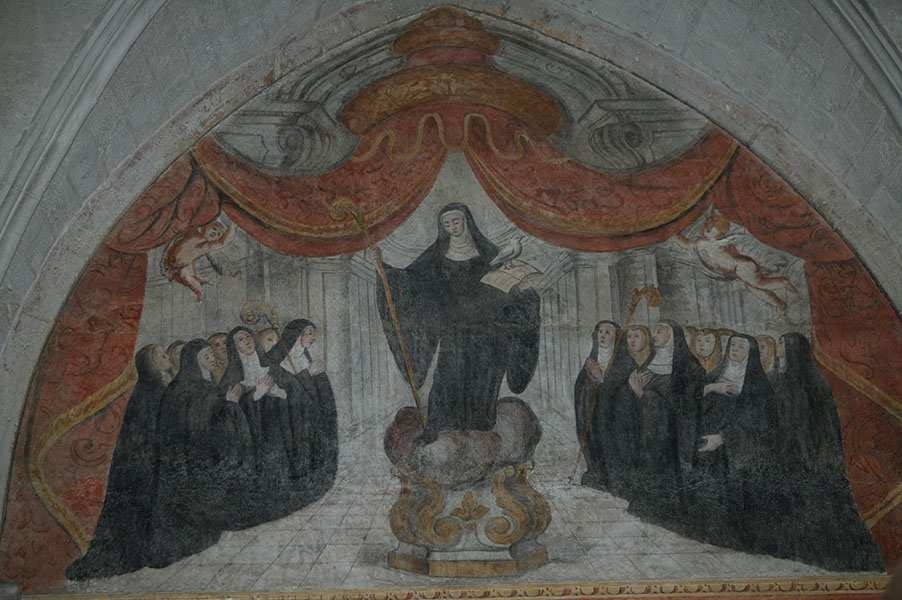


Image gallery


