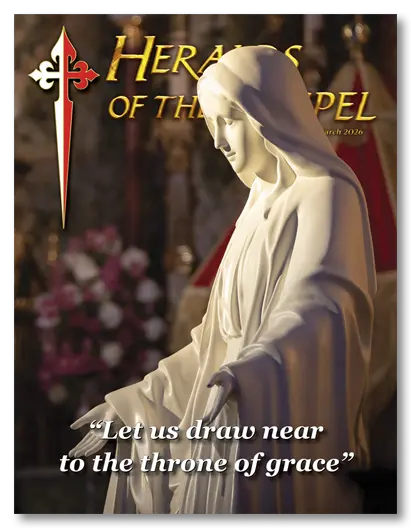
When used in Theology, the word grace has a panoply of meanings. In Hebrew, it indicates a benevolent inclination toward someone. The Greek term kháris expresses both the fascination of beauty and favour, benefit or recognition. The Latin gratia adds, through its etymology, the connotations of gratuitousness and gratitude.
The Pauline epistles represent the pinnacle of Theology on grace. So elevated are the Apostle’s considerations that St. Peter admits that “there are some things in them hard to understand” (2 Pt 3:16), according to the wisdom given to him. For St. Paul, the wisdom of God is hidden, for it contains depths penetrable only by the Paraclete Himself (cf. 1 Cor 2:6-10).
Starting from this biblical foundation, the scholastic philosophers defined grace as participation in divine life, but it seemed that something was missing… Indeed, how to discover the mysteries of grace?
St. Gabriel answered us when greeting his Queen: “Hail, full of grace!” (Lk 1:28). It is the only passage in all of Scripture in which an angelic spirit addresses someone not by their name, but by a title, expressing a reality that, in the original Greek, becomes even more perceptible: before God, the Virgin’s name is full of grace.
With this greeting, the Archangel prefaced the moment, sublime above all others, in which the divinity would unite with humanity in the Person of the Son, effectuating in the womb of Mary the hypostatic union, the grace par excellence that St. Thomas Aquinas qualifies as “infinite, as the Person of God is infinite” (Summa Theologiæ,III, q 7, a.11). Our Lady thus became the throne of grace, where Jesus Christ dwelt, from where He departed to redeem the universe, and from where He desires to reign.
The Mother of God carried within herself the grace of graces, the Word made flesh, and, assuming the role of mediatrix, delivered Him to the world as the remedy for its sins. But men, throughout the millennia, have rejected her… And for that very reason they plunge even deeper into the abysses from which they had emerged. It is therefore necessary for new graces to come, and they will come, as before, from the Heart of Mary, in which dwell unprecedented graces, which were granted only to God’s chosen one.
In this sense, St. Louis Grignion de Montfort refers to the Secret of Mary, which would reveal a more special knowledge of the Blessed Virgin and the wonders worked by God in her. To find divine grace, it is necessary to find the Mother of God, for it was She who found grace before the Lord. As the Marian Saint asks, “Is it not fitting, remarks St. Bernard, that grace should return to its author by the same channel that conveyed it to us?” (Secret of Mary, n.35).
This secret does not consist simply in external acts, but above all in an interior posture, so as to accomplish all things with Mary, in Mary, through Mary and for Mary, and thus establish her own life in the soul.
Certain, therefore, that without grace we can do nothing, and assured of the omnipotence of the intercession of the Blessed Virgin, “Let us then with confidence draw near to the throne of grace, that we may receive mercy and find grace to help in time of need” (Heb 4:16). ◊