When we read through the annals of Bible History, we often come across extraordinary deeds that are beyond human comprehension. Who could explain, for example, Jacob’s prophetic boldness in fighting with the Angel of the Lord for an entire night in order to obtain his blessing? Or who would question the shrewd daring of Judith, who, alone, cut off the head of the dreadful Holofernes and freed Israel from the Assyrians?
These ancient heroes, if they lived in our days, would perhaps be labelled reckless by some practical minds. However, God often inspires elect souls filled with faith to actions that seem foolhardy at first glance, but which are actually holy and effective in promoting His glory and confounding the wicked. Their examples, recorded in the inspired texts, can certainly teach us useful lessons when adapted to present realities.
Let us consider, then, one of these eloquent and lesser-known episodes narrated in Holy Scripture.
Without weapons or combatants
After entering the Promised Land, for a long time the Israelites were ruled directly by God, in the person of judges and prophets. At a certain point, however, wishing to be like other nations, they demanded a king to rule over them. Divinely inspired, the prophet Samuel anointed Saul as sovereign, a Benjaminite who, unfortunately, distanced himself from the Lord soon thereafter, disobeying His laws and precepts.
Now, during his reign, the chosen people found themselves in great distress: Jonathan, Saul’s son and a brave warrior, devastated the Philistine garrison at Gibeah, attracting their hatred upon the Hebrews. The Philistines gathered “to fight with Israel, thirty thousand chariots, and six thousand horsemen, and troops like the sand on the seashore in multitude” (1 Sm 13:5), while there were only six hundred Jews prepared for battle, for many “hid themselves in caves and in holes and in rocks and in tombs and in cisterns” (1 Sm 13:6), trembling with fear.
In addition to the vast disproportion between the armies, there was yet another obstacle: “there was no smith to be found throughout all the land of Israel; for the Philistines said, ‘Lest the Hebrews make themselves swords or spears’ […] So on the day of the battle there was neither sword nor spear found in the hand of any of the people with Saul and Jonathan; but Saul and Jonathan his son had them” (1 Sm 13:19, 22).
Without swords, with insufficient men, and having to fight under the command of a sinful king: such was the predicament of the Hebrews…
A daring attack
One day Jonathan, seized by divine inspiration, said to his armour-bearer (cf. 1 Sm 14):
“Come, let us go over to the Philistine garrison on yonder side.”
And without telling his father Saul, he set out for a position near some high, steep cliffs, from where he could attack the enemy camp. The people were also unaware of Jonathan’s departure.
Arriving at the canyon, he invited his armour-bearer: “Come, let us go over to the garrison of these uncircumcised; it may be that the Lord will work for us; for nothing can hinder the Lord from saving by many or by few.”
The soldier, faithful to his lord and to the voice of God, replied: “Do all that your mind inclines to; behold, I am with you, as is your mind so is mine.”
Jonathan then asked the Most High for a sign and made the following proposal: “Behold, we will cross over to the men, and we will show ourselves to them. If they say to us, ‘Wait until we come to you,’ then we will stand still in our place, and we will not go up to them. But if they say, ‘Come up to us,’ then we will go up; for the Lord has given them into our hand. And this shall be the sign to us.”
Then the brave warriors approached their opponents, who shouted: “Look, Hebrews are coming out of the holes where they have hid themselves. Come up to us, and we will show you a thing.”
Filled with enthusiasm, Jonathan understood the sign sent by God and said to his armour-bearer: “Come up after me; for the Lord has given them into the hand of Israel.” Jonathan rushed over the rocks and reached the Philistines, who fell one after another before him, and were killed by the armour-bearer who followed him.
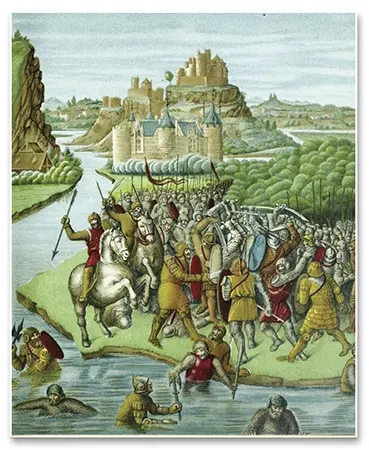
Jonathan in battle, by J. Fouquet
The terror of God spread throughout the land
When they saw the turmoil caused by Jonathan, “there was a panic in the camp, in the field, and among all the people; the garrison and even the raiders trembled; the earth quaked; and it became a very great panic” (1 Sm 14:15).
Saul, who remained in the camp, was unaware of what was happening. Soon the sentries saw a crowd of fugitives scattering in all directions. They did the roll call and found that Jonathan and his armour-bearer were missing. Meanwhile, confusion and astonishment only increased in the Philistine camp, where they turned their swords against each other.
The Israelites who had previously fled, when they learned that their adversaries were fleeing, went out to pursue them. On that day, through a profound inspiration, which to human eyes might have seemed great imprudence, “the Lord delivered Israel” (1 Sm 14:23).
“The bow of Jonathan turned not back!”
Jonathan shines as a symbol of faith and generosity in the Old Testament.
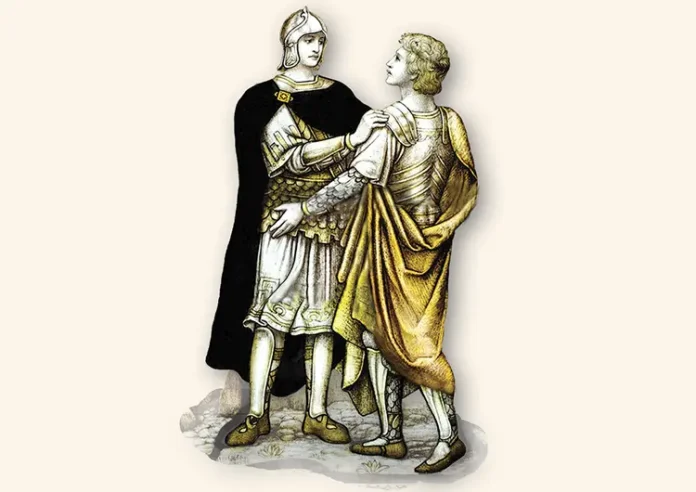
Strong and valiant in battle – because he placed all his trust in the help of the Lord God of hosts – gifted with the capacity of a commander, and esteemed by the people (cf. 1 Sm 14:45), he was the perfect candidate for the throne of Israel after Saul’s death. Nevertheless, he did not hesitate to yield his place, in a gesture of profound admiration, to the Lord’s anointed, David, “because he loved him as his own soul” (1 Sm 18:3): “you shall be king over Israel, and I shall be next to you” (1 Sm 23:17).
David esteemed Jonathan so much that later, when he learned of his death on the battlefield, he composed a beautiful song in his honour, even praising – out of consideration for Jonathan – the memory of Saul, even though Saul had disobeyed God:
“Thy glory, O Israel, is slain upon thy high places! How are the mighty fallen! Tell it not in Gath, publish it not in the streets of Ashkelon; lest the daughters of the Philistines rejoice, lest the daughters of the uncircumcised exult.
“Ye mountains of Gilboa, let there be no dew or rain upon you, nor upsurging of the deep! For there the shield of the mighty was defiled […] the bow of Jonathan turned not back, and the sword of Saul returned not empty. Saul and Jonathan, beloved and lovely! In life and in death they were not divided; they were swifter than eagles, they were stronger than lions. […]
“How are the mighty fallen in the midst of the battle! Jonathan lies slain upon thy high places. I am distressed for you, my brother Jonathan; very pleasant have you been to me; your love to me was wonderful, passing the love of women. How are the mighty fallen, and the weapons of war perished!” (2 Sm 1:19-27).
Let us ask the valiant Jonathan to assist us in all the battles of life and intercede for us, so we may imitate his holy audacity, his admiration and profound humility, his complete docility to the voice of grace! ◊