

Slavery!… Such a cruel word, evoking dire and dreadful impressions within us: heavy chains, violent subjugations, horrifying punishments, realities that make us tremble all the more as they distance us from what we cherish so much, freedom. However, as incredible as it may seem, there is a slavery that frees and a freedom that enslaves.
An example of this can be found in the Book of Genesis. Rich in stirring and dramatic scenes, it proffers a veritable treasure of moral teachings. Among these, we can highlight the paradigmatic story of Joseph, the young “dreamer” (Gen 37:19), which well expresses the contrast between envy and admiration in the human soul.
The most beloved of sons…
Jacob had one daughter and twelve sons, among whom Joseph was the object of special favour: his father loved him “more than any other of his children” (Gen 37:3a). Why?
At first glance, it seems obvious that this preference was based on the fact that Joseph was the child born to him almost at the end of his life. At least that is what the sacred text indicates: “because he was the son of his old age” (Gen 37:3b). However, the explanation may not be complete. If this was the only motivation for Jacob’s paternal predilection, the main object of his affection should have been Benjamin, the last offspring conceived by Rachel (cf. Gen 35:18).
There was certainly something of sublimity in that innocent soul, which not only attracted paternal favour but, above all, won the heart of God Himself. A special grace and design rested upon Joseph, in whom, from his youth, exceptional rectitude and remarkable supernatural gifts had shone.
…and the most despised among the brothers
It is characteristic of love to manifest itself. Faithful to this rule, Jacob wished to clothe his favourite son in a multicoloured tunic, as proof of his deep affection. This gesture, however, constituted a test for the brothers… Perceiving that Joseph enjoyed primacy, “they hated him, and could not speak peaceably to him” (Gen 37:4).
It was envy that, “when it seizes the soul, does not leave it until it leads it to the most extreme monstrosity,”1 as St. John Chrysostom rightly observes. In fact, the brothers’ mounting hatred darkened their hearts until it led them to plot one of the most heinous crimes: fratricide.
A freedom that enslaves
Envy! If we examine its etymology, we will encounter an interesting peculiarity: the term comes from the Latin invidia, which derives from invidere, meaning “to cast an evil eye.”2
The envious person becomes obsessed; they delude themselves, considering the good of their neighbour as an obstacle to their own glory. Thus, they expose themselves to terrible consequences: sadness for the virtue of others, hatred, defamation, calumny, joy at the misfortune befalling others, and a long et cetera… They do not realize that this vice brings them only culpability and remorse.
This was the sad case of those brothers who, faced with an admiring and innocent soul, did not rest until they had unleashed all their fury against him: “Come now, let us kill him and throw him into one of the pits” (Gen 37:20).
Two manifestations of the same vice
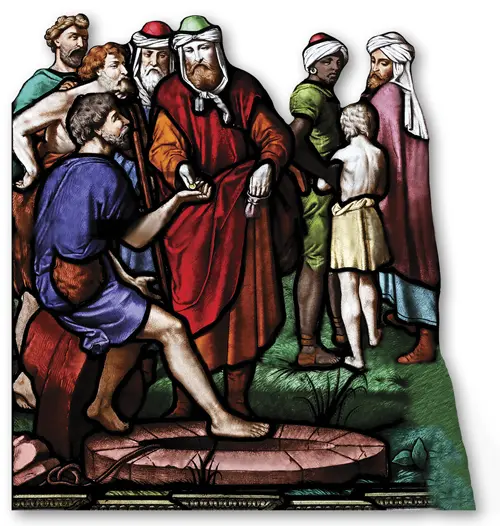
However, their malice did not stop at that infamous cry… Soon the voice of hypocrisy was heard: “What profit is it if we slay our brother and conceal his blood? Come, let us sell him to the Ishmaelites, and let not our hand be upon him, for he is our brother, our own flesh” (Gen 37:26-27). And so they did! “Then Midianite traders passed by; and they drew Joseph up and lifted him out of the pit, and sold him to the Ishmaelites for twenty shekels of silver; and they took Joseph to Egypt” (Gen 37:28).
These are two manifestations of the same envy: the radical one, which aims at the destruction and total disappearance of the one who is envied; and the hypocritical one, which neither tolerates nor admires good entirely, but also does not fully adhere to sin or evil. Is he a villain? No, rather indolent, despicable, and mediocre, like Pontius Pilate, who washed his hands of the worst crime in history.
Those poor blind men! Without realizing it, they were more enslaved than Joseph, whom they were actually selling into servitude. He, although captive, remained free because he did not allow himself to be bound by the fetters of sin. And it would be from this slavery that God would perform great wonders.
Admiration, the presupposition of love
The first element of love is admiration. The commandment to love God above all things presupposes, therefore, admiring God in all things. Let us explain: when we esteem someone, we feel the need to enjoy their presence. The same occurs in our love for the Creator, which impels us to the tireless search for reflections of Him in the mirror of the universe, finding no rest until we encounter Him.
Incidentally, the word admiration comes from the Latin admiratio. Miror signifies, among other meanings, to look with astonishment, enchantment;3 while ad translates as “to” or “towards”.
Applying this to our relationship with the Creator, it seems plausible to affirm that ad-mirari indicates the movement of the person who turns their attention outside of themselves, in order to seek God.
Understood in this way, admiration could well be called a slavery of love!
A slavery that frees
This deep-seated supernatural relationship bought freedom for Joseph. Indeed, he knew how to see God’s hand behind Pharaoh’s dreams, saving the country from the terrible famine that was to come.
The sovereign, as a sign of affectionate gratitude, freed him from prison and, taking off his own ring, “put it on Joseph’s hand, and arrayed him in garments of fine linen, and put a gold chain about his neck; […]. Thus he set him over all the land of Egypt” (Gen 41:42-43).
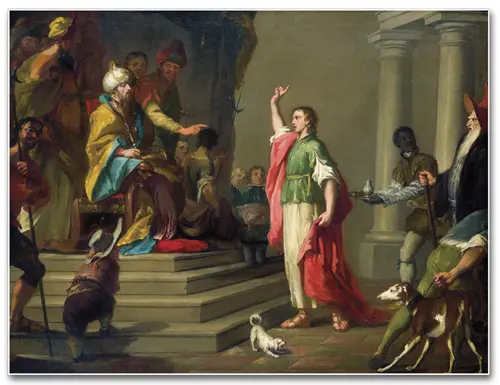
“Joseph interprets the Pharao’s dreams” – Bassenge Gallery, Berlin
Here we see the reward of the admiring soul: God frees it from the prison of selfishness, to make it dwell in the palaces of charity; He breaks the chains of sin to place, in their stead, the ring, symbol of His indissoluble covenant; freed from the yoke of diabolical slavery, to place around its neck the most precious necklace of the “glorious liberty of the children of God” (Rom 8:21)! ◊
Notes
1 ST. JOHN CHRYSOSTOM. Homiliarum in Genesim. Homilia LXI, n.1: PG 54, 526.
2 INVIDEO. In: ERNOUT, Alfred; MEILLET, Alfred. Dictionnaire étymologique de la Langue Latine. 4.ed. Paris: Klincksieck, 2001, p.321.
3 Cf. MIRUS. In: ERNOUT; MEILLET, op. cit., p.406.