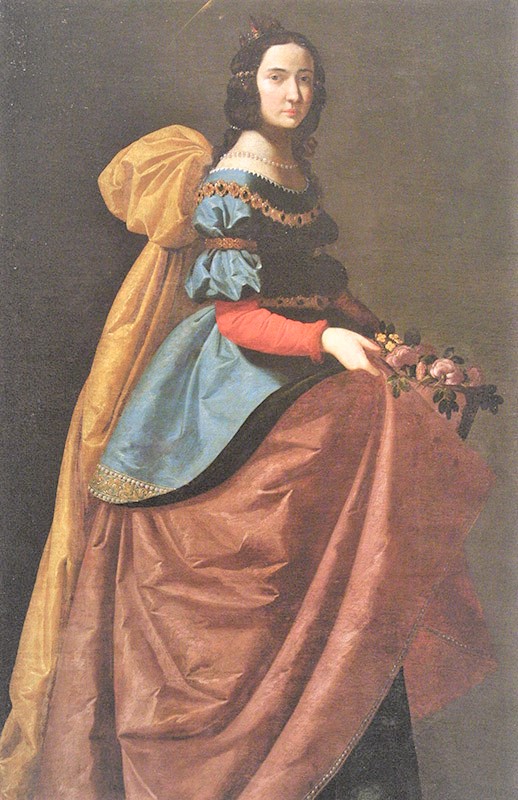
Saturday of the 13th Week in Ordinary Time
Optional Memorial of St. Elizabeth of Portugal, queen (†1336). Daughter of the King of Aragon, she was given in marriage to the King of Portugal. She suffered much due to his infidelities and from false accusations. She acted as a peacemaker in grave family disputes and thereby prevented bloodshed. After the death of her husband, she became a Franciscan tertiary and spent the rest of her days in detachment and mortification.
Mass Readings
First Reading – Amos 9:11-15
Thus says the LORD: On that day I will raise up the fallen hut of David; I will wall up its breaches, raise up its ruins, and rebuild it as in the days of old, That they may conquer what is left of Edom and all the nations that shall bear my name, say I, the LORD, who will do this. Yes, days are coming, says the LORD, When the plowman shall overtake the reaper, and the vintager, him who sows the seed; The juice of grapes shall drip down the mountains, and all the hills shall run with it. I will bring about the restoration of my people Israel; they shall rebuild and inhabit their ruined cities, Plant vineyards and drink the wine, set out gardens and eat the fruits. I will plant them upon their own ground; never again shall they be plucked From the land I have given them, say I, the LORD, your God.
Responsorial Psalm – Ps 85:9 and 10, 11-12, 13-14 (R. see 9b)
R. The Lord speaks of peace to his people.
I will hear what God proclaims;
the LORD–for he proclaims peace to his people.
Near indeed is his salvation to those who fear him,
glory dwelling in our land.
Kindness and truth shall meet;
justice and peace shall kiss.
Truth shall spring out of the earth,
and justice shall look down from heaven.
The LORD himself will give his benefits;
our land shall yield its increase.
Justice shall walk before him,
and salvation, along the way of his steps. R.
Gospel – Mt 9:14-17
The disciples of John approached Jesus and said, “Why do we and the Pharisees fast much, but your disciples do not fast?” Jesus answered them, “Can the wedding guests mourn as long as the bridegroom is with them? The days will come when the bridegroom is taken away from them, and then they will fast. No one patches an old cloak with a piece of unshrunken cloth, for its fullness pulls away from the cloak and the tear gets worse. People do not put new wine into old wineskins. Otherwise the skins burst, the wine spills out, and the skins are ruined. Rather, they pour new wine into fresh wineskins, and both are preserved.”
Featured Saints
Blessed Pier Giorgio Frassati, layman (†1925). Born to a wealthy family of Turin, Italy, he habitually renounced personal privileges and comforts to help those in need, whether materially or spiritually, and showed zeal in defending virtue among youth, one of his causes being a “Eucharistic Crusade ”. He died of a fulminant case of poliomyelitis at the age of 24, and his funeral brought out thousands of mourners who regarded him as a saint.
St. Andrew of Crete, bishop (†740). Archbishop of Gortyna (Crete); eminent preacher and hymnodist.
St. Ulrich, bishop (†973). Bishop of Augsburg, in Bavaria (Germany). He died in his nineties after exercising his Episcopal ministry for 50 years.
St. Bertha of Blangy, abbess (†c. 725). In her widowhood she became a religious in the monastery which she founded, in the city of Blangy, France.
St. Caesidius Giacomantonio, priest and martyr (†1900). Franciscan who was stoned and burned in the city of Hengyang, China, while he protected the Blessed Sacrament from profanation.
Blessed Jozef Kowalski, priest and martyr (†1942). Salesian priest, arrested for practising his ministry and shipped to Auschwitz concentration camp where he continually ministered to souls despite being subjected to barbarous treatment. He was violently attacked and killed out of religious hatred by the prison guards.
Blessed Boniface of Savoy, bishop (†1270). Carthusian monk born of a noble French family and elected Archbishop of Canterbury, England.
Blessed Mary of the Crucifix Curcio, religious (†1957). Founded the Congregation of the Carmelite Missionary Sisters of St. Thérèse of the Child Jesus, in Santa Marinella, near Rome. She desired to unite a missionary aspect to Carmelite spirituality, with the goal of “bringing souls to God.”
Blessed Catherine Jarrige, virgin (†1836). Dominican tertiary; during the French Revolution, she helped priests who had not taken the revolutionary oath, supplying them with bread and wine for the Eucharistic celebration.
Image gallery