

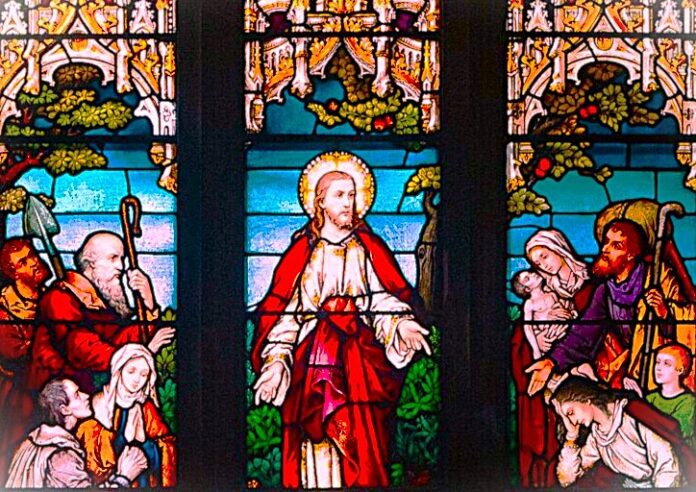
Sunday of the 11th Week in Ordinary Time
See also:
Mass Readings
First Reading – Ex 19:2-6a
In those days, the Israelites came to the desert of Sinai and pitched camp. While Israel was encamped here in front of the mountain, Moses went up the mountain to God. Then the LORD called to him and said, “Thus shall you say to the house of Jacob; tell the Israelites: You have seen for yourselves how I treated the Egyptians and how I bore you up on eagle wings and brought you here to myself. Therefore, if you hearken to My voice and keep My covenant, you shall be My special possession, dearer to Me than all other people, though all the earth is Mine. You shall be to Me a kingdom of priests, a holy nation.”
Responsorial Psalm – Ps 100:1-2, 3, 5 (R. 3c)
R. We are His people: the sheep of His flock.
Sing joyfully to the LORD, all you lands;
serve the LORD with gladness;
come before Him with joyful song. R.
Know that the LORD is God;
He made us, His we are;
His people, the flock He tends. R.
The LORD is good:
His kindness endures forever,
and His faithfulness to all generations. R.
Second Reading – Rom 5:6-11
Brothers and sisters: Christ, while we were still helpless, yet died at the appointed time for the ungodly. Indeed, only with difficulty does one die for a just person, though perhaps for a good person one might even find courage to die. But God proves His love for us in that while we were still sinners Christ died for us. How much more then, since we are now justified by His blood, will we be saved through Him from the wrath. Indeed, if, while we were enemies, we were reconciled to God through the death of His Son, how much more, once reconciled, will we be saved by His life. Not only that, but we also boast of God through our Lord Jesus Christ, through whom we have now received reconciliation.
Gospel – Mt 9:36—10:8
At the sight of the crowds, Jesus’ Heart was moved with pity for them because they were troubled and abandoned, like sheep without a shepherd. Then He said to His disciples, “The harvest is abundant but the laborers are few; so ask the master of the harvest to send out laborers for his harvest.” Then He summoned His twelve disciples and gave them authority over unclean spirits to drive them out and to cure every disease and every illness. The names of the twelve apostles are these: first, Simon called Peter, and his brother Andrew; James, the son of Zebedee, and his brother John; Philip and Bartholomew, Thomas and Matthew the tax collector; James, the son of Alphaeus, and Thaddeus; Simon from Cana, and Judas Iscariot who betrayed Him. Jesus sent out these twelve after instructing them thus, “Do not go into pagan territory or enter a Samaritan town. Go rather to the lost sheep of the house of Israel. As you go, make this proclamation: ‘The kingdom of Heaven is at hand.’ Cure the sick, raise the dead, cleanse lepers, drive out demons. Without cost you have received; without cost you are to give.”
Featured Saints
St. Elisha, disciple of Elijah. He was prophet in Israel from the reign of Jehoram until the time of Jehoash.
St. Fortunatus of Naples, bishop (†fourth century). He preserved his diocese from the Arian heresy, proclaiming far and wide the divinity of Jesus Christ.
St. Methodius, bishop (†847). Patriarch of Constantinople. Of Sicilian origin, he lived as a monk on the Island of Chios, Greece. He had recourse to Rome in abolishing iconoclasm.
Sts. Valerius and Rufinus, martyrs (†fourth century). Christians from Soissons, France, beheaded for spreading the Gospel among pagans.
Sts. Anastasius, priest, Felix, monk, and Digna, virgin, and martyrs (†853). Beheaded by order of the Moorish king of Cordova. St. Anastasius and St. Felix for professing the Christian Faith; St. Digna for denouncing the injustice.
Blessed Francisca de Paula de Jesus, laywoman (†1895). Born as a slave and orphaned at age ten, she was freed in 1820, and dedicated her life to prayer, serving the needy, and gathering the means for the construction of a Marian Chapel in Baependi, Minas Gerais, Brazil.
Image gallery


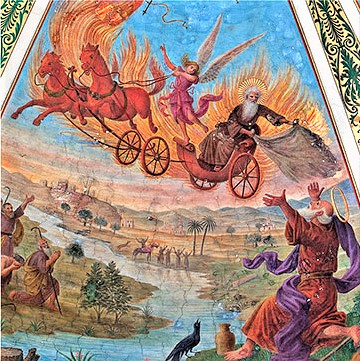
Image gallery


