If Christ commanded everyone to be “the light of the world” (Mt 5:14), the Supreme Pontiffs are the veritable beacons of civilization. Whether in the apostolic or medieval era, in modern times or in our own day, the Papacy remains the north star of human aspirations.
Its power does not proceed from human intelligence, for even demons surpass that; nor from military might, for its struggle is transcendent; nor from territorial extension, although through charity it embraces the entire globe. Its power is based on the authority to unite earth with Heaven, a dignity not even granted to the Angels.
Christ built His Church solely on Peter, and it was only for him that Jesus prayed in such a special way: “I have prayed for you that your faith may not fail” (Lk 22:32). As the object of such exalted graces of state, he is required to show distinguished love: “do you love Me more than these?” (Jn 21:15). Simon remained a mortal man; Peter, however, became an institution.
The Holy Father is the vicar of Christ, the mystical continuator of the, God-Man on this earth, applying the merits of the Redemption in time, as a renewed victim on Calvary. It is from the height of the Cross that Peter’s chair becomes unshakeable, for from there, with the Saviour, he draws all to himself.
Over the centuries, many have tried to reduce this rock to ruins. In the Protestant Reformation, everyone would be Pope; in the French Revolution, with the proscription of the Church, there would be no more Pontiffs; in autocratic revolutions, tyrants would take all power, including that of the Prince of the Apostles. However, as M. Thiers, intellectual heir of the anticlerical Voltaire, confessed, “here is a lesson from history: whoever devours the Pope succumbs.”
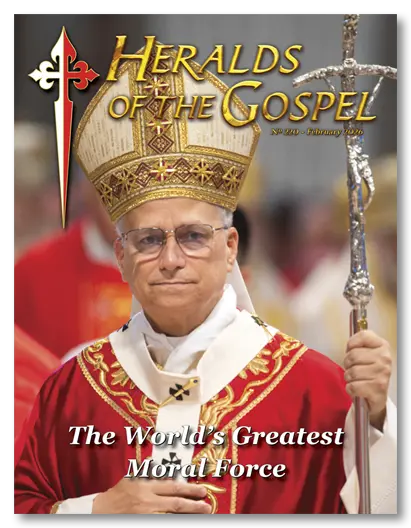
The Successors of Peter are sons of their time, and Pope Leo XIV is no exception. In every Pontiff there is a kind of “primordial light,” a unique vocation, which makes him illuminate a special facet of the Petrine ministry.
What shines most in the current visible head of the Church?
Undoubtedly, something related to the Augustinian motto of his pontificate: In illo uno unum – In the one [Christ], we are one. St. Augustine does not refer to an amorphous unity, complacent with evil. Jesus was unequivocal: “He who does not gather with Me scatters” (Mt 12:30).
Christ is one, head and body united. Now, all members of His Mystical Body must seek only what is necessary, in imitation of St. Mary Magdalene (cf. Lk 10:42). This is the only vocation of the Christian: to unite oneself to Jesus, the source of all individual vocations.
Also, the fullness of spiritual life is called the unitive way, a transforming union that belongs especially to the Bishops and in particular to the Holy Father. This way has as its goal not only perfection, but the state of exercizing perfection, a task that today belongs to Pope Leo, who is called, like Peter, to confirm his brothers in unity (cf. Lk 22:32).
Exactly a quarter of a century ago, through the pontifical approval received on February 22, 2001, the Heralds of the Gospel acquired an enduring bond with the Petrine See. Like Silvanus of old, they seek to be a “faithful brother” (1 Pt 5:12) to the Successors of Peter, seeking to walk with them on the path of unity in order to collaborate in the recapitulation of all things in Christ. For the Heralds, as for Leo XIV, the model of such union is found in the Mother of Good Counsel, who, through her maternal intercession, united the Saviour to humanity in the person of John. ◊