March 29 – Palm Sunday of the Lord’s Passion
The Liturgy of Palm Sunday, with its procession and Mass, presents us with two Gospels in which the glory and the Passion of Christ come face to face, inviting us to meditate on these lofty mysteries as preparation for the Easter Triduum.
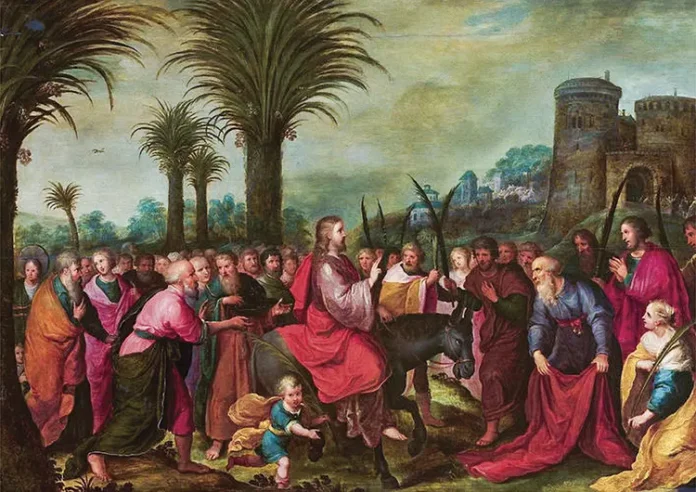
Our Lord chooses the Holy City as the stage for the dramatic episodes of Redemption: “Exult greatly, […] O daughter Jerusalem! Behold: your king is coming to you, a just saviour is he, humble, and riding on a donkey, on a colt, the foal of a donkey” (Zec 9:9). There Jesus is received and acclaimed to the sound of songs and praises: “Hosanna” – redemption, in Hebrew1 – “to the Son of David; blessed is He who comes in the name of the Lord” (Mt 21:9). Some spread their cloaks, others cut branches from trees and scattered them on the road to show their joy. What the Pharisees, doctors, and authorities of the Sanhedrin had denied Him, the multitude proclaims, shaking the city to its foundations.
However, Jerusalem lay in the darkness of mediocrity and worldliness. The Temple had become a den of thieves, the priesthood had divided into factions, the people had lost hope in the coming of the Messiah. They only wanted a leader who would deliver them from Roman rule and make them masters of the world. For this reason, they went from the acclamations of Palm Sunday to the cries of condemnation of Good Friday because, as Isaiah prophesied, they had God on their lips, but not in their hearts (Is 29:13).
The Evangelist tells us a detail that does not go unnoticed. On two occasions, the Holy City was shaken by the presence of the Messiah. On the occasion of His birth, when the Magi arrived asking: “Where is He who has been born King of the Jews?” (Mt 2:2). And in the episode we celebrate today: “And when He entered Jerusalem the whole city was shaken and asked, ‘Who is this?’And the crowds replied, ‘This is Jesus the prophet, from Nazareth in Galilee’” (Mt 21:10-11).
The presence of Our Lord was a rebuke to the unbelief, vices, and hardness of heart of those Jews. And for this reason, they supported the conspiracy of their leaders. Little did they know that they were unmasking themselves, showing an irrational and satanic hatred. With the death of the Redeemer, the authentic separation took place: “The veil of the sanctuary was torn in two from top to bottom. The earth quaked, rocks were split, tombs were opened, and the bodies of many saints who had fallen asleep were raised” (Mt 27:51-52). The barren fig tree was uprooted, and in its place sprouted the seed born from the side of Christ: the Holy Catholic Church.
Let us pray – through the merits of the Passion of Christ and the sorrows of Mary Most Holy – for the grace to always be attentive to what They ask of us and never harden our hearts with the allurements of the world or the mediocrity of daily life. ◊
Notes
1 Cf. ST. HILARY OF POITIERS. Comentario al Evangelio de Mateo, c.XXI, n.3. Madrid: BAC, 2010, p. 265.