


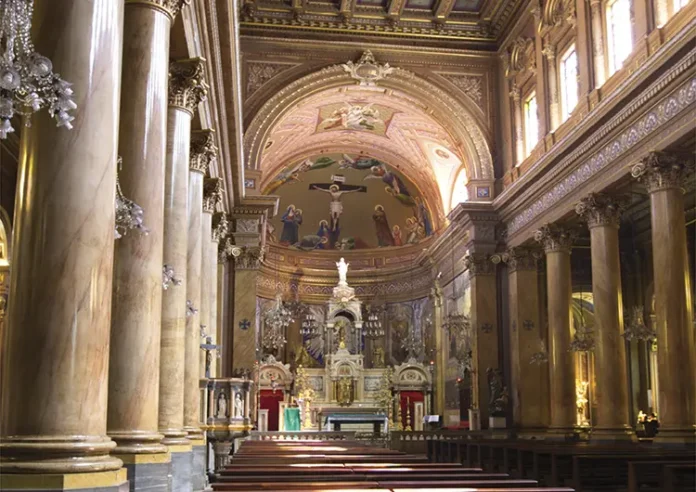
During my childhood, I began to notice that there was a uniformity in the Catholic Church which gave me the following impression: it seemed to me that the people, customs, doctrine, Liturgy and prayers had, from the beginning, a single mentality.
I looked at the objects in the Shrine of the Heart of Jesus1 and thought: “This is curious… There is something in this image and in that stained-glass window that makes them all similar to each other and they form a whole. There is more than just the beautiful glass, the beautiful mosaic and the beautiful music. There is a unity in this that also exists within me and that enchants me more than each individual thing, but I do not know what it is…”
I tried hard to formulate what this unity might be, but my child’s mind was not able to do so…
Loving the “unum” of the Holy Church
And I noticed that it was not just a mentality, but the mentality par excellence. I realized that, strictly speaking, only the Church possesses a true mentality, and outside of it no one else has one.
It was a certain way of being, present in absolutely everything, even in the smallest details: in the opening words of a prayer in a Missal, in the ambo on which the Missal itself stood, in the shape of the altar and the windows, in the manner of the priest, in the ringing of the bell, in the echo of footsteps inside the church, in the way the confessional was placed closer to here or closer to there, in the arrangement of the vases on the altars… I seemed to see a correlation between the shape of the holy water font and the spirit of a particular saint, or between an episode in the life of another saint and the colour of a particular stained-glass window… In short, everything imaginable was the expression of a whole mentality.
I then leafed through albums with photographs of churches, showing Catholic styles from other times and things from the life of the Church in other eras, including the period of the catacombs. And in everything, I noticed that same mentality present, expressing itself in a thousand ways, styles and forms. Nothing could be more different than a Roman catacomb and the Sainte-Chapelle in Paris, for example. However, the mentality was the same.
Thus, this set of symbols, doctrines, laws, customs, and concrete realities constituted an unum from which one had a complete view of the universe, considered in its centre and in its true meaning; which led people to think, want and feel to the full extent of their own dimension, for every soul possesses immense “vastitudes”, inhabited or uninhabited, dirty or clean, caves or chapels… And all these spaces found something to entertain themselves with in the Church, according to that unum, which was appropriately externalized, with varying intensities and with greater or lesser fullness of expressive force, but always authentic, throughout the centuries.
On the other hand, as São Paulo is a city of great immigration, receiving religious orders and congregations from many different countries, I sometimes attended very different churches. I realized then that the Church imbued the most varied nations with this mentality.
The charm of the “Italian stained-glass window”
One example was the majestic and severe manner, but deep down good-natured and with a certain grandiose relaxation – typical of Neptune in the midst of the waves – of certain very fat and very tall Italian priests, who celebrated Mass with the air of someone speaking to eternity who would then play with a bambino…
These were priests with slightly shabby cassocks and surplices that were not very well placed, whose stoles were somewhat worn, for reasons of economy, but possessing an indefinable “something” of Roman eternity and that intelligence with which Italians overlook details to remain within the general lines of things or, sometimes, focus on a detail to express only a general line in it, and move on, which is part of the delights of sparita Rome…2
I would attend the Italian priest’s Mass and I liked him, thinking: “Look how intelligent and subtle he is; how he softens a series of rules that, for my Fräulein,3 are ‘axes of the universe’! And the universe does not tremble before all his vagueness. How beautiful human intelligence is when it flies over obstacles instead of facing them and, in a flap of its wings, overcomes the problem without paying attention to it, lands right on top of a solution and leaps to greater heights. I appreciate this Italian way! I like the Church when it passes through the ‘Italian stained-glass window!’ It delights me!”
Attending Mass at the German school
On Sundays, Fräulein Mathilde would often make me get up much earlier than usual to attend Holy Mass at a German nuns’ school on Conselheiro Crispiniano Street, followed by a walking tour. I willingly obeyed, to please my mother and because I was enchanted by all things German.

The streets were still somewhat dark and the gas lamps had just been extinguished. The school was on high ground, and upon entering the garden, we climbed a very steep ramp, along which there were plaster figures in relief, painted with great ingenuity, representing the Passion of Our Lord. This seemed designed to compel visitors, upon arrival, to make the most of every minute by doing something useful.
Although not particularly beautiful, these figures were pious and always very clean, giving me the impression that every half hour a nun would pass by with a wet sponge and clean them with love. It was a “bath” of fresh colour that I received before entering the chapel, and there was something there that made me aware of the divine holiness of Our Lord Jesus Christ enduring the pains of the Passion.
The chapel was dimly lit, and the lamp of the Blessed Sacrament flickered. I had the impression that the statues were waking up and looking at me benevolently, saying, “Here is this son. Let us see what he wants.” There was a nun playing the harmonium and a group of children younger than us, sons and daughters of members of the German, Austrian and Swiss colonies, all in order in straight rows and praying. The German priest who celebrated Mass was the opposite of the Italian: firm and hieratic, as if those children were uhlans4 whom he was commanding there.

The chapel of the old St. Adalbert College – São Paulo
Grace filled me with supernatural sensations, and I thought: “This is magnificent! Such order, such cleanliness. Everything here is right, without whims or hitches! If I could live in this environment, I would not want anything else! I feel perfect. God is here!”
A friendly Portuguese priest
We also attended the church of a Portuguese priest: he was completely different! Kind, gentle and accessible to everyone. He asked us what we wanted and said:
“Yes, of course!”
And I immediately felt at home. Everything there seemed to be immersed in sweetness! As I approached the tabernacle, I had the impression that God himself was somewhat Portuguese and welcomed us thus: “My son, come closer.”
Observing Dona Lucilia in church
More than once, in the Sacred Heart Shrine, I would look at the members of the family and then observe my mother out of the corner of my eye, without her noticing. I perceived how earnestly she prayed! Anything could happen in church, but she never turned to the sides or took her eyes off the altar, at the top of which is the image of the Sacred Heart of Jesus. I, on the other hand, looked everywhere – which was natural for a boy – and she let me do so. Then I thought:
“There is an attraction between the Sacred Heart of Jesus and Mama. I have the impression that when she is looking at Him, there is an extraordinary life in her. And also, looking at Him, it seems to me that He has had such an effect on her that, in some way, He lives in her. How admirable He is! How perfect! How divine! How incomparable! But also… How much she resembles Him! Mama is thus a created model! How fantastic she is! Her kindness is a spark of His love. All this goodness that I appreciate so much was born of Him… The pinnacle of her perfections is in Him! If Mama were not devoted to the Sacred Heart of Jesus, she would not have them. My affection and my unlimited confidence in her are explained by this!”
She was very reserved about her spiritual life and never told me about any grace she had received in church. I felt I should not ask, but I noticed that she was deeply affected by the atmosphere of the church and kept thinking:
“It is curious: there is some connection between this church and her. What is in Mama, in the altar and in the priest’s vestments is the same thing. She seems made to pray here, and the church seems made for Mama to pray. One resembles the other. How harmonious she is with this! Mama is happier here than at home, and this is her environment, where her soul opens up completely, which does not happen in other places.
“Here she accepts everything, inhales everything and adapts to everything! This environment lives in Mama and she receives an influence here that makes her more and more like the church, and then she spreads this to the family. All her affection is a radiance of this.
“But then, what is it? When we get home, I will talk to her to see if I feel the same way, and check if what she has is a reflection of what exists here or something she brings with her. I need to know, for I want to understand things!”
Therefore, on Sundays, when the family dispersed after lunch, I would enter my mother’s room, begin to converse about anything, and notice qualities in her that seemed analogous to those I had noticed in the Church: a very dignified and respectable personality, but at the same time, one of indescribable affability and sweetness. She continually brought with her an atmosphere of contemplation, suggesting that her spirit was hovering in a very high region.
It was a reflection of God’s goodness, infinite but condescending, which goes down to the smallest details: talking about the little sheep, paying attention to the chicken, pleasing the little child and meditating on the lily of the field. The lower it descends, the sweeter it becomes. And this brought with it the vague idea that, in the small world of the family, Mama was an image of God.
And I thought: “I see that she has the same thing that exists there, but I do not even know how to find the words to ask her about it. I will explain this one day!”
An archetypical episode
Everything I felt in the Church seemed to me to come from an infinitely superior spirit, which almost revealed itself and made itself felt mysteriously here, there and everywhere, through symbols and through that interior action within my soul, which filled me with veneration. It was the cause that sustained and made everything in the Shrine of the Sacred Heart shine like a very rich, faithful, precise and exact reflection of God Himself. And I thought: “It is curious, but it seems that everything here speaks to my soul with the voice that Jesus would have if He were on earth! This is the very timbre of His voice! Deep down, it is the Sacred Heart of Jesus that is in Heaven!”
I cannot forget something that happened to me in that church, not just once, but on countless occasions – perhaps for years on end – which, however, on a certain day marked me more especially and remained in my memory as an archetypical episode.
I was attending Mass, enchanted by the figures, the colours, the stained glass, the Liturgy and the supernatural atmosphere that hovered in the air, when suddenly the whole picture came together in my mind and I concluded:
“Above all this there is Someone who is greater than everything! It is a curious thing. The Church does not seem like an institution, but rather a person who communicates through a thousand aspects. It has movements, grandeur, holiness and perfection, as if it were an immense ‘soul’ that expresses itself in all the Catholic churches of the world, all the images, all the Liturgy, all the organ chords and all the bell-ringing. This ‘soul’ wept with the requiems and rejoiced with the bells of Hallelujah Saturdays and Christmas eves. It weeps with me and rejoices with me. How I love this ‘soul’!
“I have the impression that, in relation to it, my soul is like a small resonance or repetition; something in which this ‘soul’ lives entirely, as if it were in a material temple. I feel in it like a drop of water in which the sun is reflected entirely. Like a miniature and a reflection, I contain this ‘soul’!”
I could not explain what this “soul” was, but I had the impression that the whole doctrine and spirit of the Catholic Church enveloped me! Identifying myself with this unum of the Holy Church, immersing myself in it and getting used to living without any discrepancy with it, I found a splendid fullness, in which I felt more and more myself. This touched me to the depths of my soul, inspired me with gratitude, and left me incomparably more enchanted than, for example, the carriages of Versailles.
I believe it was the presence of God in me, through the grace of Baptism.
“I believe in the Holy Roman Catholic and Apostolic Church!”
Then, at a certain moment, a splendid idea came to mind: “This is the spirit of the Roman Catholic Church! Mama received all this from the Church! The artists who built this temple and the priests who celebrate Mass also received their inspiration from the Church!”
At the same time, I became convinced that in the Holy Church everything was so logically and perfectly intertwined that it alone was the one true Church. Then my act of faith became fully explicit: “I believe in the Holy Roman Catholic Church!”
From this came an act of love: “She is worth everything! In such a way that everything I like is similar to her, but she is also similar to everything I like. She is the ideal of my existence! I want to live for the Church and I want to be like her, having this spirit for my whole life! And something makes me entirely in tune with her and only with her!” ◊
Taken, with slight adaptations, from:
Notas Autobiográficas [Autobiographical Notes].
São Paulo: Retornarei, 2008, v.I, p.521-531
Notes
1 Located in the Campos Elíseos neighbourhood of São Paulo, near the house where Plinio lived with his parents.
2 From the Italian: literally, disappeared. A term coined to describe certain picturesque aspects – now having almost completely disappeared – of the Eternal City, immortalized in the watercolours of Italian painter Ettore Roesler Franz (1845–1907).
3 Fräulein Mathilde Heldmann, Plinio’s German governess during his childhood.
4 Light cavalry soldiers.
