How many names has the Holy Church affectionately given to the Holy Father throughout history? Supreme Pontiff, Vicar of Christ, Successor of Peter… However, one of the most beautiful names, and perhaps the one that best encompasses such a lofty mission, is: the sweet Christ on earth. What could be more sublime than reflecting something of the Son of God Himself, the Second Person of the Holy Trinity, the Incarnate Word?
The Pope is elevated to the most sublime dignity possible on this earth. Monarch of the Church and of souls, he is in a sense the king of the whole world. What would become of us Catholics if there were no supreme hierarch in the Mystical Body of Christ? Dr. Plinio Corrêa de Oliveira1 maintains that the Church would fall apart, for it would become chaos, a den of confusion. And if this has not yet happened, it is because there is a Supreme Pontiff!
The Papacy was instituted when Our Lord Jesus Christ conferred the power of the keys on St. Peter, uttering the immortal decree: “And I say to thee: That thou art Peter; and upon this rock I will build my Church, and the gates of hell shall not prevail against it. And I will give to thee the keys of the Kingdom of Heaven. And whatsoever thou shalt bind upon earth, it shall be bound also in Heaven: and whatsoever thou shalt loose upon earth, it shall be loosed also in Heaven” (Mt 16:18-19)[DR].
However, the official exercise of this sacred function did not take place immediately, because Our Lord remained among men and, therefore, there was no need to be represented. Furthermore, some of the first Pontiff’s actions, before he was sanctified by the Holy Spirit, were at odds with his high mission, such as his rebuke of the Saviour after hearing from His divine lips the announcement of His Death (cf. Mt 16:21-22), and the three denials at the supreme hour of the Passion (cf. Jn 18:17-27).
How and when, then, did St. Peter become, with all his prerogatives, the Vicar of Jesus Christ in the nascent Church?
Pentecost: sanctification through Mary
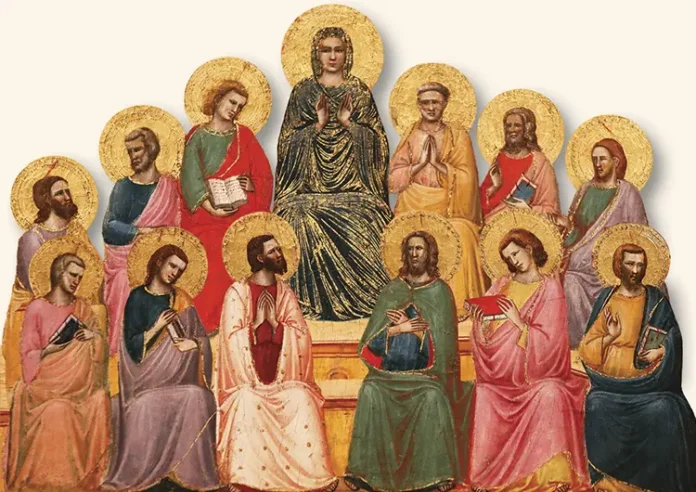
After the Ascension, the Apostles gathered with Our Lady in the Upper Room and spent days in prayer because, deprived of the physical presence of Our Lord, the means of remaining steadfast and persevering consisted, above all, in being united and with their hearts lifted up in ardent supplication.
Who could discern what was going on in the Immaculate Heart of Mary? Msgr. João, based on the reflections of various saints, believed that during those days Our Lady modelled within herself what the Church should be like, from its general aspects to the most concrete details, such as “the various paths of holiness, the beauty of the Liturgy, the wealth of charisms in the Religious Orders.”2 Furthermore, She certainly discerned the mission of each Apostle and prayed to God to keep them faithful, predisposing their souls, without their realizing it, for the descent of the Holy Spirit.3
Imbued with this maternal concern to pray for each one, what must have happened when the Blessed Virgin gazed at the one who had received the power to unite earth to Heaven? Like no one else, She understood the greatness of the mission of the Papacy, and in St. Peter She glimpsed all the splendours of this sacred institution until the end of the world, imploring God for all the Pontiffs of history, that they might always be the perfect image of the Supreme Shepherd.
We may assume that, when their fervent pleas reached their peak, “suddenly a sound came from Heaven like the rush of a mighty wind, and it filled all the house where they were sitting” (Acts 2:2). Then appeared what looked like tongues of fire, which rested on Mary and then spread to each of the Apostles.
God, who is supremely hierarchical, would be acting against Himself if He granted His gifts equally to all. He therefore did so in different degrees, granting specific graces proportionate to each soul. It can be assumed that, after Our Lady, the first soul to benefit from the flames of the Paraclete was the one who, except for Mary, was closest to God: St. Peter. He benefited twice, being sanctified by the Holy Spirit in the presence of Our Lady.4
Through her, the Head of the Church was endowed with a new fervour, redoubled apostolic zeal, love of sacrifice and extraordinary charisms. “The Light that terrifies the infernal regions, strengthens the wise and confirms the just, made shine in Peter’s soul the sign of the victory promised by Jesus: ‘I have prayed for you that your faith may not fail; and when you have turned again, strengthen your brethren’ (Lk 22:32).”5
One can conjecture, finally, that on that same day, in addition to receiving the Divine Fire, St. Peter understood that everything he had been granted was due to the intercession of Our Lady, and therefore decided to give himself to her as a slave of love.6
Consolidating his union with the Mother of the Church
From this event onwards, it seems reasonable that an unbreakable bond was formed between the Mother of the Church and its cornerstone, through which St. Peter determined to begin his apostolic work under her auspices. When he needed to decide on any matter concerning the direction of the Church, he would immediately turn to Mary, who would resolve everything with the utmost maternal care and clarity.7
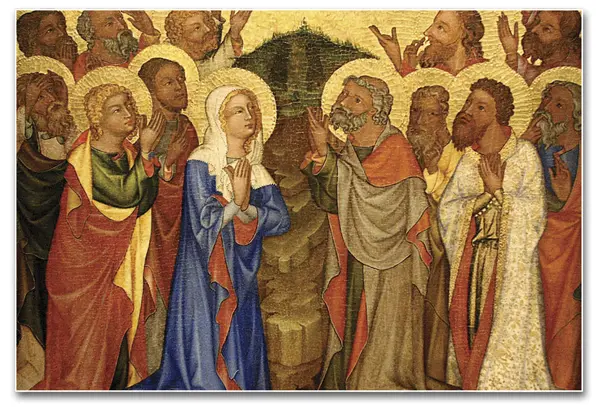
Our Lady and St. Peter, by the Master of Vyšší Brod – National Gallery of Prague
In turn, there is no doubt that Our Lady would insist that St. Peter always exercise his authority, in order to form him in the role of Supreme Pontiff. Through this mutual intertwining of souls, the Queen of Heaven not only influenced him, but also guided the Holy Church.
Our Lady’s devotion to the papacy
The relationship between Mary Most Holy and the Prince of the Apostles, however, cannot have been limited to simple protection and support. As stated earlier, there is no higher mission on earth than that of a Pontiff, and therefore She would not fail to render St. Peter the great veneration he deserved.
Let us imagine, for example, that St. Matthew came to Our Lady asking for guidance on how to deal with a group of pagans who, although eager to receive instruction in the Faith, were being maliciously ensnared by some Pharisees. After hearing the whole story, She would undoubtedly advise the Apostle to first bring the matter to Peter, imploring him, as the leader, to indicate the best course of action.
Although She was the Mother and Mistress of the Pontiff, She also acted as his most humble servant, the most loyal of his subjects, setting in the annals of history the perfect example of submission to the Papacy, which all the faithful should imitate until the end of time.
An eternal bond
Now, considering the reflections made so far, there is a risk of thinking that they are nothing more than ramblings, albeit beautiful ones; or that this sublime relationship between Our Lady and the Papacy, even if it existed, was restricted to the early days of the Church and only to the first Vicar of Christ. What an illusion!
In her contact with the one who possessed the key to the Kingdom of Heaven, the Blessed Virgin thought not only of him, but of all those who would succeed him in governing the Church until the end of the world. Assumed into Heaven and crowned Queen of the universe, She is always ready to strengthen the bond She established on earth with the Papacy, extending her maternal hands to all the Pontiffs who turn to her and open themselves to her influence.
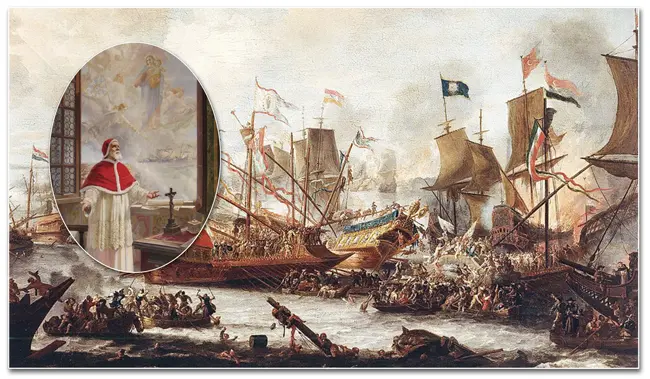
Battle of Lepanto, by Jan Peeters the Elder – St. Peter’s Church, Antwerp (Belgium); inset, St. Pius V beseeches Our Lady for the victory of the Catholic fleet – Basilica of Our Lady Help of Christians, Turin (Italy)
Mary has an intimate relationship with all Popes because She is the Mother of the Church.8 To elucidate this reality, Dr. Plinio9 has recourse to a metaphor. It would be monstrous to imagine a mother who considered herself responsible only for part of her child’s body. A mother watches over the entirety of the one she gave birth to, and over the head with particular care, because the health of the whole body depends on it. Now, as the Apostle says, Christ “is the Head of the Body, the Church” (Col 1:18), and if the Pope is Christ on earth, he is also the head of the Church, from which it follows that Our Lady supports and assists him in a special way, like a mother with her son.
What would have become of the nascent Church if the first Pope had not sought Mary’s guidance and help in the midst of adversity? Buried under what ruins would the Mystical Bride of Christ find herself if St. Pius V had not confidently turned to the Queen of Victories, imploring her powerful help in the fight against the enemies of Christendom? They and many others, such as St. Leo the Great, St. Gregory VII, Blessed Urban II, Innocent XI, and St. Pius X understood that, being the rocks upon which Christ’s edifice was built, they would only succeed under the patronage of the Blessed Virgin.
New heavens and a new earth
Echoing the hope of the Holy Apostles Peter and John, we all “wait for new heavens and a new earth in which righteousness dwells” (2 Pt 3:13) and where the new Jerusalem will descend from Heaven, like a bride adorned for her bridegroom (cf. Rv 21:1-3). This Bride is an image of the sanctified Church, that is, completely configured to the Blessed Virgin; and the new heavens and earth are figures of the Kingdom of Christ that will be established in the world, as the magnificent fruit of the Most Precious Blood shed by Him on the Cross.
However, for this Marian configuration of the Mystical Body of the Redeemer to occur, it must begin with the Head. The Successors of Peter must ardently devote themselves to her and, like the first Pope, become slaves to her love.
When there is a Pontiff who thus gives himself to Mary with all his heart, She will allow herself to be drawn to earth and will finally establish, through the action of the Holy Spirit, the “new heavens and new earth” that we so long for! ◊
Notes
1 Cf. CORRÊA DE OLIVEIRA, Plinio. Conference. São Paulo, 21/9/1991.
2 Cf. CLÁ DIAS, EP, João Scognamiglio. Mary Most Holy: The Paradise of God Revealed to Men. Houston: Heralds of the Gospel, 2020, v.II, p.526.
3 Cf. SCHEEBEN, Matthias Joseph. A Mãe do Senhor. São Paulo: Cultor de Livros, 2017, p.164.
4 Cf. ST. FRANCIS DE SALES. Sermon pour la fête de Saint Pierre. In: Œuvres Complètes. Annecy: J. Niérat, 1896, t.VII, p.37-38.
5 CLÁ DIAS, op. cit., p.503.
6 Cf. Idem, p.530.
7 Cf. Idem, p.530-532.
8 Cf. SCHEEBEN, op. cit., p.160.
9 Cf. CORRÊA DE OLIVEIRA, Plinio. Conference. São Paulo, 1/11/1966.