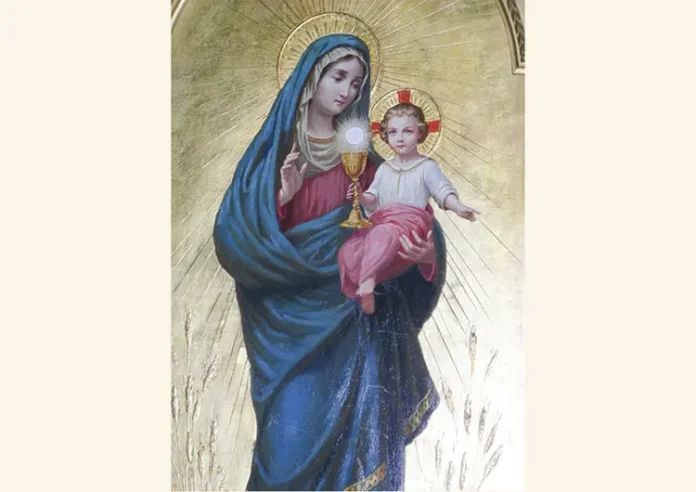
What if someone were to claim that the Eucharist is not only a perpetuation of the Incarnation, but also an extension of Our Lady’s action on earth? That would be rather bold, would it not?
At first glance, the statement does indeed seem to audaciously approach the borderlines of orthodoxy… However, audacity and heresy are not synonymous.
In fact, this idea, defended by a Servant of God1 in the 20th century, was upheld and explicated by the Magisterium of the Church in the Encyclical Ecclesia de Eucharistia: “In the ‘memorial’ of Calvary [the Holy Mass] all that Christ accomplished by His passion and His death is present. Consequently all that Christ did with regard to His Mother for our sake is also present. To her He gave the beloved disciple and, in him, each of us: ‘Behold, your Son!’ To each of us He also says: ‘Behold your Mother!’ (cf. Jn 19:26-27). Experiencing the memorial of Christ’s death in the Eucharist also means continually receiving this gift. It means accepting – like John – the one who is given to us anew as our Mother. It also means taking on a commitment to be conformed to Christ, putting ourselves in the school of His Mother and allowing her to accompany us. Mary is present, with the Church and as the Mother of the Church, at each of our celebrations of the Eucharist. If the Church and the Eucharist are inseparably united, the same ought to be said of Mary and the Eucharist.”2
This well-founded proposition gives rise to beautiful and fruitful meditations on the union between Our Lady and her Divine Son in the Sacrament of the Altar.
Guardian of Jesus’ royal table
As Catholic piety has discerned over the centuries, there are several analogies between the Incarnation and Transubstantiation. If it was through the consent and word of a Virgin that the Divine Word became Man, it is also through another human word, that of the priest, that a second Incarnation is renewed for us daily on all altars; just as it was five words that drew God into the world for the first time – “Fiat mihi secundum verbum tuum” (Lk 1:38) – it is also five words spoken by the priest – “Hoc est enim corpus meum” – that bring Him back to earth.
Moreover, if in little Nazareth the Saviour hid Himself in the most pure womb of His Mother, once again He conceals Himself under the Eucharistic Species on the altars. In this sense, Our Lady anticipated the Eucharistic faith of the Church by offering her virginal womb for the Incarnation of the Word of God.3
She who offered her virginal womb for the Incarnation of the Word of God was made the guardian, organizer and protector of the royal table of Jesus
The divine link between Mary and the Sacrament of the Altar was prophesied even in the Song of Songs: “Posuerunt me custodem in vineis – They made me keeper of the vineyards” (Sg 1:6), meaning that the Virgin was made guardian, organizer and protector of the royal table of Jesus.4 Undeniably inspired by grace, although initially misconstrued and even persecuted, the proclamation made by St. Peter Julian Eymard in 1868, when he gave her the title of Our Lady of the Blessed Sacrament, appears in this context.
A “relic” of Mary
There were also authors who claimed that the Eucharist was a “relic” of Mary. In fact, we call relics the remains of the bodies of the saints, something that belonged to them or that came into contact with them. When we consider the union between mother and son, we see that the latter has a physical body formed by the mother, with her own blood, as a product of her substance. It is undeniable that he ends up becoming a kind of “relic” of the one who gave birth to him.5
And the veracity of this thought is made sublime when applied to the exalted union between Mary and Jesus. As theology teaches, Our Lady, through her Divine Maternity, was honoured with affinity and consanguinity6 with God, in addition to being the only one who cooperated physically in the constitution of the Sacred Body of her Son – caro Christi, caro Mariæ.
Now, if the Eucharist contains the real and physical presence of Our Lord Jesus Christ veiled under the Sacred Species, it can be considered, in this sense, a “relic” of His virginal Mother.
This is a most original idea, which invites the soul to redoubled Eucharistic devotion.
From her “fiat”, Redemption and the Holy Mass
Mary alone gave the world the one Priest, of whom the others are but ministers: the Incarnate Word who becomes present on the altar
If, therefore, it was with a view to Redemption that the Incarnation took place, it is through the Eucharistic Celebration that both are renewed on the altar. In fact, Providence saw fit to make the fulfillment of its most exalted designs depend on the “yes” of a Maiden, since “if Mary had not pronounced her ‘fiat’, the Church would have neither Christ, nor the priesthood, nor the sacrifice, nor the Sacrament.”7 She alone gave the world the one Priest, of whom the others are just ministers: the Incarnate Word who becomes present on the altar.8
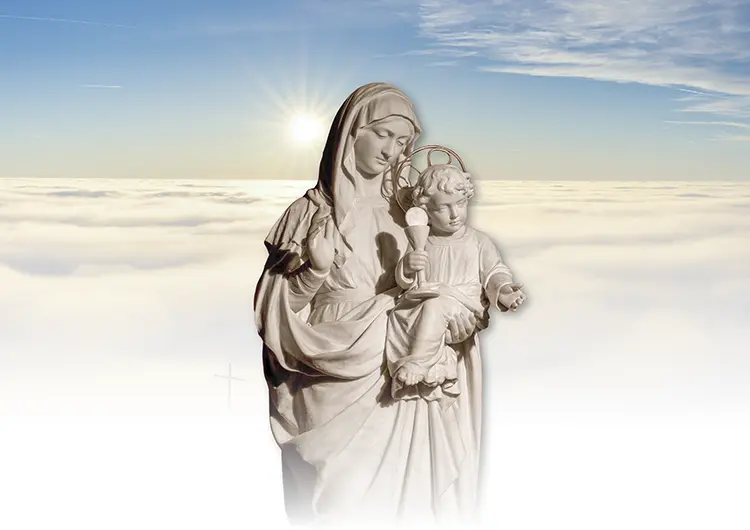
Thus, intimately associated with the work of Redemption, Our Lady grants the Liturgy the pinnacle of its splendour and one of the main foundations of its institution: the ineffable communion of man with God in the Holy Mass. Not without reason, then, can Mary’s sublime and mysterious presence be contemplated in various aspects of the Church’s ceremonies.
Symbols of invisible realities, some liturgical objects used by the Church for sacred functions represent the august mission of the Mother of God alongside her Son. For example, She is compared by Christian tradition to “an altar of pure gold on which the Great Victim offered Himself.”9 The crucifix also reminds us of her: Our Lady was like the first cross on which the God-Man lay for the sacrifice. One can even see her as the mystical candelabra that brought the true Light, Jesus Christ, into the world. And the vestments worn by the priest represent the sacerdotal raiment of the Saviour: His most holy humanity, received from Mary.10
The presence of the Virgin is also manifest in the contemplation of certain parts of the Holy Mass. When kissing the altar and addressing the faithful, pronouncing the “Dominus vobiscum”, the priest repeats the angelic greeting: “Dominus tecum” (Lk 1:28). Then, when reciting the Confiteor, the minister bows his head before the holiest in Heaven and on earth, invoking the name of Mary, Refuge and Advocate of sinners. During the Offertory, as the faithful silently place their intentions on the altar, they remember the secret offering that the Redeemer made of Himself in the most pure womb of His Mother. And, as he adds the drop of water to the chalice as a symbol of the union between the divine and human natures, the celebrant recalls the one through whom this mystery was accomplished.11
Mass with Mary
When narrating to his spiritual children, at a conference, the graces he had received during a Mass celebrated at the motherhouse of the Heralds of the Gospel, Msgr. João12 indicated to them a simple and effective way to draw closer to the Blessed Virgin and to participate fruitfully in the Eucharist.
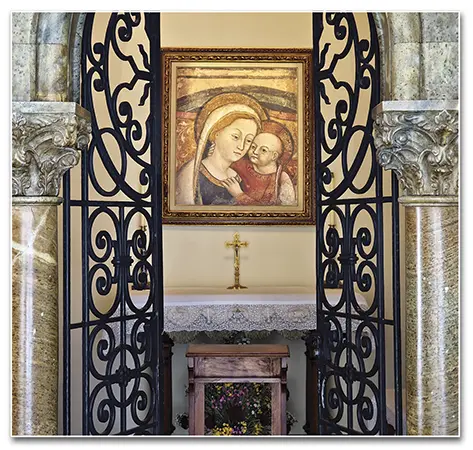
As he celebrated in front of an expressive image of the Mother of Good Counsel, he rejoiced at being in her presence, and that of her Divine Son, which led to a filial interior dialogue with both of them.When he said “sursum corda – lift up your hearts,” for example, he applied the exhortation to Mary, imagining what her response would be: “But, my son, it is impossible to lift it higher…” Thus, he perceived the Holy Sacrifice as a true encounter with Our Lady, who introduced him, in an indescribable way, into an encounter with God Himself.
To attend Mass well, simply seek the presence of Mary, Mother and nourisher of the Bread of Life, in every movement of the liturgical ceremony
This is a very accessible solution for those who wonder how to attend Mass well: simply seek the presence of Mary Most Holy, Mother and Nourisher of the Bread of Life,13 in every movement of the liturgical ceremony, in each song and in every word. For her Heart is a thurible of Eucharistic love, whose pulsations unite with the adoration of the faithful as a sweet-smelling incense rising to Heaven.
To conclude, as Dr. Plinio recommended,14 let us desire not only to rest our heads on the Immaculate Heart of our Heavenly Mother, as St. John the Evangelist once did on the Lord’s, but also to establish our dwelling there, so that, listening to the beating of her Heart, we may live of these secrets of love for Jesus in the Blessed Sacrament. ◊
Notes
1 Cf. DE LOMBAERDE, DNSS, Julio Maria. Maria e a Eucaristia. Estudo doutrinal de um título e uma doutrina: Nossa Senhora do Santíssimo Sacramento. Manhumirim: O Lutador, 1937, p.13. Fr. Julio Maria was born in Waereghen, Belgium, on January 8, 1878. Sensing a call to the priesthood, he entered the Congregation of the Holy Family, founded by Fr. Berthir to receive late vocations. He was ordained on January 13, 1908 and, in 1912, sent to the Brazilian Amazon, where he worked for fifteen years as a missionary. In Macapá, he founded the Congregation of the Sisters of the Immaculate Heart of Mary, approved by Pope Benedict XV. In 1928, he moved to Minas Gerais, where he founded the Congregation of the Missionaries of Our Lady of the Blessed Sacrament, as well as that of the Sacramentine Sisters of Our Lady. He wrote dozens of doctrinal, apologetic, and spiritual works. He died on December 24, 1944.
2 ST. JOHN PAUL II. Ecclesia de Eucharistia, n.57.
3 Cf. Idem, n.55.
4 Cf. LÉMANN, Joseph. La Mère des chrétiens et la Reine de l’Église. 2.ed. Paris: Victor Lecoffre, 1900, p.267.
5 Cf. LOMBAERDE, op. cit., p.221-223.
6 Cf. MERKELBACH, OP, Benito Enrique. Mariología. Bilbao: Desclée de Brouwer, 1954, p.91-92.
7 PHILIPON, OP, Marie-Michel. Los sacramentos en la vida cristiana. 2.ed. Madrid: Palabra, 1979, p.334.
8 Cf. Idem, ibidem.
9 VAN DEN BERGHE, Oswald. Marie et le sacerdoce. Bruxelles-Paris: Haenen; Laroche, 1872, p.126.
10 Cf. LHOUMEAU, SMM, Antonin. La vie spirituelle à l’école de Saint Louis-Marie Grignion de Montfort. Bruges: Beyaert, 1954, p.442-443.
11 Cf. Idem, p.444-447.
12 Cf. CLÁ DIAS, EP, João Scognamiglio. Conference. São Paulo, 28/5/2008.
13 Cf. ST. AUGUSTINE. Sermo CLXXXIV, n.3. In: Obras Completas. 2.ed. Madrid: BAC, 2005, v.XXIV, p.6.
14 Cf. CORRÊA DE OLIVEIRA, Plinio. Coração de Maria, nossa esperança [Heart of Mary, our Hope]! In: Legionário. São Paulo. Year XVI. No.555 (March 28, 1943), p.3.