


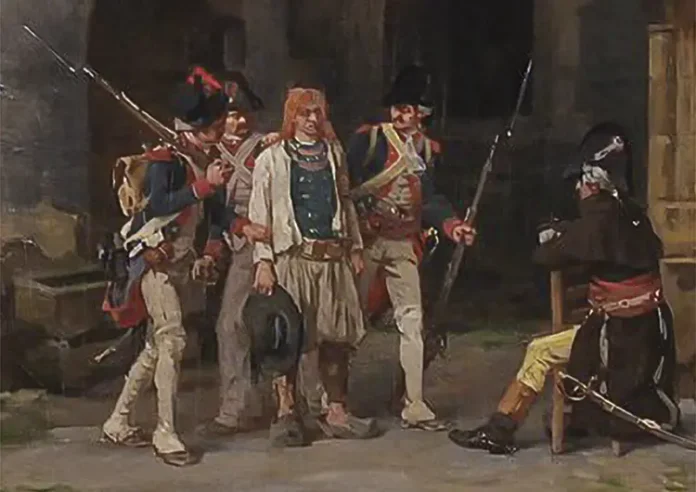
It was dusk on December 24, 1795. An intensely cold winter was ravaging the regions of Brittany, reminding a poor peasant of the holy night par excellence when the Saviour came into the world.
However, the situation in which he found himself differed tragically from that first Christmas: the song of the Angels was not heard, the star of the Magi did not shine, and the maternal gaze of Our Lady, together with the paternal benevolence of St. Joseph, was replaced by the hatred of four revolutionary villains who had tied him to a tree…
The young man was one of the fervent Catholics who lived in north-western France, known as the Chouans, who resisted the violence of the French Revolution in the name of religion and the monarchy.
He had been brutally tormented, and now listened in anguish to the taunts of his persecutors, feeling death approaching for, in times of war like those, being a captured man meant being a doomed man!
“If only I could kill more than a thousand of your kind with a single shot!” growled one of the revolutionaries.
The prisoner, with his head bowed, said nothing. Nor was it necessary for him to do so; God would speak for him.
Suddenly, a crystal-clear melody broke the silence of those vast expanses. Sometimes deep and solemn, sometimes high-pitched and innocent, bells rang in the distance. Surprised, thinking it was an alarm signal from the resistance, the republicans asked the Chouan what it meant.
“It is Christmas,” he replied, “the bells are ringing for Midnight Mass.”
Christmas! That word echoed in their hardened hearts, awakening a world of fond memories: Midnight Masses attended with the family, enchanting nativity scenes and brightly lit Christmas trees, songs of diaphanous candour, eagerly awaited gifts, delicious dinners… in short, everything that could embellish a true and holy Christmas whispered irresistible invitations to conversion to their souls. Innocence, already agonizing in those souls, made its last appeals… and seemed to be answered.
After an eloquent silence, the revolutionaries addressed the unfortunate man with a certain compassion. They asked him where he was from and what his name was.
“I am from Coglès and my name is Branche d’Or,” declared the Chouan.
“Is your mother still alive? Do you have a wife and children?”
A hoarse groan was his only answer, and in the flickering light of the bonfire, a tear glistened on his cheek. The soldiers glanced at each other, abashed. They tried to contain their desire to release him, while the bells continued to ring in the surrounding area.
“You can go,” said the commander to the counter-revolutionary, untying his bonds.
The Breton raised his head, unable to believe what he was hearing.
“Get out of here, fast! Run away! You’re free.”
Imagining this to be just another insult, the Chouan stood up and stared at the revolutionaries for a moment. A light, miraculous as the star of Bethlehem, seemed to glimmer in the visage of those murderers. Realizing it was true, he fled into the forest towards his village. He had been saved by Christmas…
What tenderness, sublimity and holy unction accompanies this feast! Its bells ring out to all, even those who have strayed from God. To the righteous it echoes as a hymn of consolation; to sinners, as an invitation to renounce their inveterate vices. And what about us? What will we do with the graces of this Christmas? ◊


