From the beginning, called to the order of grace
The book of Genesis reveals to us not only the natural order of existence, but at the same time, right from the beginning, the supernatural order of grace. […] Man is called to familiarity with God, to intimacy and friendship with Him. God wants to be close to him. He wants to make him a participant in His plans. He wants to make him a participant in His life. He wants to make him happy with His own happiness. […]
We know that the first man, who enjoyed original innocence and the particular closeness of his Creator, did not show this availability. This first covenant of God with man was interrupted, but the will to save man did not cease on the part of God. The order of grace was not broken.
ST. JOHN PAUL II.
General Audience, 13/12/1978
The admirable restoration of the divine plan
St. Athanasius explains that the Son of God became man so that man might be deified. […] Divinization in no way implies the self-deification of man. On the contrary, divinization protects us from the primordial temptation to want to be like God (cf. Gen 3:5). What Christ is by nature, we become by grace. Through the work of redemption, God not only restored our human dignity as His image, but the One who created us in a wondrous way, has now made us partakers in His divine nature in an even more wondrous way (cf. 2 Pet 1:4).
LEO XIV.
In unitate fidei, 23/11/2025
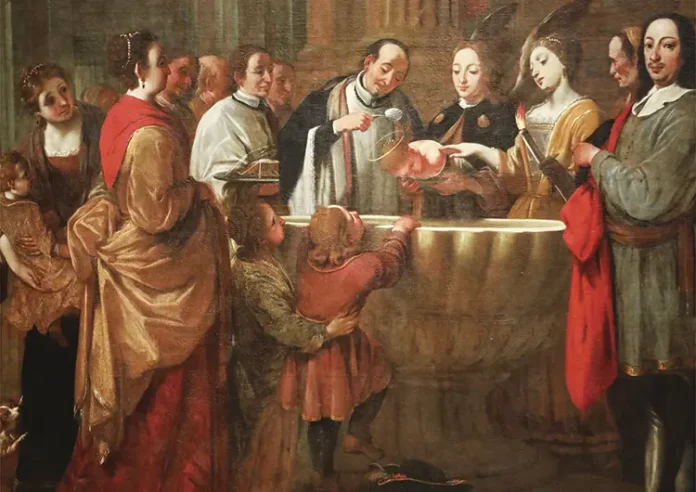
Grace is obtained through Baptism
The name of Christ is very useful for obtaining the faith and sanctification wrought by Baptism, so much so that everyone who, wherever they may be, has been baptized in the name of Christ immediately receives the grace of Christ.
ST. STEPHEN I.
Letter to the Bishops of Asia Minor,
Year 256: DH 111
The life of grace, the fullness of life
Sooner or later everything that begins on earth comes to its end, like the meadow grass that springs up in the morning and by evening has wilted. In Baptism, however, the tiny human being receives a new life, the life of grace, which enables him or her to enter into a personal relationship with the Creator for ever, for the whole of eternity. […]
We all feel, we all inwardly comprehend that our existence is a desire for life which invokes fullness and salvation. This fullness is given to us in Baptism.
BENEDICT XVI.
Homily, 13/1/2008
Living in God and by God
Through the gift of grace, which comes from the Holy Spirit, man enters a “new life,” is brought into the supernatural reality of the divine life itself and becomes a dwelling-place of the Holy Spirit, a living temple of God. For through the Holy Spirit, the Father and the Son come to him and take up Their abode with him. In the communion of grace with the Trinity, man’s “living area” is broadened and raised up to the supernatural level of divine life. Man lives in God and by God: he lives according to the Spirit, and sets his mind on the things of the Spirit.
ST. JOHN PAUL II.
Dominum et vivificantem, 18/5/1986
The exalted dignity of redeemed man
When, furthermore, we consider man’s personal dignity from the standpoint of divine revelation, inevitably our estimate of it is incomparably increased. Men have been ransomed by the blood of Jesus Christ. Grace has made them sons and friends of God, and heirs to eternal glory.
ST. JOHN XXIII.
Pacem in terris, 11/4/1963
A new interior organism
The whole Christian life develops in faith and charity, in the practice of all virtues, according to the intimate action of that renewing Spirit, from whom proceeds the grace that justifies, vivifies, and sanctifies; and with grace proceed the new virtues, which constitute the fabric of supernatural life.
This is the life that develops not only through the natural faculties of man – intelligence, will, sensibility – but also through the new capacities acquired – superadditæ – by means of grace, as St. Thomas Aquinas explains. They give […] to all the powers of the soul, and in some way also of the body, the possibility of participating in the new life with acts worthy of the condition of men elevated to participation in the nature and the life of God through grace: “consorte divinæ naturæ”, as St. Peter affirms (2 Pet 1:4).
It is like a new interior organism, in which the law of grace manifests itself: a law written in hearts, more than on tablets of stone or on paper codices.
ST. JOHN PAUL II.
General Audience, 3/4/1991
The need to cooperate with the grace of God
No one, of course, can deny that the Holy spirit of Jesus Christ is the one source of whatever supernatural powers enters into the Church and its members. For “The Lord will give grace and glory” as the Psalmist says (83:12). But that men should persevere constantly in their good works, that they should advance eagerly in grace and virtue, that they should strive earnestly to reach the heights of Christian perfection and at the same time to the best of their power should stimulate others to attain the same goal, – all this the heavenly Spirit does not will to effect unless they contribute their daily share of zealous activity. “For divine favours are conferred not on those who sleep, but on those who watch,” as St. Ambrose says.
For if in our mortal body the members are strengthened and grow through continued exercise, much more truly can this be said of the social Body of Jesus Christ in which each individual member retains his own personal freedom, responsibility, and principles of conduct. For that reason he who said: “I live, now not I, but Christ liveth in me” (Gal 2, 20), did not at the same time hesitate to assert: “His [God’s] grace in me has not been void, but I have laboured more abundantly than all they: yet not I, but the grace of God with me” (1 Cor 15:10).
PIUS XII. Mystici
Corporis Christi, 29/6/1943
First and fundamental condition
Prayer is the first and fundamental condition for cooperating with the grace of God. It is necessary to pray in order to have God’s grace – and it is necessary to pray in order to cooperate with God’s grace.
Such is the true rhythm of the Christian’s interior life.
ST. JOHN PAUL II.
Angelus, 4/7/1982
History awaits the true children of God
Creation waits with impatience for the revelation that we are children of God, to be set free from bondage and obtain His splendour. Dear friends, we want to be these children of God for whom creation is waiting, and we can become them because the Lord has made us such in Baptism. Yes, creation and history – they are waiting for us, for men and women who are truly children of God and behave as such.
BENEDICT XVI.
Homily, 3/6/2006