In 1580, Scotland found itself at a crossroads: its Catholic history, personified in the controversial figure of a queen imprisoned for her faith, Mary Stuart, confronted a turbulent present, agitated by the waves of John Knox’s political and religious revolution. What would the future hold?
This dilemma was well symbolized in the home of the Baron of Drum-na-Keith. The mother, a Catholic of noble lineage. The father, head of the lesser branch of the Ogilvie family, and one of the Calvinists responsible for investigating and arresting Jesuits. What would become of little John, the couple’s newborn son?
A young man in search of the truth
Since 1560, John Knox’s Calvinist Presbyterianism had been established, at the cost of bloodshed, as the official religion of the country, denying the Holy Eucharist, the Liturgy, the Papacy, and the episcopate. On August 24th, Parliament prohibited the celebration of Holy Mass throughout Scottish territory. Offenders would be subject to confiscation of property, exile, corporal punishment at the discretion of magistrates, and even capital punishment. Knox himself confessed that “a Mass was more fearsome to him than if ten thousand armed enemies landed anywhere in the kingdom.”1
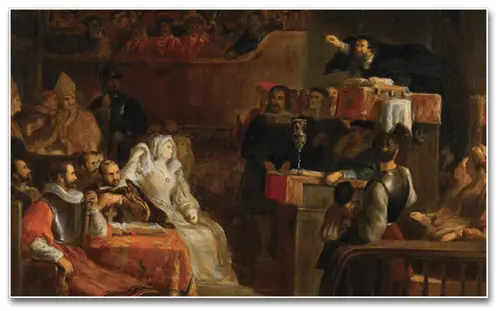
The preaching of John Knox, by David Wilkie – National Gallery of Scotland, Edinburgh
It was from this Scotland that, a few decades later, young Ogilvie would leave to study in France at the age of thirteen.
The boy, who had received a Calvinist education at home, began to take a keen interest in the religious controversies that were then raging throughout Europe. Guided by sincere goodwill, he soon received the help of the Holy Spirit, who opened his understanding to the meaning of the Holy Scriptures and inspired in him a deep admiration for the stories of the martyrs. Thus, John soon perceived that the Catholic Church was the true Church of Christ.
At the age of seventeen, he entered the Scottish College of Louvain, run by Catholic priests. However, it was only with the Jesuit teachers at Olmütz, Austria, that he found his vocation.
A fervent Jesuit
An enthusiast of the pugnacious Ignatian charism, Ogilvie submitted his request to join the Order in his first year of studies at the institution. However, an epidemic forced the closure of the college.
Undeterred, the persistent Scotsman accompanied the superior to Vienna, where he was granted entry into the novitiate in Brno.
Ordained a priest in 1610, he came into contact with two other Jesuits who had returned from unsuccessful missions in Great Britain. One of them, Fr. Gordon, had spent three years imprisoned in the dreaded Tower of London! Enthralled by the daring undertaking and feeling an ardent desire to dedicate himself to the dangerous apostolate in his homeland, Scotland, the newly ordained priest expressed his aspirations to the Superior General.
Fr. Aquaviva, however, following the Ignatian school, severely reprimanded him for wanting to impose his will over that of his superiors. At that point, God was not asking of him the sacrifice of risking his life, but only that of religious obedience… At that point.
“Pleased to meet you, John Watson”
Indeed, two and a half years later, the superiors determined that Father Ogilvie should leave for Scotland. Due to the anti-Catholic laws then in force in those lands, he had to disguise himself as a former soldier and horse trader.
Thus, Captain John Watson – that was his pseudonym – disembarked at the small port of Leith, near Edinburgh, in the autumn of 1613. His objective was clear: to develop an apostolate among the Catholic nobility and bourgeoisie, with a view to restoring Catholicism in Scotland.
Everything had to be done with discretion, efficiency, and sagacity, so as not to be denounced to the government.
Despite his good intentions, the first period of his apostolate was fruitless, as the complacent nobility showed no interest whatsoever in the Catholic cause.
In February 1614, the Jesuit presented – unsuccessfully – a proposal for a political-religious truce at the court in London.
At Easter he travelled to Paris, where he was reprimanded by his provincial, Father Gordon, for having left Scotland without the approval of his superiors.
Back in Scotland
A lover of obedience, the young priest did not become discouraged, but, on the contrary, returned – with even greater enthusiasm – to his mission. Perhaps due to this good disposition, it pleased Our Lady that this time his clandestine apostolate would be more fruitful.
From Edinburgh to Glasgow, with the continual risk of falling prey to a snare, that mysterious Captain Watson would slip furtively through the prisons to encourage incarcerated Catholics to persevere in the Faith, preaching and administering the Sacraments in secret, in the homes of Catholic families.
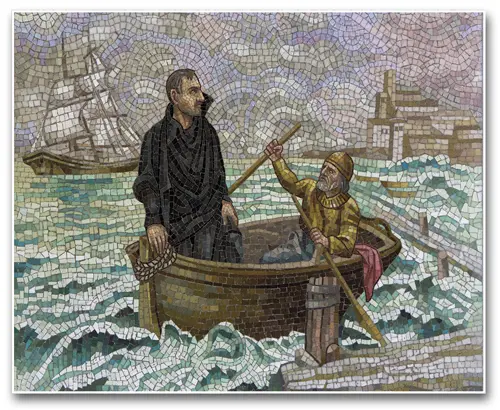
St. John Ogilvie returns to Scotland – Church of St Aloysius, Glasgow (Scotland)
In the brief period between Easter 1614 and the beginning of 1615, numerous souls were reconciled with the Holy Church thanks to the zeal of the courageous missionary.
And surely many more conversions would have occurred if Father Ogilvie’s work in those lands had not been brutally interrupted.
The betrayal
After celebrating Mass in the presence of Adam Boyd, a Protestant who had declared himself willing to return to the true Church, “Captain Watson” arranged a meeting with the supposed convert in the Glasgow marketplace in order to enlighten him about Catholic doctrine.
However, directly after the celebration, Boyd went to see the Anglican “archbishop” Spottiswood, a former Presbyterian minister responsible for keeping Catholics and Calvinists in Glasgow under the control of the royal power. Thus, when Fr. Ogilvie arrived at the agreed location, he was arrested and taken to the mayor’s house. Spottiswood also went there with his henchmen.
From then on, the most sublime pages of the Saint’s biography began.
Resembling Our Lord in the Passion
In a grim re-enactment of the encounter between Our Lord Jesus Christ and Annas, the pseudo-archbishop slapped the sacred minister, censuring him for “the audacity of celebrating Mass in a city of the Reformed Church.”2 To which, intrepidly, the Jesuit retorted: “And Your Grace has the audacity to behave like an executioner and not like an archbishop.”
Upon hearing the fearless reply, Spottiswood’s lackies threw themselves with infernal fury upon the young priest, tearing out his beard and wounding him with their nails. Only the intervention of a civil authority was able to contain the furious wrath of those henchmen.
In a further resemblance to Our Lord in his Passion, Fr. Ogilvie was subjected to the humiliation of being stripped of his garments before being imprisoned.
Sagaciousness, intrepidity and steadfastness
The following morning, the interrogation began, in the presence of the prelate and the judge of Glasgow. From the very beginning, the Saint was questioned about the main accusation: “Have you celebrated Mass in the Kingdom?” Knowing the penal code, the priest limited himself to answering: “Since it is a crime, it is not for me to answer, but for the witnesses.” Asked if he recognized the kingship of the Calvinist James VI, he answered with precision: “James is, in fact, King of Scotland,” without expounding on the legitimacy of his power. At other times, he simply refused to answer more compromising questions.
However, prudence did not cloud his valour. On one occasion, he rebuked Spottiswood for the invalidity of his episcopal consecration: “You are a layman, and you have no more spiritual jurisdiction than your crozier!”
At the end of the twenty-six hours that constituted the first session of the interrogation, the defendant was trembling with fever, as he had not eaten anything. Having been allowed to approach a fireplace to regain his strength, a servant of the Anglican leader approached him and threatened to throw him into the fire then and there. “You have chosen the best moment to do so, for I am trembling with cold,” retorted the Saint wittily and with superiority, revealing an unperturbed detachment, the fruit of absolute trust in God.
Despite the numerous accusations, the magistrates’ greatest interest was, in reality, to discover the names of those who desired the return of Catholicism to Great Britain. Thus, as they failed to obtain any denunciation from Fr. Ogilvie, the executioners decided to deprive him of sleep in the hope that his resistance would diminish and – even involuntarily – he would end up denouncing one of his friends.
For eight consecutive days and nine nights, he was subjected to constant torture: he was exposed to deafening noises, violently dragged across the floor, his hair was torn out, and he was wounded with sharp stakes. Furthermore, he was tied to iron beams, which prevented him from standing upright or lying down.
In addition to the physical punishments, Spottiswood also inflicted a grievous moral torment on him, spreading the rumour that the Jesuit had betrayed the Catholic cause by revealing the names of some of the faithful.
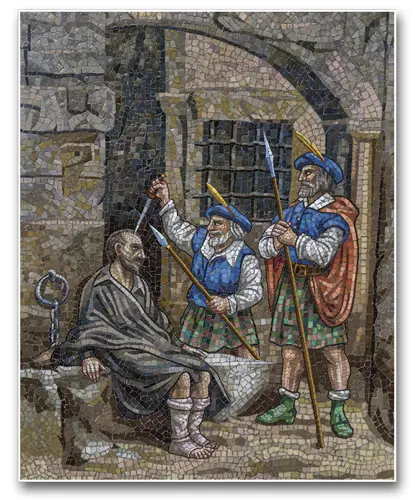
St. John Ogilvie in prison – Church of St Aloysius, Glasgow (Scotland)
As the doctors warned that the defendant could not endure such brutal agony for another three hours, they allowed him to rest for twenty-four hours. After that, the sessions multiplied without a verdict being declared, and – above all – without Fr. Ogilvie revealing any information.
Condemned to death
Finally, the King himself sent him a questionnaire about the relations between the Church and the State. Although he was aware of the consequences, Fr. John Ogilvie could not, however, deny his faith. He answered the sovereign’s delicate questions according to Catholic doctrine, which was equivalent to signing his own death sentence.
A final tribunal was established to judge Fr. Ogilvie for his answers to the royal questionnaire. The young priest could not and did not wish to exonerate himself from this accusation: if necessary, he would give his life in defence of the true Church and its divine rights.
The sentence was pronounced. John Ogilvie would go to the scaffold. With cynical subtlety, the tribunal took meticulous care to issue a verdict that did not appear to be based on religious convictions, but only on civil crimes: high treason and violation of the laws of the State. As usual, the wicked wished to conceal the true reasons for the condemnation in order to tarnish the glory of the faithful martyr with the mud of vulgarity.
But a man of Fr. Ogilvie’s moral stature could not die as a mere forger of documents…
Until martyrdom, doing damage to the wicked
By this time, the “Ogilvie affair” had already become known throughout Scotland. Realizing that the apostasy of the famous Jesuit would be more valuable to the Protestant cause than his heroic martyrdom, the enemies of the Church swooped down, like vultures, upon the condemned man in an attempt win him over.
March 10, 1615. While the convict is on the way to the scaffold a Protestant minister, by the name of Scott, simulating affection and compassion, tries to convince him to renounce the Catholic Faith and embrace heresy.
In a last display of astuteness, the Jesuit pretends to be pleased with the proposal and, feigning fear of death, replies hesitantly: “If it depended on me to die or not… but I can do nothing. I have been declared guilty of high treason, and therefore I will die.”3
Without realizing the holy ruse, the heretic replies: “Treason! Not at all! Abjure Papism and everything will be forgiven you; you will even be showered with favours.” And he reveals that he was sent by Spottiswood with orders to offer him the hand of the schismatic prelate’s daughter, along with a significant sum, if he would agree to become a Protestant.
At this point, both arrive at the scaffold. The Saint invites the messenger to repeat the proposal before the numerous witnesses. Upon hearing it, the Protestants exult, while the Catholics who are there to witness the martyrdom tremble in anguish at the prospect of such a scandalous apostasy.
Fr. Ogilvie then asks, as if apprehensive: “And in this case, can I not fear being persecuted as being guilty of high treason?”
“No!”, the crowd shouts. “My crime, therefore, is only my religion?” Judging that they were about to obtain the capitulation of the missionary, the mob led by Scott shouted: “Religion alone, and only religion!”
Fr. Ogilvie had achieved what he longed for. In a typically counter-revolutionary manoeuvre, he thus unmasked the real motive of the execution before History, and with it, the bloodthirsty malice of the agents of the pseudo-reform.
With dignity and contentment, the martyr proclaims: “Very well! This is more than I desired. I am condemned to death solely for my religion. For it I would give a hundred lives, if I had them. I only have one, take it; for you will never take my religion from me.”
Enraged at seeing himself so cleverly deceived, the Protestant minister ordered the executioner to carry out the sentence immediately. The latter tearfully begged the condemned man to pardon him for shedding his innocent blood.
In a final gesture of generosity, the missionary embraced the executioner and cast his belongings to the people. The priest’s rosary fell on the chest of a Calvinist youth. Years later, that young man would attribute his conversion to Catholicism to this episode.
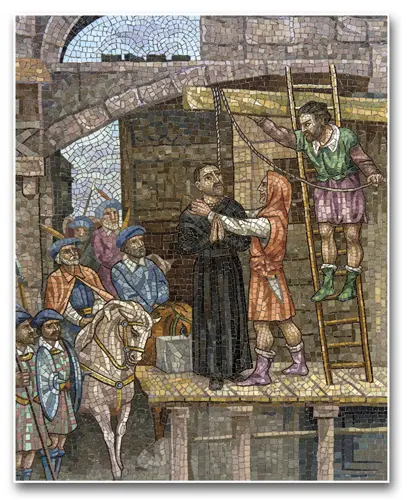
Execution of St. John Ogilvie – Church of St Aloysius, Glasgow (Scotland)
Finally, the priest was hanged. Scotland lost a missionary, andHeaven received a hero!
“Non prævalebunt”!
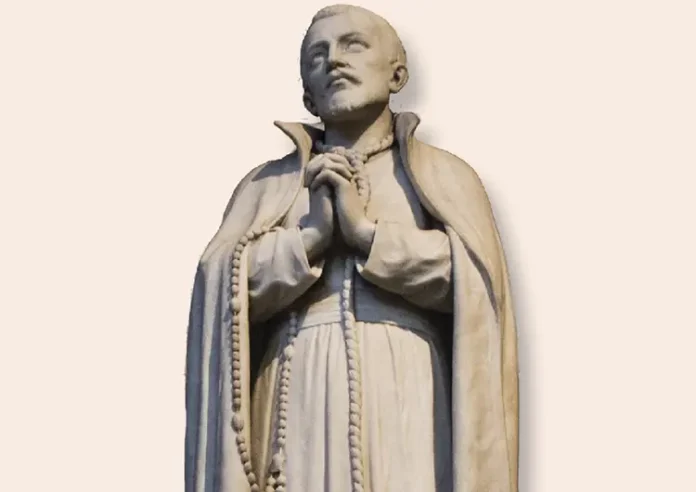
John Ogilvie was beatified on November 22, 1929, by Pius XI, and canonized on October 17, 1976, by Paul VI. He is commemorated in the Liturgy on March 10.
His death is undoubtedly one of the most compelling of the martyrdoms that took place in Great Britain between the 16th and 17th centuries. However, it is not the only one. Little is said about the horrific tortures to which many Catholics were subjected in the United Kingdom, starting with the schism of Henry VIII.
However, with each persecution it faces, the Holy Church will always engender new heights of sublimity and holiness, proudly proclaiming its immortality: “Non prævalebunt”! ◊
Notes
1 IRIBARREN, Jesús. San Juan de Ogilvie. In: ECHEVERRÍA, Lamberto de; LLORCA, SJ, Bernardino; REPETTO BETES, José Luis (Org.). Año Cristiano. Madrid: BAC, 2003, v.III, p.199.
2 BUTLER, Alban. Vidas de los Santos. Ciudad de México: Clute, 1965, v.I, p.522.
3 The following dialogue is taken from the work: MOLINARI, SJ, Paulo (Ed.). Santos e Beatos da Companhia de Jesus. Suplemento. Braga: Secretariado Nacional do Apostolado da Oração; Apostolado da Imprensa, 1974, p.215-217.