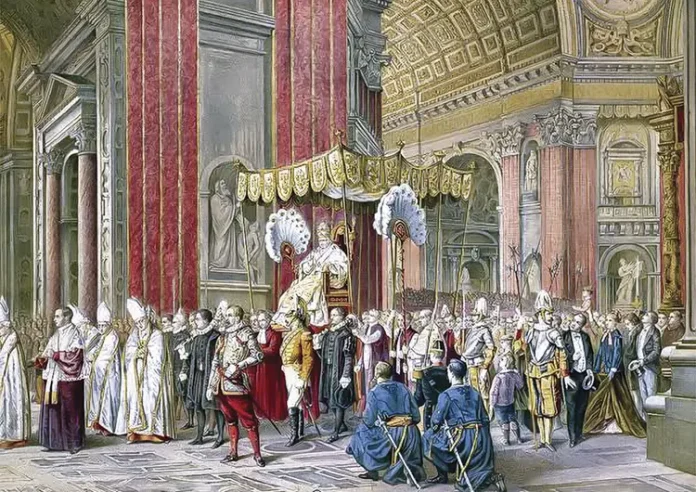
On a certain occasion, rummaging around in one of my grandmother’s1 drawers, I discovered something I had never noticed before in a bundle of old papers: a panoramic photograph depicting a papal procession.
It was part of a series of postcards, forming a full-colour brochure, showing St. Peter’s Basilica from the front to the back, Bernini’s2 columns around the altar, and the papal throne.
The photograph of the procession showed, in detail, the Cardinals, the various dignitaries, and the Swiss Guard, in a ceremony held in the Vatican. And, through some of those high windows of St. Peter’s Basilica, beams of light entered and illuminated parts of the procession. At the end came the Pope, carried on the gestatorial chair.
They were certainly souvenirs brought from Europe, on the trip my relatives and I had taken in 1912. Those postcards were kept for the children look at them at some time in the future, but no one had ever looked at them since. I remember being enchanted, enraptured by what I saw! It was truly a thrill!
Comparing those outward appearances with what I already knew from catechism and Sacred History, I thought: “How right this is! Much more: it is sublime! And, more than sublime, it is supremely sublime! I cannot find a word to express what I think about this!”
That is the first remembrance I have of myself contemplating the Papacy.
A boy with defined tastes
Thus, my mentality prepared me for the enthusiastic acceptance of one of the truths that the Church teaches, which touched me more than anything else: the doctrine of papal infallibility.
How was this mentality formed in me?
From an inborn trait: decisiveness. Intellectually speaking, and in relation to anything, my tastes in early childhood were always decisive. I was even surprised to see that many other children hesitated on various occasions, and I did not understand that they were still defining themselves, while I had already been born defined, like a minted coin.
For example, when it was time to go out to buy a toy, I remember that I already knew at home, a priori, what I was going to choose. Arriving at the store, I would do a little searching and say to the cashier:
“I want this!”
It was bought. The other children would wander around the whole store, fluttering about, hesitating, and sometimes a boy or a girl would call me and say:
“Plinio, come and see!”
I would see them agitated or nervous, and I would reflect: “Don’t they realize they’re wasting their time with all this trouble in choosing? I’ve already chosen beforehand and I’m all set.”
Reflection on the diversity of opinion among people
As I grew older, I began to realize that this uncertainty was felt in a thousand small and minute circumstances of life, and it wasn’t just about choices, but also about opinions.
I also noticed that the older people around me – whom I deeply respected – disagreed on numerous opinions. Each of them thought differently and they never fully agreed. So, I heard many discussions around me and noticed endless disagreement about countless subjects…
And I thought: “Here are reasonably intelligent and well-educated people who disagree with each other on almost everything. Now, where there is much disagreement, one of the parties is wrong. Therefore, if one side is always wrong, and there are many opposing theses, there must be many errors; and if there are many errors, there are numerous very wrong people! I see that the error is in their nature! Where will this end? And if everyone is wrong, what is the point of reasoning?”
In making these considerations, I sensed the idea of chaos and felt tremendous insecurity, overcome by the impression that, deep down, it was not worth thinking because, if in every ten ideas I had, at least one of them was wrong, it would be like someone who was walking and, every ten steps, fell once to the ground.
“So” – I asked myself – “is it worth walking? For what? To hurt myself along the way?”
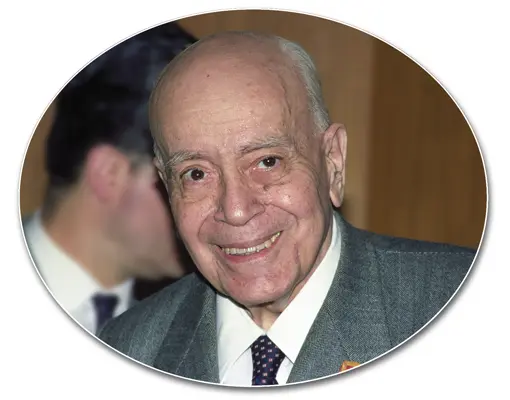
Dr. Plinio in 1989
And I thought: “I don’t know what kind of confidence I will be able to have in myself and my own reasoning when I’m a grown man. I already know beforehand, and I’m realizing that I’m going to be wrong on several points. Where could that lead me? On the other hand, what solution can be given to the world’s problems if everyone makes mistakes? Is this a world of madmen?”
Looking for a flawless person
And my thoughts continued: “It can’t be, because I see that in it there is something that is not crazy: the Roman Catholic Apostolic Church. But is it true that the Church doesn’t err? It’s made of men! Priests are like other people, children of parents who err or have erred! Like father, like son! And the son of people who have erred also errs! So, what is the compass that guides the world? The only solution would be for someone to have the power to command everyone else, who would have to conform to that person. However, it couldn’t be, for example, a man like me, because I see that I don’t have the stature, substance, or worth to make my personality the norm for others. It’s no use! If that man is like me, he will also end up making mistakes and will be like the blind leading other blind men. Will it all be nothing more than immense blindness? How to choose that man, then? I don’t know, I don’t know… Ah! If only I could rely on a man who didn’t err!”
I longed for someone to contemplate, a person whose elevation surpassed all heights. I knew that God, in the highest of Heavens, is exactly that, just like Our Lady, in the order of mere creatures.
But, for the order of the earth to imitate that of Heaven, it would be necessary that there also be someone like Them.
However, this was not in me such an explicit rationale nor such a conscious search as I am explaining. It was a matter of impressions, arising throughout a thousand episodes of daily life, which always returned to my mind and formed something like a stalactite and a stalagmite. The first was made up of recent events that came “drop by drop,” while the second was constituted by the remote memory of past facts.
And these impressions, fixing themselves in my spirit, always led me to the same conclusion, albeit implicit.
Explanation of papal infallibility
Later, when I was approaching adolescence, the solution to the problem appeared.
I believe that I had first heard about papal infallibility in catechism classes, during my preparation for First Communion, but I was very young and didn’t consider the subject in the context of the problems I was experiencing. Therefore, I didn’t have a clear understanding of the topic then.
However, as a student at St. Louis School3 and receiving methodical lessons in Religion, one fine day someone – I don’t remember who – explained to me that the Pope is infallible. It must be said that the Jesuits spoke a lot about the Pope and the devotion one should have to him.
I then learned about the Catholic doctrine of infallibility:I was told that the Pope teaches the truth and does not err, because he speaks in the name of Jesus Christ, and God assists him by virtue of a promise made by Our Lord Himself in admirable circumstances, at the most majestic moment of all when He instituted the Papacy.
Thus, whenever the Pope speaks, invoking the power of infallibility and declaring that he makes use of it, only the truth can come from those blessed lips.
Therefore, I understood that if I thought something and the Pope taught the opposite, he was the one who was right, not me.
One of life’s greatest delights
I remember thinking to myself: “There it is! It’s the formula, the solution! How right this is! This is how it should be!”
I cannot express the complete consonance I felt with this doctrine, nor can anyone imagine the well-being of my soul. It was for me a rapture, a flight! I felt something inside me like the pealing of bells, causing me an enormous, extraordinary, incalculable enthusiasm, beyond all limits. It was a marvel! It was a cry from my soul that no one can imagine! Columbus’ joy upon discovering America is nothing compared to what I felt when I discovered the dogma of infallibility. I felt inwardly illuminated by this joy, which marked an era in my history.
But why did my soul rejoice so much upon learning that Our Lord Jesus Christ gave the Church the charism of infallibility?
Because I understood that the path to truth was accessible to me, since there was an authority that guided me and protected me from my follies. I felt enormous relief and at the same time felt free, thinking: “I know I am a human being and I feel my own fallibility. I can err, and with my intelligence alone I cannot find my way. But this path is shown to me by an infallible guide, supported by God, and before whom I can place myself in the position of disciple and subject! I feel like a man who was walking among cliffs, afraid of falling, and suddenly someone told him: ‘Look closely: there is a handrail!’ Now I am at ease and I can contemplate the panorama. Now I can breathe easily!”
The stone in the ring and the eagle on the mountain

At that time, I had already won the battle against laziness and was carrying out my plan, which was to be innocent like Jacob and resilient like Esau (cf. Gen 25:27). And one of the results of the discovery of infallibility was that my natural definition, based on common sense and reasoning, was now supported by a retaining wall.
But I realize that, if Our Lady had not helped me to resolve to be pure and strong beforehand, and if I had not hated the revolutionary chaos that prevailed in so many environments, this definition would have been diluted.
In this way, through interior paths of nature and grace – those that Providence prepares for each person – a state of soul was defined within me that disposed me to receive this doctrine. Just as a ring can be set to have a precious stone placed in it, my mentality was prepared to receive the stone of stones, of inestimable value: the doctrine of papal infallibility.
Knowledge of this dogma rested upon an entire pre-existing psychological construction, like an eagle perching atop a mountain.
The key to all human order
From that moment on, the doctrine of infallibility became the reason for my joy and delight. It was the gladness of the faithful person who found the one in whom to place their loyalty, and without whom I would end up being an irremediably sad man, for I would have no one to guide my steps.
On the other hand, this doctrine became the great defence of my mentality and the lock through which all treasures opened for me. And I came to the following conclusion: “Even if I were not Catholic, but knew that there is a religion which maintains that its leader is infallible, for that reason alone I would consider that to be the true Church, the Religion of God!”
I understood that God, in creating a true Church, had to make it infallible, and that the key to all human order, as well as the straight line to reach Heaven, was in the Papacy, for without it, the earth would be madness, a den of confusion and horror.
How to avoid chaos in the world, if chaos is established in ideas? And how can there not be chaos in ideas if there is no government for them? And how is a government for ideas possible if it does not have divine guarantees of infallibility? Necessarily, God had to make someone infallible! The Pope is, therefore, the axis of world history.
It was then that I began to pay more attention to religious ceremonies, gestures, and attitudes.
I understood better that the priest was a representative of the Pope, which, for me, had an extraordinary meaning! I also began to understand more clearly the guidelines, the hierarchy, and the organization of the Catholic Church.
In the end, it was Our Lady who helped a boy – as with every Catholic – to have enthusiasm, veneration, affection, and obedience towards the supreme authority of the Holy Church, as well as every legitimate and Catholic authority, because it was like a shoot, a branch of the tree of the Church, which extends the trunk without breaking with it.
“The foundation of my firmness”
Thank God, I am a man who possesses much conviction and certainty in what I think, but, in reality, this is because I believe in papal infallibility, the foundation of my firmness. Without this belief, my certainties and my common sense would soften, and I would be less than nothing!
Even at my age,4 in everything I affirm, my essential concern is: “What would the Holy See think? Are there documents from the Popes confirming this or that?” And I know that, if I rely on the infallible doctrine of Christ’s representatives on earth, I can move forward without danger, because I will not err!
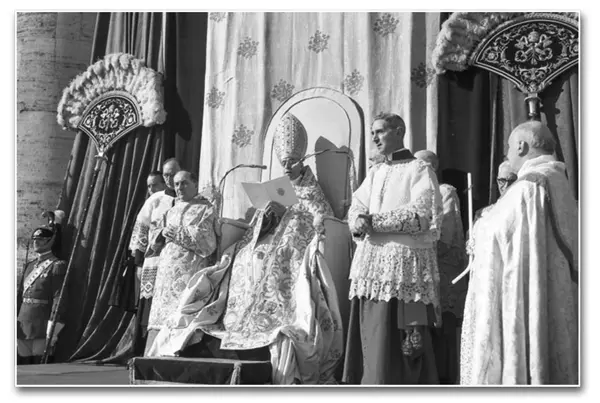
Proclamation of the dogma of the Assumption of Mary, on November 1, 1950
And if the Pope, using the power of the keys, affirmed as true that which would seem contrary to my most evident convictions, I would arise and applaud at length. When the moment of my death comes, I want to be convinced of this more than ever in my life.
When pronouncing the august word “Pope,” I seem to hear, from the depths of the ages, the divine voice of Our Lord Jesus Christ proclaiming: “Peter, you are the rock, and on this rock I will build my Church, and the gates of hell will not prevail against it” (cf. Mt 16:18).
There is nothing in the world that is worth as much as the man to whom God made this promise. ◊
Taken, with minor adaptations, from:
Notas Autobiográficas [Autobiographical Notes].
São Paulo:Retornarei, 2012, v.III, p.237-248
Notes
1 Gabriela Ribeiro dos Santos, Dr. Plinio’s maternal grandmother.
2 Dr. Plinio is referring to the baldachin above the Altar of the Confession, a work by Gian Lorenzo Bernini, Italian architect and sculptor.
3 School run by Jesuit priests that opened in São Paulo in 1918 and was located on Paulista Avenue.
4 This citation is from August 1994. Dr. Plinio was then eighty-five years old.