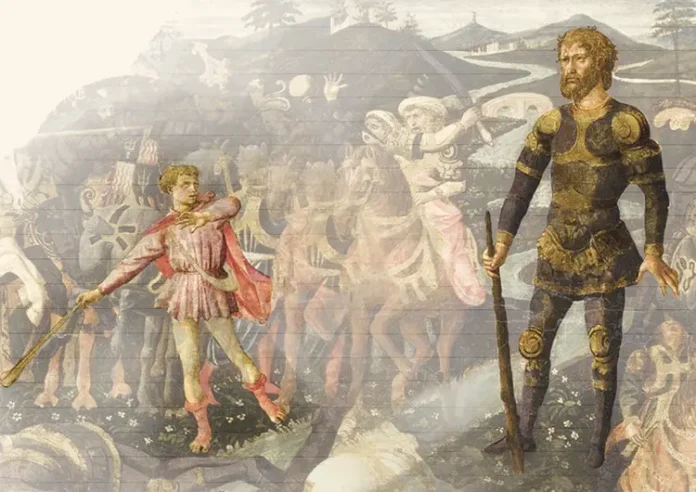
The sacred pages contain paradigms for all of history. One of them – and one of the most eloquent – is the duel between a young man who was “ruddy, and had beautiful eyes, and was handsome” (1 Sam 16:12) and a brutal giant from Philistia (cf. 1 Sam 17).
David had been chosen by God to replace the unfaithful Saul as king of Israel. Since the prophet Samuel had anointed the son of Jesse, the spirit of the Lord had already taken hold of him (cf. 1 Sam 16:13). However, it was necessary for him to gradually gain renown among the people so that, at a certain moment, he would be recognised as monarch. The context for this to occur was not long in coming: the Philistines, seeking revenge for the defeat Saul had inflicted on them, launched a violent counteroffensive.
Audacity, fruit of reason
David served as harpist to the king when the evil spirit took hold, and only the melodies of the shepherd from Bethlehem could relieve him (cf. 1 Sam 16:14-23). Thus began his life at court.
When mobilization for war against the Philistines began, his three older brothers enlisted, and he, the youngest of the family, remained at his father’s house to tend the flock.
At one point, David was sent by his father to take provisions to his combatant brothers and to obtain news of them. The situation the youth encountered at the camp was most discouraging.
The Philistine and Israelite troops came face to face in the Valley of Elah. Initially, the adversaries presented their best warrior, who proposed a duel with any fighter of the Hebrew army: “give me a man, that we may fight together” (1 Sam 17:10). It was Goliath, a huge man, almost three metres tall. He was clad in armour weighing approximately sixty kilograms and a bronze helmet, and carried a large spear with an iron tip weighing more than seven kilograms!…
Terrified by this giant, the Hebrews cowered, afraid to face him. Who could stand up to this indomitable warrior? The dilemma continued for forty long days, with no solution…
David arrived at the camp as Goliath repeated his challenge, as he had done on previous days. Upon hearing such arrogant words, he was filled with indignation and began to walk among the ranks of soldiers, asking, “What shall be done for the man who kills this Philistine, and takes away the reproach from Israel?” Anyone who thinks that the young son of Jesse was motivated by ambition is mistaken; one need only continue reading to dispel this misconception: “For who is this uncircumcised Philistine, that he should defy the armies of the living God?” (1 Sam 17:26). His boldness was the product of reason, not emotion. He simply pondered everything before offering to fight the giant!
His stance impressed everyone, especially the king, who, after some hesitation, authorized him to undertake the task. In fact, “Saul did not recognize in him the shepherd from Bethlehem, the skilled musician who had calmed his fury not long before. He had become stronger, his face more manly.”1
David’s weapons
The young warrior was clad in Saul’s armour, the royal sword, a bronze helmet and a breastplate. However, he was not accustomed to such equipment, so much so that he could not even walk! He therefore rejected them immediately. With incredible simplicity, he took his staff, his satchel and his sling, chose five smooth stones and advanced courageously against Goliath.
The practical significance of the stones is that, being smooth, when thrown they do not deviate, as irregular ones do, but rather hit their target accurately. They represent the five wounds of Our Lord Jesus Christ: taking refuge in them and through their merits, there is no evil that we cannot overcome.
The weapons of war, translated into our spiritual life, can represent the great means that the world uses to triumph: prestige, money, oppression, lies… Considering the strength of the enemy, our body trembles, our heart is distressed, fear takes hold of us completely. However, if we take refuge in the Lord God of hosts, fear gives way to the certainty of victory. Thus, the hero of the Most High used the “weapons” of the humble: the stone and the sling, symbols of prayer and trust in the King of Heaven.
Invincibility or camouflaged cowardice?
But if we pay close attention, we will see that beneath the arrogance of the adversary lies a shameful weakness.
Does it not seem strange to the reader that the entire Philistine army hides behind a single man, who stood out for his unusual stature and, moreover, was protected by armour, a shield, and a shield-bearer?… Was Goliath really that strong? Was his invincibility real? Or was it all just a farce? Perhaps all that display of strength was covering up great cowardice!
This is the stratagem of the world: to use pompous and flashy means to boast, when in reality it has nothing, because it does not have the help of the Almighty. Only those who have God are truly strong and valiant. St. Augustine rightly states: “The world wages a double battle against the soldiers of Christ: it flatters them to seduce them, and it terrorizes them to break their resistance”; however, “even if it presses, it will not oppress, and even if it attacks, it will not prevail.”2
If David achieved such a brilliant victory, what wonders will the sons of light accomplish with the merits of the Passion and Mary’s intercession?
We all know the end of the biblical account: David took a stone from his satchel and slung it, striking Goliath on the forehead.
“The same blow that took the life of this proud Philistine instilled such terror in the hearts of all the others that, not daring to try their luck in battle after seeing the one in whom they had placed all their trust fall before their very eyes, they decided to flee.”3
A lesson for the new “Davids”
In closing these considerations, it is worth pondering, or rather, questioning our own faith: if David, who was an ancestor of Our Lord and therefore did not yet live under the regime of grace, was crowned with such a brilliant victory, what epic feats can the children of light accomplish today, strengthened by the merits of the Most Precious Blood of the Saviour and the intercession of our Queen, Mary Most Holy?
May these verses from Sacred Scripture serve as an encouragement to each of us, so that we may not rely on natural strength or be frightened by the threats of evil. Let us rather base our hope on the Almighty, and we will be invincible, as God Himself is invincible! ◊
Notes
1 BERTHE, Augustin. Relatos bíblicos. Porto: Civilização, 2005, p.259.
2 ST. AUGUSTINE. Sermo 276, n.1-2. In: Obras Completas. Madrid: BAC, 1984, v.XXV, p.21.
3 JOSEPHUS, Flavius. História dos Hebreus. São Paulo: Editora das Américas, 1956, v.II, p.221.