November 2 – The Commemoration of All the Faithful Departed
The Church can be compared to a magnificent palace with three interconnected levels.
On the highest level is the Church Triumphant, in which the saints – those who did violence to Heaven (cf. Mt 11:12), entered “by the narrow door” (Lk 13:24) and heard the sweet call: “enter into the joy of your Master” (Mt 25:21) – share the blessed company of Jesus Christ, Mary Most Holy and the Angels.
On the ground floor of the palace, the Church Militant fights, as Job said: “Militia est vita hominis super terram – The life of man upon earth is a warfare” (Jb 7:1). The heroes of this permanent combat configure themselves to Christ and will be admitted into the society of the Angels and saints in Heaven.
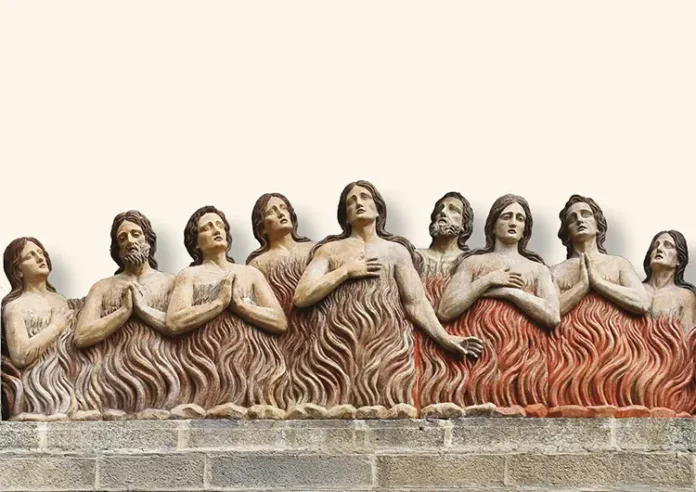
The less “diligent” ones, who just “passed”, and did not fulfil the mandate to be perfect (cf. Mt 5:48), constitute the Church Suffering. They are in Purgatory, which they will not leave until they have paid “the last penny” (Mt 5:26).
It is for this reason that the Church established the Commemoration of all the Faithful Departed on November 2, a celebration instituted by St. Odilo of Cluny in 998, with the intention of praying in a special way for the deceased who still suffer in Purgatory, to thus alleviate their suffering.
Through the sacrosanct means of the Communion of Saints, the blessed communicate with the faithful of the Church Militant and with those still being purified in Purgatory. In the same way, the faithful on earth can communicate with the saints in Heaven, beseeching their help in the struggles of this world, and with the members of the Church Suffering, asking them for small favours and offering prayers and suffrages to shorten their sufferings.
The first penitentiary in Brazil was called the Court House of Correction. Its threefold purpose was to punish offenders, correct them, and reintegrate them into society. Now, if life in earthly society has its laws, all the more so, in the eternal dwellings, is “nothing unclean” (Rv 21:27) permitted. When the likeness to Christ, which is the first requirement for life in Heaven, is not achieved in this life, it must be completed in the “house of correction” of the heavenly court, where a purifying fire cleanses souls of false human criteria.
After death, the soul contrasts its miseries with the infinite perfection of Christ, and the splendour of His beauty communicates to it the desire to be purified in the restorative flames of Purgatory. There, certain of its salvation, it finds peace, knowing that it is “in God’s grace and friendship.”1
Meditate, then, on your last things (cf. Sir 7:40), so that the day when you go to God may be a day of celebration and joy, not of weeping and lamentation. ◊
Notes
1 CCC 1030.