


Catechism of the Catholic Church
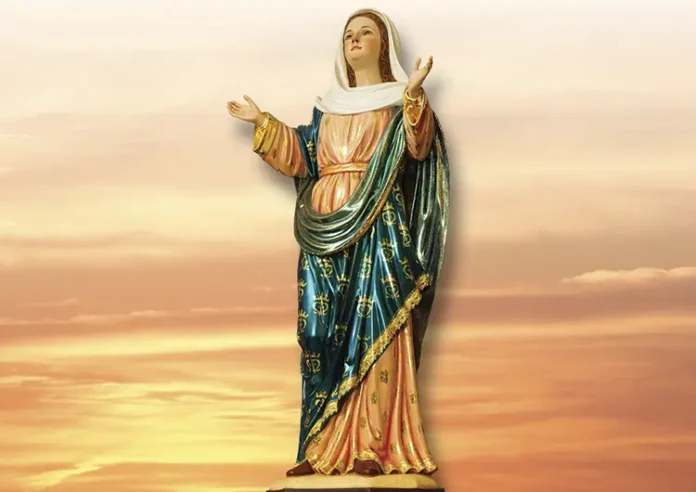
§149 Throughout her life and until her last ordeal when Jesus her Son died on the Cross, Mary’s faith never wavered. She never ceased to believe in the fulfilment of God’s word. And so the Church venerates in Mary the purest realization of faith.
One of the most beautiful and symbolic moments of Holy Saturday occurs while, in darkness and silence, the faithful await the beginning of the celebration. The lights that usually illuminate the temple seem to have succumbed, overcome by dense shadows. A single light remains undefeated: the embers of the holy fire. Soon, the ceremony will begin and the Paschal Candle will be lit, transmitting the lumen Christi to the entire church.
If the symbolism of this fire that conquers darkness is beautiful, how much more so is that of another “fire” it represents!
We read in the Holy Gospels that, while Jesus was on the Cross, from the sixth hour until the ninth hour, the whole earth was covered in darkness (cf. Mt 27:45). This is physical darkness, no doubt, but even more so spiritual, for the light of faith fades in the hearts of the disciples and the Holy Women. However, as Dr. Plinio reflects, “there is one lamp which does not go out, or even flicker, and which burns fully alone in this universal darkness. It is Our Lady, in whose soul faith shines as intensely as ever. She believes. She believes entirely, without reservations or restrictions. Everything seems to have failed. But She knows that nothing has failed. In peace, She awaits the Resurrection. Our Lady summed up and epitomized the Holy Church in those days of such widespread desertion.”1
What was Mary’s faith like? We can affirm, with St. Louis Grignion de Montfort, that it was greater than “the faith of all the patriarchs, prophets, Apostles and all the saints.”2 Therefore, it is the greatest faith that has ever existed in history. How can this be explained?
Faith is a supernatural infused virtue, by which we firmly assent to revealed truths, supported by the authority or testimony of God. Now, Christ Our Lord, being the Second Person of the Holy Trinity and His Soul being in the beatific vision, even in His human nature already saw these truths revealed in His own divine essence and, therefore, did not and could not have faith. It is in this sense that the Blessed Virgin constitutes the highest and most sublime model of faith that has ever existed.3
Mary’s faith was subjected to a triple test: that of the invisible, that of the incomprehensible, and that of contrary appearances. And She overcame them in a truly heroic manner, for “She saw her Son in the stable in Bethlehem and believed that He was the Creator of the world. She saw Him flee from Herod and did not cease to believe that He was the King of kings. She saw Him born in time and believed that He was eternal. […] She saw Him, finally, mistreated and crucified, dying on the most ignominious scaffold, and She always believed in His divinity.”4
Indeed, there has never been and never will be on earth a faith like Mary’s! ◊
Notes
1 CORRÊA DE OLIVEIRA, Plinio. Via-Sacra. XIV Estação. In: Legionário. São Paulo. Ano XVI. N.558 (18 abr., 1943), p.5.
2 ST. LOUIS-MARIE GRIGNION DE MONTFORT. Traité de la vraie dévotion à la Sainte Vierge, n.214.
3 Cf. ROYO MARÍN, OP, Antonio. La Virgen María. Madrid: BAC, 1996, p.274.
4 ROSCHINI, OSM, Gabriel. Instruções marianas. São Paulo: Paulinas: 1960, p.162.


