“Believe in yourself”: self-confidence is one of the top-selling values of today – and at a high price.
Now, the laws of supply and demand lead us to conclude that if there are sales, there is interest in the item, and if there is interest, there is possibly a need for it. No one cares about their car’s air conditioning unless it stops working. Therefore, this philosopher’s stone called security and inner peace may be being sought after on account of its having become more difficult to find. Has it deserted our world?
* * *
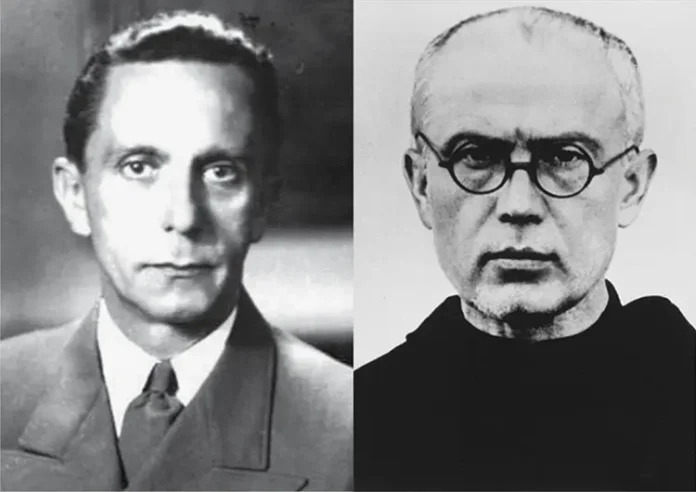
In the photos illustrating these pages, we have, on one side, Joseph Goebbels, Nazi propaganda minister who, until his death by suicide in 1945, was Hitler’s closest collaborator.
His passion was writing. However, his failures in this field made him the ideal person to harmonize with the Führer, a man who had also suffered setbacks, as in his youth he had wanted to devote himself to the visual arts, but without success. His biographers note that the meeting between the two was that of a frustrated writer and a failed painter, both choosing world domination as their second career option.
Fate has its ironies, and so does human pride…
Goebbels became a staunch Nazi. Married to a great admirer of Hitler and father of six children, he had a family that, at first glance, was the perfect Aryan model. Dominated by him, cinema, radio and the press exposed his life to the admiration of the entire Reich: at work, on holiday, at home, or being visited by Uncle Adolf.

However, behind appearances, the giant of Nazi propaganda was nothing more than a dwarf in the kingdom of pygmies. And this is not just a reference to Goebbels’ proverbial short stature, which made even Hitler look like a big man – not a great man, which is much more difficult – but above all to the fact that the brilliant country of Germany grew so much under Nazism that it imploded: from a supernova, it turned into a black hole, reducing to nothing anything that came near it, including life.
Recalling all this deception, we ask ourselves: how can this be explained?
In Revolution and Counter-Revolution, Dr. Plinio denounces the revolutionary maxim he describes as the “immaculate conception of the individual.”1
As André Frossard2 observed, after original sin was abolished by philosophical decree, starting with Rousseau, it was decided that man is born good. We should not distrust ourselves; on the contrary, we must seek the drive to surpass ourselves within ourselves. Now, when man seeks within himself what he lacks – which is a contradictory situation – and does not find it, what happens? Goebbels.
Made into an actor for the interests of the state – or, rather, in the interests of what Dr. Plinio also denounced as the “immaculate conception of the masses and the State,”3 the same that would lead Germany to the above-mentioned suicide – he was nevertheless unable to hide his own insecurity, betrayed by his rigid gestures, vacant gaze, and broad smile on lips of vague contours. All this indicates the frustration of a man who adhered to “believe in yourself”, a proposition far more seductive than the Greek axiom: “know yourself”.
Now, “humility is walking in truth,”4 says St. Teresa, adding: the truth is that we are misery and nothing. Every man goes through moments when the mask of the “immaculate conception of the individual” falls away, revealing what he really is. At such times, there are two paths: either to try to put it on again at all costs, even by a shot to the head, as Goebbels more or less did; or to follow the example of St. Maximilian Maria Kolbe.
This Franciscan religious also devoted himself to the mass media. He was able to extend his sphere of influence even to Japan, where, without initially speaking a word of the national language, he managed to produce publications that, together, exceeded a circulation of one million copies – and this in a country alien to the Catholic faith, to say the least.
However, the formula for his success was not based on marketing techniques, but rather on one principle: “Do not write anything that the Virgin Mary would not sign.”5A man of delicate conscience, vigilant against his evil inclinations, he knew he was weak. Therefore, he relied on a deep devotion to Our Lady, whom he invoked especially under the title of the Immaculate Conception.
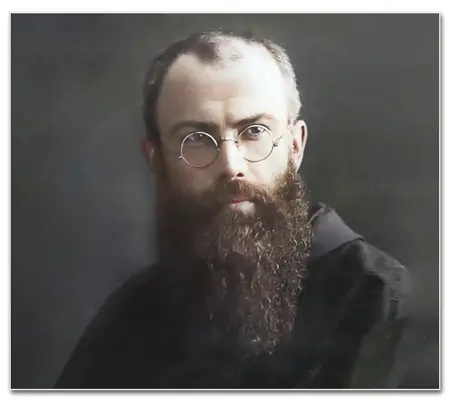
Kolbe also experienced failures. On several occasions, he was seen sad and anxious; he sometimes wept in the face of setbacks. However, nothing prevented him from overcoming obstacles, because he fought in the shadow of the Immaculate. He saw “the Virgin Mary everywhere and, consequently, difficulties nowhere.”6 One need only contemplate his gaze to be convinced of this.
* * *
Both characters died because of Nazism and had their bodies cremated, as if to confirm the biblical verse that “there is one fate for the righteous and the wicked” (Eccl 9:2). In the afterlife, however, Kolbe was welcomed into the arms of the One in whom he had placed his trust. Goebbels, on the other hand, could not save himself.
Therefore, “immaculate conception versus Immaculate Conception” is not an empty play on words, but a synthesis of two life programmes, deeply antagonistic in their starting point, their means and, above all, their respective eternal destinations. ◊
Notes
1 CORRÊA DE OLIVEIRA, Plinio. Revolução e Contra-Revolução. 9.ed. São Paulo: Arautos do Evangelho, 2024, p.130.
2 Cf. FROSSARD, André. Excusez-mois d’être Français. Paris: Fayard, 1992, p.41.
3 CORRÊA DE OLIVEIRA, op. cit., p.131.
4 ST. TERESA OF AVILA. Moradas del castillo interior. Moradas sextas, c.10, n.8.
5 FROSSARD, André. N’oubliez pas l’amour. La passion de Maximilien Kolbe. Paris: Robert Laffont, 1987, p.93.
6 Idem, p.52.