

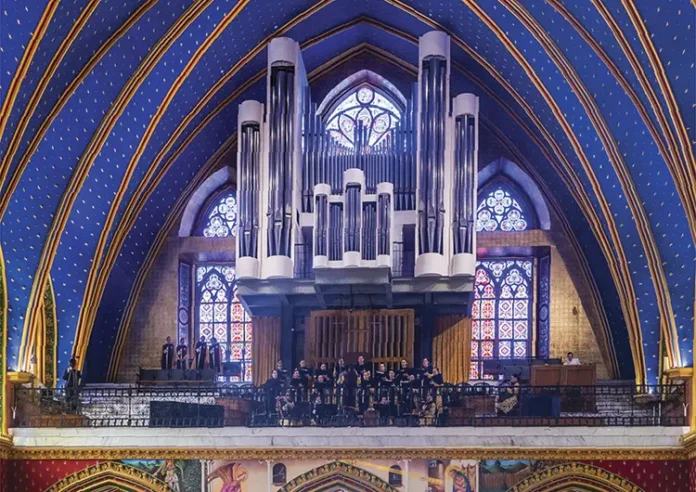
Anyone wishing to visit the Basilica of Our Lady of the Rosary in the municipality of Caieiras, in São Paulo, Brazil, enters the gates that lead to the Thabor Formation House of the Heralds of the Gospel. They encounter a beautiful statue of Our Lady of Zion on a column and climb an inviting ramp, to the right, lined with trees.
After being greeted by the courteous gatekeepers, the visitor feels overcome by curiosity about what they will find beyond the path ahead, in the fresh air and cool shade of the appealing Atlantic forest – their first host, since no one else has yet appeared. As they ascend, they gradually become aware of the pulsating life of a community they do not quite know how to define: monastery, barracks, castle, cathedral – or all of the above, for here there is an air of all this.
As they step out of the vehicle, they can already sense something, through what they hear… Soothing chords coming from Heaven? Melodic breezes? The distant rumble of thunder? Angelic whispers? Our visitor, an attentive listener, cannot decide and wonders: what could it be?
Arriving at the esplanade in front of the basilica, he notices a vitality that is simultaneously recollected, prayerful, and effervescent. There he meets the Herald appointed to show the newcomers the various areas and tell them the story of the church. He climbs the steps of a fer-à-cheval staircase and enters the atrium. Forms, colours, proportions, and details, lights and shadows, voices and sounds form a whole made up of beauty, of spiritual and material realities, of something that human language cannot translate, but which the heart comprehends! …
Beauties that speak to us of the Creator
God created human beings with an innate thirst for the infinite so that we would seek Him incessantly from the dawn of our existence, for He destined us for eternal happiness with Him, and here on earth we are expatriates, awaiting future glory in Heaven, as the Hail Holy Queen suggests: “After this exile, show unto us the blessed fruit of thy womb, Jesus.”
Now, in His infinite goodness, the Lord has given us certain “samples” of Paradise in this valley of tears, which give us a foretaste of what we were created for. This is the reason for the natural beauty we contemplate in minerals, flora, and fauna, as well as in the marvellous works of art created by human genius, such as churches, castles, paintings, sculptures, and so many other wonders, which, elaborated according to the right order established by the Creator, speak to us of Him, the Source of all gifts, who gave humanity the ability to produce on earth tangible reflections of His perfection.
In the world of art, we highlight in this article one form that is at the special service of the Liturgy: sacred music. And within it, we will consider, in particular, the role of the organ.
An orchestra of orchestras
Coming in a wide variety of shapes and sizes, this instrument can produce sounds that are at times powerful and full-bodied, at other times delicate and simple, at others profound and spiritual.
For both listeners and the organist, it holds a mystery: for the former, there is the enigma of what sounds will follow the soft Gedeckt 8’, or when the thunderous Clarion 4’ will fade, giving way to a Harmonic Flute 4’, and so on.1 For the latter, there is always the suspense and expectation of how the instrument will respond to the inspirations and demands of his creativity. Being a wind instrument, it gives the impression that the sound, as it is emitted, is absorbed by something immaterial that will or will not produce the desired acoustic result, to touch souls according to what the Liturgy calls for at the moment.2
It is as if Angels, inspirers of the recollection, the intonation of the voices, and the imponderables of the ambience, assume the sound waves and, through them, make souls more sensitive to the mysterious voice of grace that murmurs in the depths of their hearts words of sweetness, peace, and confidence in God.3
This is one of the most moving effects produced by the nearly limitless diversity of timbres provided by a sizeable organ, such as the one in the aforementioned Basilica of Our Lady of the Rosary. Playing it is like holding in your hands an orchestra of orchestras; a stained-glass window of sounds; a diamond capable of reflecting every colour, luminosity, and scintillation.

A glimpse at the internal mechanism of the organ
Our visitor, if they have never had the opportunity to closely examine a pipe organ, might wonder: what causes this kaleidoscope of such diverse sounds?
As incredible as it may seem to today’s mindset, dominated by the idea that everything is the result of digital technologies, such a variety of sounds is produced mechanically. It is a complex but efficient system of keyboards, levers, springs, bellows, and other parts that move air toward pipes of various sizes and shapes, from which the sounds proper to the instrument emerge.
In general, the organ includes the family of flutes, strings, reeds, and diapasons – which are, strictly speaking, organ stops, as they do not seek to imitate other instruments – as well as other variations that further enrich the ample range of timbres. The number of keyboards, called manuals, can vary from one to six. Having more than one facilitates the mutation of sounds and volume, as each has its own specific registers.4
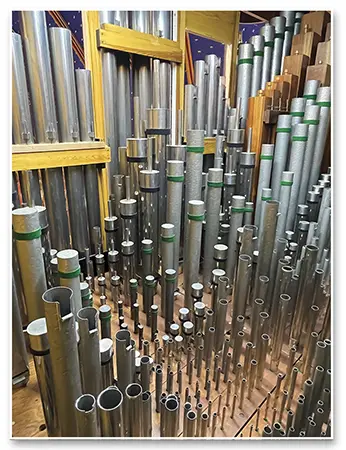
The first of our organ’s three manuals, called the Positiv, features a timbre more accessible to the public in the basilica, and it is with this manual that we accompany the hymns of the faithful. The second manual, also called the Great Organ, features the most powerful stops, such as the 16’ 8’ Trumpets, the 5f Mixture, and the 16’ Bourdon, among others. Finally, we have the Swell, the third manual, used to accompany the voices of soloists or to play soft solos.
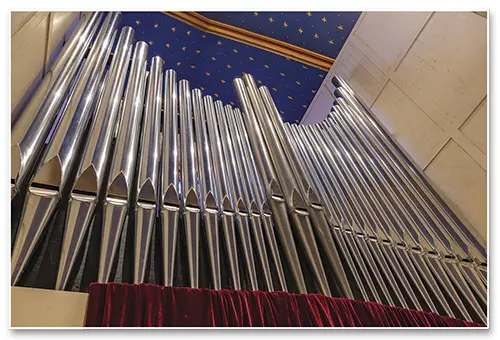
The numbers on the stops indicate the measurements in feet of the various pipes, with the lowest, at 32’, reaching up to twelve metres, and the highest, at 1’, measuring approximately six millimetres.
The Catholic instrument par excellence
Registration or combination of the various stops is a complex art that every organist must master, as the successful performance of the pieces depends on it. Each composition, whether from the Medieval, Renaissance, Baroque, or Romantic periods, has its own special characteristics and requires the appropriate timbres.5 Furthermore, the choice of stops takes into account the difference between a solo performance, a strictly instrumental piece, or one accompanied by voices.
In short, the organ is a great instrument, whose main function is to assist the faithful in prayer, emphasizing the prevailing state of recollection and providing souls with a better disposition to receive the graces that God, the infinitely generous Father, bestows upon all who place themselves under the shelter of the one whom He gave us as our immaculate and indefectible Mother: the Holy Church.
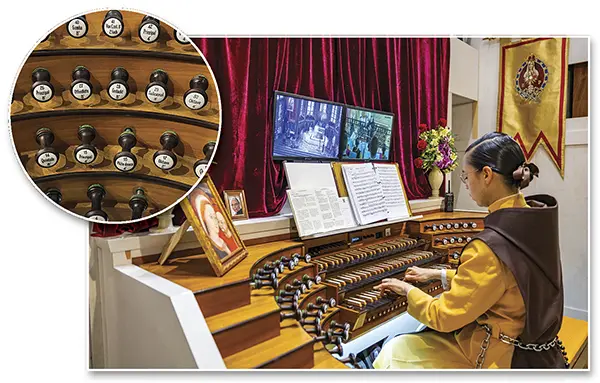
The author playing the organ on its inauguration day, September 21, 2024; inset, detail of the stops
Come visit us!
What we have seen so far has been an attempt to explain the mysterious sounds our visitor with a refined ear has experienced.
However, more than listening to beautiful melodies, delighting in the spectacle of shapes and colours, or appreciating any other form of material beauty, he will profit by using these gifts to grow in faith and love for God, as one who is not satisfied with simply having pleasant impressions, but makes firm resolutions that bring him closer to the truth. Otherwise, he may fall into the same error as the Romans, accused by St. Paul of not elevating themselves to the Lord through creatures (cf. Rom 1:18-21).
Finally, dear reader, we conclude these lines by extending our warm invitation also to you: come and allow the melodies of adoration of the organ and the splendour of the Basilica of Our Lady of the Rosary to touch your heart and thus strengthen the bonds that unite you to the Heavenly Father. ◊
Notes
1 The Gedeckt 8’ register imitates the sound of a wooden flute; the Clarion 4’, the sound of a bugle; the Harmonic flute 4’, the sound of a higher-pitched recorder.
2 Far beyond technique or a simple complement, the role of the organist in the performance of any musical piece is extremely important, as he must not only accompany its unfolding, but also support the tuning of the singers and the correct interpretation of the speed and style desired by the composer, especially when dealing with sacred music, in which the imponderables of the melody must accompany the sublimity of the mysteries celebrated (cf. FETIS, François-Joseph. Treatise on Accompaniment from Score on the Organ or Pianoforte. London: William Reeves, [s.d.], p.32-36).
3 Cf. SAINT-LAURENT, Thomas de. O livro da confiança. São Paulo: Retornarei, 2019, p.13.
4 Cf. BEDOS DE CELLES, OSB, François. L’art du facteur d’orgues. Paris: Saillant & Nyon, 1766, p.2-142.
5 Cf. FETIS, op. cit., p.35-36.


