As the year 1793 dawned, France seemed a nation doomed to disappearance. Everything that had been stable in thirteen centuries of Christian monarchy was disintegrating or being destroyed: the king had been beheaded; the royal family was imprisoned; the nobility had emigrated; the clergy was divided between the persecuted and the schismatics; the bourgeoisie was convulsed by revolutionary miasmas; Paris had become the centre of the revolt.
The solution would come from the only power capable of stirring providential forces in the humblest and most unsuspected recesses of society, at times when the elites decline. It was the same power that, centuries before, had made a shepherdess named Joan of Arc the saviour of the “firstborn daughter of the Church”.
As a certain author observes,1 there are episodes in the annals of France that constitute echoes of Sacred History. And in this sense, it can be said that it was up to the Vendée counter-revolution to repeat the words of David when fighting the giant Goliath: “and that all this assembly may know that the Lord saves not with sword and spear; for the battle is the Lords and He will give you into our hand” (1 Sam 17:47).
In the midst of the French Revolution, a great duel would begin between Christianity and the Revolution,2 which would be the parable of the supreme battle between light and darkness.
The beginnings of a religious war
On August 24, 1790, the Civil Constitution of the Clergy was sanctioned, the cornerstone of a modern, state-run “church”, separate from the Roman See. Months later, the clergy was summoned to sign it, under penalty of exile or, if they remained in the country, death. The protagonists of the Revolution dreamed that, with the shepherds wounded, the flock would scatter.
But this would not be the case in a region traversed less than a century earlier by St. Louis-Marie Grignion de Montfort, where the bonds between the Church and the faithful remained too strong to be dissolved by a mere republican mandate.
On January 21, 1793, Louis XVI was guillotined. This was not merely a regicide, but a true attack on the Catholic order of the Ancien régime. The news would fall like a thunderbolt on the population of western France.
Catholics arise
The Vendée is a large province situated between the Loire River and the Atlantic Ocean, framed in some places by dense forests, in others by swamps.
This region was the birthplace of men of determined will and great attachment to traditions, coupled with a deep faith and unwavering fidelity to the family.
For the Vendéans, the sadness over the execution of the sovereign would soon turn into hatred, as the Convention – the revolutionary government of the time – determined the recruitment of three hundred thousand men to defend its borders. Thus, the Revolution no longer demanded only the resignation of the French in the face of its atrocities, but that they take an active part in its initiatives. Needless to say, those rough peasants would not submit so easily…
March 12, Saint-Florent-le-Vieil. Some peasants become agitated when refusing to enlist. The Blues – as the republicans were known – bring a cannon to persuade them, but the young men throw themselves into the fray and end up capturing the artillery piece. This marks the beginning of a conflict that will spread almost simultaneously across various regions, threatening the revolutionary power.
There will, it is true, be other counter-revolutionary uprisings, such as that of the Chouannerie in Brittany, the revolts in Lyon, Toulon, and Marseille, and some scattered skirmishes with monarchists. But the Vendée insurrection will be the only movement to constitute an actual military corps in opposition to the Republic: the Grande Armée Catholique et Royale – the Great Catholic and Royal Army.
Mostly farmers and artisans, the early combatants will choose as leaders men from their area, endowed with a charisma that will draw crowds: Cathelineau, a simple vendor, unanimously appreciated for his religious fervour and his unparalleled leadership qualities, and Stofflet, a former gamekeeper who will perform unprecedented military feats.
And the nobles? At first, they will not act. Those who had not emigrated remained aloof in their domains, waiting for the storm to end. Eventually, some would accept command, given the insistence of the peasants. “It is up to the nobles to guide us,” Cathelineau summarized, “we are brave like them, but they understand the art of war better.” This is why the insurgents would seek out qualified men like Charette, d’Elbée, Lescure, de La Rochejaquelein, and Bonchamps.
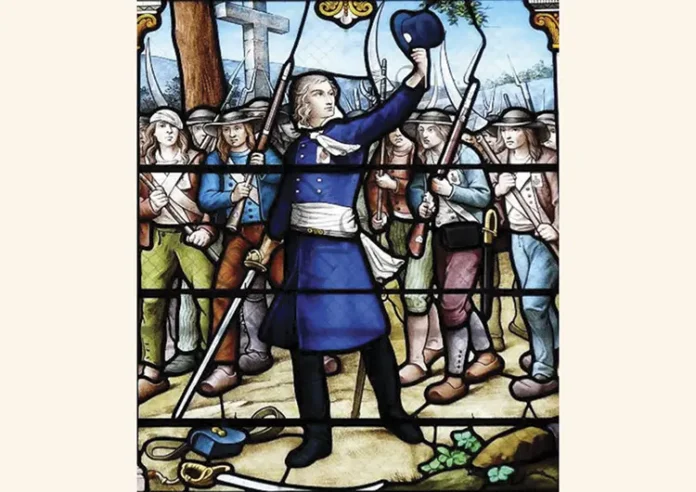
Thus, the Marquis de Bonchamps would make great soldiers out of his men. Lescure would command attacks in Haute-Poitou, while his cousin, Henri de La Rochejaquelein, would go down in history as one of the emblematic figures of the resistance, immortalized by his famous words: “If I advance, follow me; if I retreat, kill me; if I die, avenge me.” However, it is primarily to François Athanase Charette that the War in the Vendée will owe its most unexpected achievements and its most tragic chapters.
The roles reverse
In the first battles on open ground, the Vendéans still feared cannon fire: the shots were followed by a disorderly disbanding. Armed with sticks and pitchforks, those novice warriors seemed defenceless against the well-equipped ranks of the Republic. But, urged on by their leaders and even by their own wives, they quickly learned to fight with skill and flair: crouching at the sound of gunfire, they dodged the shots; then they advanced before the enemy could reload their artillery.
The roles then reversed, and the Blues began to retreat. The spoils were, of course, captured by the Vendéans, who then began to combat properly armed. More valuable than any plunder, however, was the mutual respect reigning among the Catholic ranks.
The Whites, that is, the Vendéans, began by attacking villages considered strongholds of the Republic.
Wearing their large rosaries and emblems of the Sacred Heart of Jesus, they conquered several cities in a few days. Every piece of open ground became a battlefield, every scythe a weapon, every gulley a trench.
In a veritable exodus, dozens of parishes rose up, uniting with the nearest commander. Entire families left their homes to head towards combat and the unknown.
And the heroic feats multiplied. Once, during a battle, a republican shouted: “Shoot the one with a red handkerchief!” Now, it was Henri de La Rochejaquelein who always distinguished himself by wearing one. The shots missed him, but, after the battle, the officers begged Henri to remove it, but the leader refused to comply. Faced with this predicament, the peasants decided to all adopt the same accessory, to prevent the enemy from singling out their commander.
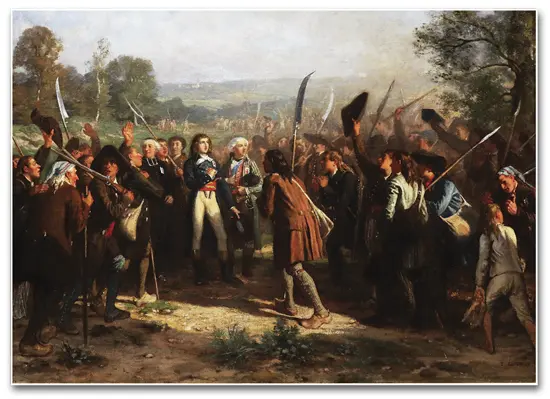
“Henri de la Rochejaquelein is proclaimed leader by the peasants of La Vendée,” by Eugène Gluck – Vendée History Museum, Lucs-sur-Boulohne (France)
From brilliant victories to a sad dispersion
The most brilliant opportunity the Great Army had to reverse the situation in France was the conquest of Saumur. On June 9th, the supposedly impregnable fortress fell to the counter-revolutionaries. The spoils were considerable: fifty cannons, fifteen thousand rifles, ten thousand prisoners. The way was clear for the capture of Paris and the consequent restoration of the throne.
But, unfortunately, the army scattered with each success. In order to harvest the crops, many returned to their fields, and thus, the dispersion prevented them from taking advantage of the privileged situation. To make matters worse, naiveté led them to release the prisoners, under an oath not to take up arms again.
This was an injudicious decision, for those who were spared, devoid of honour, became murderers at the first opportunity. In the words of General Westermann, “mercy is not revolutionary.”3
Furthermore, there was no coordinated action on the part of the commanders. To be precise, the Grand Army consisted of three divisions that usually operated individually.
Thus, the uprising lost the impact that unity would have provided.
On June 18, the Vendéans seized Angers. They proposed attacking the port of Nantes, which would allow them to unite with the counter-revolutionaries of Brittany, known as the Chouans. However, the results of the undertaking were disastrous. Cathelineau was wounded during the battle and, after two weeks of agony, gave his soul to God.
From this moment on, the struggle took on a new aspect: the opposing forces would alternate successes with the royalist warriors. Although the scales seemed to tip in favour of the Blues, at times the Whites miraculously recovered. There was still hope for them.
The ascent of Calvary
October 17th. While the inert body of Queen Marie Antoinette lay in the Madeleine Cemetery in the French capital, the decisive battle of Cholet was being fought.
Despite their numerical superiority, a mysterious panic gripped the Vendéans. The Marquis de Lescure fell, shot in the left eye, d’Elbée was seriously wounded, as was Bonchamps, whose last request was the release of the captives.
The defeat was on the verge of becoming a catastrophe.
Determined to abandon a land doomed to extermination, eighty thousand men crossed the Loire towards Brittany, awaiting English support at the port of Granville. After an odyssey as arduous as it was thankless, the survivors had to return; the episode went down in history as the Turn of the Galerna – the name given to the northwest wind, responsible for shipwrecks and storms.
With the army disbanded and almost all the combatants dead, the epic was drawing to a close. On December 23, the remaining survivors succumbed in the swamps of Savenay, hunted like beasts by the cruel General Westermann.
Only Charette would resist, with a handful of loyal followers, in a way embodying the glory of the Vendée. Two years later, on March 29, 1796, he would be captured and executed.
The Republic condemned to extermination the region from which its greatest nightmare had emerged. More than half a million men, women, and children perished in fires, drownings, massacres – in short, in the genocide decreed from 1794 onwards. The Whites went down in history, at least the history told by the revolutionaries, as disorganized and fanatical rebels who fought savagely for an unattainable ideal. A complete failure. Was it really so?
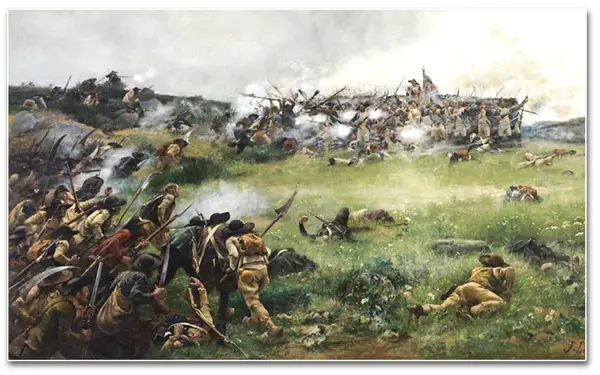
Battle of Fougères, by Julien Le Blant
Defeated?
Centuries of glory and loyalty of the Church’s firstborn nation rested on the shoulders of those humble peasants. On their banners shone the certainty of victory. For the first time, the Revolution found itself facing a power greater than its own.4
But, at a certain point, the inexplicable happened. And God seemed to abandon his own cause. Was it a punishment?
In reality, the Vendean uprising – like many other events – is not a story to be read with human eyes.
Sometimes, behind the greatest failures lie the most exalted glories. Great disappointments pay the price, before God, of unimaginable triumphs.
The Lord of Hosts had deigned to adorn the Vendée banner with the cross, converting that band of invincible warriors into a multitude of martyrs. The fidelity of the righteous was thus sealed, and it was up to divine justice to glorify His chosen ones when it pleased Him, in this life or the next.
There was a material defeat, it is true, but before God there was a triumph. For on this earth battles are lost and won without, however, deciding the outcome of the ultimate war.
In fact, the supreme battle between light and darkness, of which these events constituted a chapter full of sorrows and glory, has not yet ended.
It continues in our days, and will only be concluded when Our Lord Jesus Christ comes in glory and majesty to judge the living and the dead. ◊
Notes
1 Cf. CHARLES-ROUX, Jean. Passion et calvarie d’un enfant roi de France. In: ESCANDE, Renaud (Dir.). Le livre noir de la Révolution Française. Paris: Du Cerf, 2009, p.163.
2 The terms Revolution and Counter-Revolution, when capitalized and mentioned without reference to any specific historical event, are used in these pages in the sense given to them by Dr. Plinio Corrêa de Oliveira in his book Revolution and Counter-Revolution.
3 SECHER, Reynald. La Guerre de Vendée. Guerre civile, génocide, mémoricide. In: ESCANDE, op. cit., p.231.
4 Cf. DAWSON, Christopher. Os deuses da Revolução. São Paulo: É Realizações, 2018, p.131.