


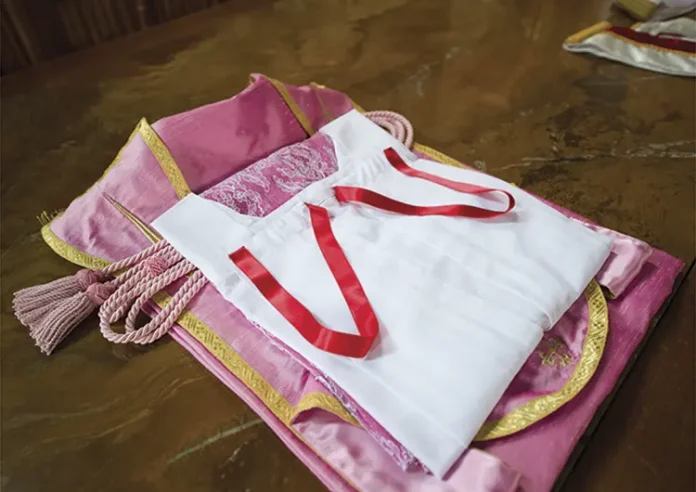
On the cold night of Christmas, Our Lady wrapped the Child Jesus in swaddling clothes with maternal tenderness. Similarly, over the centuries, Holy Mother Church has strived to clothe her sons and ministers who serve at the altar of the Lord with dignity.
However, could mere aesthetics be the only reason for using vestments in the Liturgy?
Aware of the contingency of human nature, which reaches supernatural realities through the senses (cf. Summa Theologiæ, III, q. 60, a. 4), the Church chose certain vestments for her priests so that, because of them, they might become deeply convinced of the greatness of their ministry. And St. Thomas offers us several examples in this regard (cf. Suppl., q.40, a.7).
To represent the fortitude necessary for the performance of liturgical functions, a rectangular linen cloth, the amice, covers the shoulders and neck of the cleric, much as a helmet covers the head. The alb, a long white garment, extends from the shoulders to the ankles: this symbolizes priestly purity. The cincture, a sturdy cord with tassels at the ends, fastens the alb at the waist, expressing the discipline of the flesh.
While priests have full authority in administering the Sacraments, that of deacons is participatory. This reality is demonstrated by the stole, a long sash of the same colour as the chasuble, worn differently by both ministers: the former wear the stole over both shoulders, while the latter wear it only over the left shoulder.
The dalmatic – a wide, fastened garment worn by deacons – indicates the generosity with which they should dispense the Sacraments, but always in a spirit of service, which is why it is secured on both sides.
The priest, in turn, wears the chasuble, a sign of charity, as he consecrates the Eucharist, the sacrament of love.
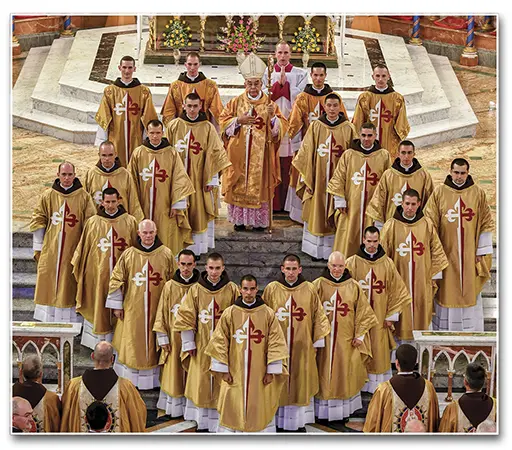
Ordination to the priesthood at the Basilica of Our Lady of the Rosary, Caieiras (Brazil) in 2019
But the symbolism of the vestments reaches its apex in the one who possesses the fullness of the priesthood: the Bishop. The mitre refers to the knowledge of both Testaments, evidenced by its two points. The crosier, similar to a staff, represents pastoral zeal: the curvature at the top indicates the role of gathering those who have strayed, the shaft demonstrates support for the most fragile, and its tip recalls the incentive that should be given to the sluggish.
In view of such distinction, we might ask ourselves: is it necessary for these sacred ornaments, already so significant, to be also precious? Does this not contradict the modesty proper to ministers of God?
In reality, the Angelic Doctor notes, the purpose of vestments is not the personal glory of the minister. Rather, they serve to separate him from the rest of the faithful, “to indicate the excellence of their office or of the Divine worship” (cf. II-II, q.169, a.1 ad 2). In short, chosen wisely by the Holy Church, liturgical vestments are intended to designate the suitability that ministers must possess in order to properly celebrate the divine mysteries (cf. Suppl., q.40, a.7).
Thus, St. Thomas affirms (cf. II-II, q.129, a.1, ad 3), whoever despises the honour due to that which is worthy of honour, deserves censure. Now, is there anything on earth more worthy of honour than the Eucharist? Indeed, if anyone, moved by any kind of negligence, were to approach the Sacred Banquet unworthily, he might well hear this grave rebuke from Our Lord: “Friend, how did you get in here without a wedding garment?” (Mt 22:12). ◊
