Simply contemplating the work of creation provides man with a prodigious kaleidoscope of divine perfections. As an example, let us consider the migratory movement of Canada geese. Who has not marvelled at the wisdom manifested in them? They cross thousands of kilometres flying always together, in an impeccable “V” formation, so that all benefit from the displacement of air caused by the one leading the expedition! To this one, however, falls not only the great effort of cutting the mass of air, opening the way for those who follow him, but also the responsibility of guiding and “confirming” his “brothers” in the achievement of the common goal.
Did God, who thus ordained the existence of these simple fowl, not accomplish something even more beautiful with the masterpiece of the universe, the Holy Catholic Church? This is what we will now consider, through the eyes of the Angelic Doctor (cf. Summa contra Gentiles, Book IV, ch. 76).
It is well known that the Divine Redeemer structured the Church hierarchically: some are shepherds, others sheep. There are those whose mission is to teach, guide, and sanctify, while others called to be taught, guided, and sanctified. However, in the face of the ever-increasing multiplication of shepherds scattered across the vastness of the Earth, the cohesion of the Mystical Body of Christ would be seriously shaken without a fundamental unity, which is that of faith.
How, then, to preserve this essential unity amidst the diversity of peoples and cultures, the clashes of civilizations, the oscillations of spirits, moreover without excluding from this panorama the deleterious factor of the epochs, which inexorably succeed one another until the consummation of history? Only a divine intelligence would be capable of solving such a problem, insoluble for the poor human mind…
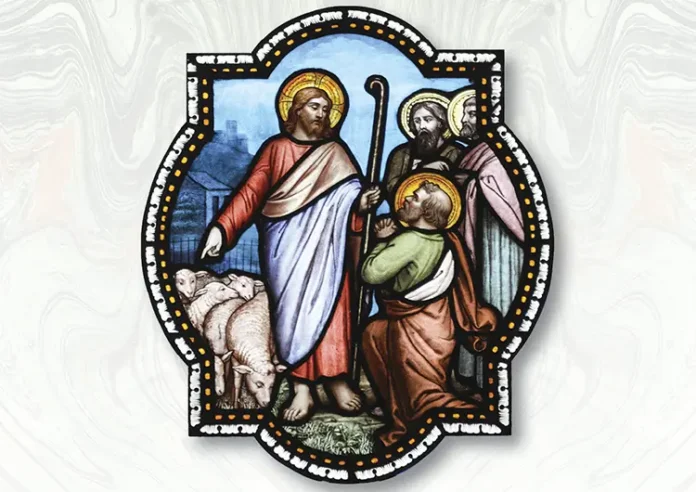
This unity of faith, explains St. Thomas, requires that the Church have a single, universal head. That is why Christ will say to Peter three times: “Feed my sheep” (Jn 21:15-17). And again: “I have prayed for you that your faith may not fail; and when you have turned again, strengthen your brethren” (Lk 22:32). Jesus thus indicated to the first Pope his mission, guaranteeing him special assistance from Providence.
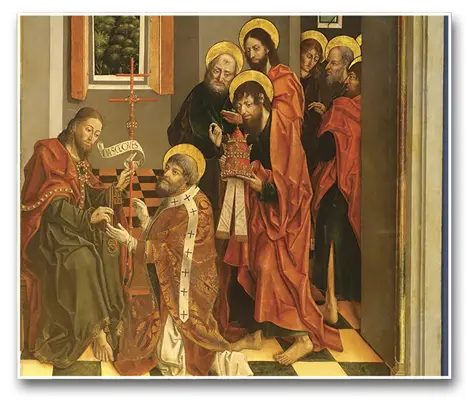
The dignity and uniqueness of Peter’s mission are, therefore, immeasurable! To emphasize them, Aquinas resorts to an argument of an eschatological nature: the Church Militant is an extension of the Church Triumphant, which constitutes one flock in Heaven, under the leadership of one Head, who is God Himself. Likewise, the Church Militant, as an extension and reflection of the Church Triumphant, also needs to be under the leadership of one shepherd, the Supreme Pontiff. Thus, Peter assumes on earth the position of deputy of the Eternal Father in Heaven!
To all that we have just explained, it could be objected that this hierarchical structure, anchored in the person of Peter, would be restricted exclusively to the initial core of Christ’s disciples. Now, St. Thomas replies, the Saviour instituted His Church so that it would traverse the centuries, as the means by which He will fulfil the promise: “Lo, I am with you always, to the close of the age” (Mt 28:20). It therefore becomes necessary that the power conferred by Him on the Apostles, particularly on Peter, be transferred to his successors until the consummation of time. ◊