


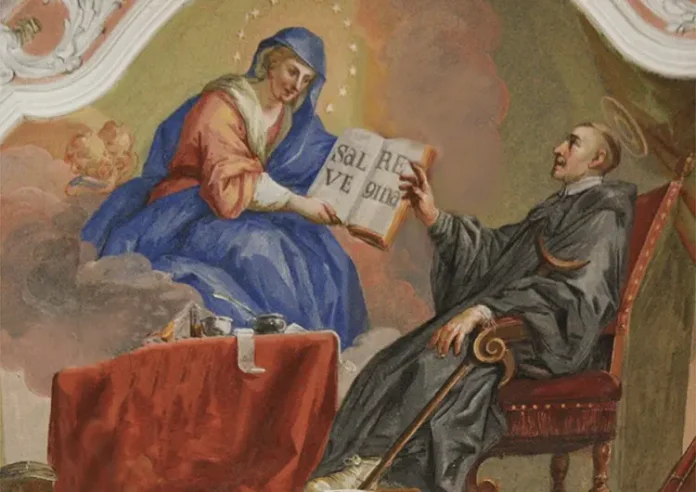
…how the Salve Regina originated?
From one end of the earth to the other, no devout Catholic fails to raise to Heaven the most beautiful prayer dedicated to the Virgin Mother of God: the Salve Regina. What is its origin?
Although the earliest reliable records of the Marian hymn date only to the end of the 11th century, authorship is most frequently attributed to Blessed Hermannus Contractus, also known as Herman of Reichenau (1013–1054). According to other sources, however, Ademar of Monteuil, Bishop of Le Puy-en-Velay, is said to have composed it, invoking the Virgin’s special protection on the occasion of the First Crusade in 1096.
Herman was sent by his parents to a Benedictine monastery as an oblate, where he received an excellent education. He suffered from a form of paralysis – contractus means “lame” in medieval Latin – but despite his frail health he became a dedicated polymath over the years: he was a theologian, astronomer, poet, mathematician, physicist and musician, as well as abbot of Reichenau Abbey in southern Germany. In the twilight of his days, having lost his sight and caught between anguish and hope, he is said to have composed the hymn of total loving confidence in Mary: the Salve Regina.
At Christmas 1146, St. Bernard of Clairvaux was at Speyer Cathedral on a papal mission when he heard the choir intone the invocation in praise of the Blessed Virgin. When the chant ceased, a reverent silence reigned in the sacred precinct, and the Saint himself added: “O clemens! O pia! O dulcis Virgo Maria! – O clement, O loving, O sweet Virgin Mary.” From then on, the threefold supplication became an integral part of the prayer.
Over time, the Marian hymn gained prominence, particularly from 1218 onwards, when it was adopted as the final antiphon at Compline in Cistercian monasteries. Other religious orders chose this supplicatory prayer for various occasions: in processions, at the end of Masses, at funerals… Therefore, wherever we may be in this valley of tears, we must not miss the opportunity to implore the Queen of Heaven to turn her “eyes of mercy” towards each one of us! ◊
…why a dog breed was named after a Saint?
In the mid-11th century, St. Bernard of Menthon founded the Hospitaller Congregation of Great St. Bernard, made up of canons regular, with the aim of establishing a monastery and providing lodgings for pilgrims crossing the Alps via the perilous pass between Valais, in Switzerland, and the Aosta Valley, in Italy.
Between the 1660s and 1670s, the canons began to use Alpine mastiffs for guarding and companionship. Over time, they realized that these dogs could detect people buried in the snow by their keen sense of smell and, when this happened, would return to the monastery to alert the monks.
Later, the rescue system became so well organized that, between 1790 and 1810, Napoleon and 250,000 soldiers crossed this same Alpine pass, now known as the St. Bernard Pass, without suffering a single casualty. One of the dogs, Barry, is known to have rescued more than forty people in the early 19th century. It is recorded that, by the end of the same century, the dogs cared for by the monks had saved more than two thousand lives.
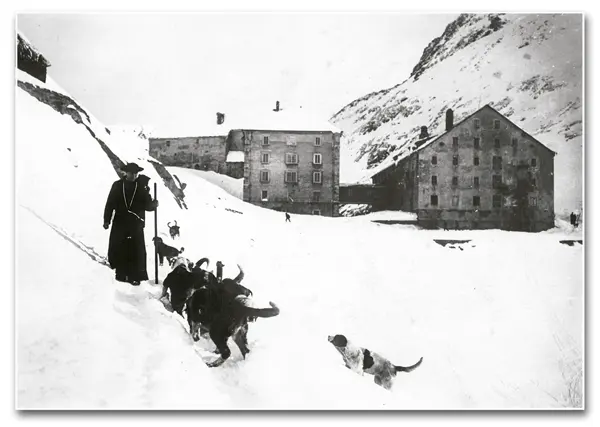
In the 1880s, to honour the founder of that pilgrims’ shelter, the breed’s name was standardized as Saint Bernard. Then, in 1923, Pius XI proclaimed the Saint of Menthon the patron saint of mountaineers. ◊
