I remember the first conversation about spiritual life that I had with Dr. Plinio, in 1959, when I was still very young and asked him for advice to help me decide which career I should pursue.
Dr. Plinio arranged to meet me at five o’clock in the afternoon, at his law office. When I arrived, I found him sitting in an armchair in the entrance hall, speaking with two gentlemen. We greeted each other and he invited me to wait in the next room.
I went in and began to follow the conversation from a distance, which revolved around a topic that I didn’t know about at the time, but which caught my attention: grace.
A mystery revealed by the God-Man
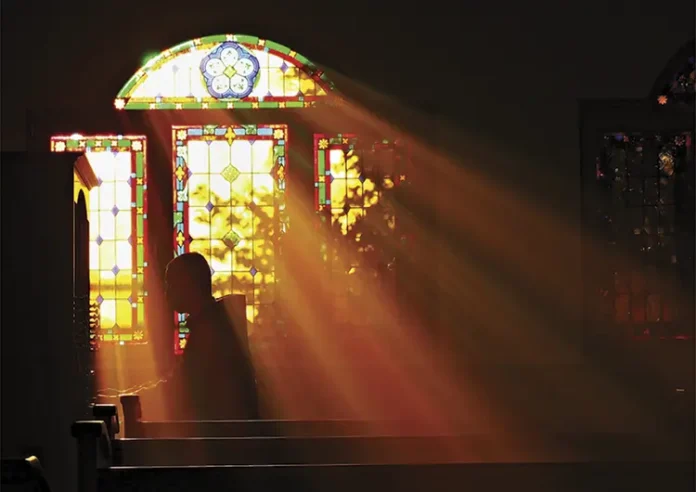
They were discussing whether grace can be found in purely material objects, such as an environment like the Sainte Chapelle, or whether it is only for man and Angels, that is, for intelligent beings. And Dr. Plinio posed a series of questions: “What does it mean to participate in the divine nature? How does this participation occur?” Until one of his interlocutors exclaimed: “Plinio, this won’t do… You want to unravel all the mysteries that exist!” He, however, replied: “No, I want to take my knowledge as far as human intelligence can comprehend!”
When you are young, events mark a strong impression, and I remember thinking: “One day I will study this subject, because it seems extremely interesting!” In fact, the episode broadened my horizons to later explore such a wonderful and fundamental topic, to the point that much later, in 1990, Dr. Plinio had several conversations with me to delve deeper into the subject.
Grace is an inaccessible mystery which, had it not been revealed by Our Lord Jesus Christ Himself, no one would be able to fathom
“Participation in the divine nature”: he reflected repeatedly on this point his entire life. He had faith, but he wanted to obtain an exact explanation, because he wished to give conferences and even offer a course on such a fundamental subject – which he had never had the opportunity to study in depth, due to lack of time – knowing that it would do good to souls.
Now, grace is a completely inaccessible mystery that, if it had not been revealed by Our Lord Jesus Christ Himself in the New Testament, no one would be able to fathom. And even after it was revealed, a certain shadow still hangs over it that we cannot penetrate: “I am a child of God?…”
While we are on this earth, it is therefore important to concern ourselves with the great horizons of the supernatural world and to seek to explore the explanations made by good Theology, to the point that it has reached.
To each nature correspond proportional strengths…
The Christian is accustomed to the name “child of God,” and it would be almost an offence to deny him this title. But, in reality, the fact of being produced by someone does not confer the right of filiation. A watchmaker who makes a watch or a carpenter who makes furniture cannot call the works of their hands “son.” To be a son, it is necessary that the father transmit, through natural generation, his own life and nature. The young of lions are lion cubs, and the sons of men are men.
We know that in the order of nature there are minerals, plants, animals, men, and Angels; and on a higher level there is the supernatural plane of grace and, after that, that of the hypostatic union. However, above all creation is the divine nature, which is defined by God’s capacity to understand Himself as He is and to love Himself because of His deity.
The mineral nature is characterized by perennity; however, it is inanimate. Plants have life and a certain movement in search of sun, water, and nutrients. Animal nature presents a higher degree of life, as defined by sensitivity. Human nature, in turn, has the use of reason and will. And angelic nature, endowed with great intelligence and power superior to that of men, is distinguished by being purely spiritual.
Consequently, the strengths of a being are proportionate to the nature it possesses. How could we ask an animal to solve a philosophical problem? It would be absurd, as it would never have the capacity for this!
Likewise, the strengths of a man or an Angel will never be divine, but always purely human or angelic.
…and an equivalent reward
Likewise, the reward that can be achieved must be proportionate to the strengths that merit it. It would make no sense to reward with an intellectual prize the physical efforts of carrying burdens performed by an elephant, since the animal could not benefit from this, as its nature does not permit.
Similarly, the reward that man may obtain for his natural actions, even if he zealously and heroically fulfils all the Commandments or undergoes the greatest torments and sacrifices, will never be a divine reward nor will it have absolutely any value for eternal life,1 since his mere nature is incapable of deserving anything in the supernatural order.
Heaven consists, above all, in seeing God face to face; and no created being, not even an Angel in its fullest power, would ever have the possibility of knowing Him and enjoying His vision, unless a supernatural gift were granted to him.
Only sanctifying grace elevates us to that happiness that God had reserved for Himself, but wished to extend to rational creatures.
A historical fact is told about Michelangelo, who, upon finishing his famous sculpture of Moses, was so enraptured by his work that he struck one of the statue’s knees with a hammer, saying: “Parla! Perché non parla? – Speak! Why don’t you speak?” The Renaissance genius, considered one of the greatest artists in history, could not transfer his human nature to the marble he had sculpted.
God, however, was far more enthusiastic than Michelangelo about the image He made of Himself and loved man immeasurably. So He was not content to leave him in the state of a mere likeness and wished to transmit to him His own divine nature.
What is sanctifying grace?
How can He divinize us? Through sanctifying grace, a created gift that, upon penetrating the soul, elevates it to the divine category, for it essentially sanctifies those who receive it.
If we were to add up all the precious stones, the stars, the animals, men and angels, all creatures together would equal nothing compared to a “drop” of grace.
There was not a moment in which Adam and Eve, coming from the hands of God, remained as mere creatures and outside the state of grace. According to Catholic doctrine, when God breathed on the clay figure, He infused it at once with both lives, the natural and the supernatural. And He did the same when He formed Eve from Adam’s rib.
Both, however, sinned, and it was necessary for Christ Our Lord to be born in the manger in Bethlehem and to accomplish Redemption, restoring supernatural life through the Sacraments.
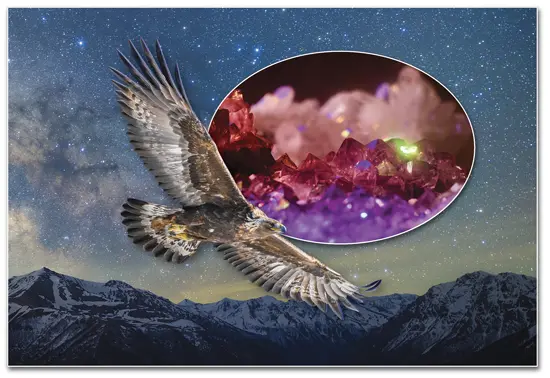
Grace is a free gift, a divine present superior to all the created natural order. If we were to add up all the topazes and other precious stones, the stars, the eagles and so many other beautiful animals, men and Angels, all these creatures together would equal nothing compared to a “drop” of grace.
Thus affirms St. Thomas: “the gift of grace surpasses every capability of created nature, since it is nothing short of a partaking of the Divine Nature, which exceeds every other nature.”2
Iron or fire?
To explain how this participation occurs, the Angelic Doctor offers a very compelling example: if we take an iron bar at room temperature and place it in a forge for a certain time, when we remove it, it comes out incandescent and even in flames, to the point that we cannot touch the iron with our hands because they would burn as if they were directly touching the fire. What happened? The fire transmitted its heat to the iron, and the iron, without ceasing to be metal, acquired all the properties of fire.

Just as iron acquires the properties of fire when placed in the forge, so too does the soul become divinized upon receiving grace
Something analogous happens to the soul when it receives grace: it remains entirely human, but a divine quality is added to it, which gives it a real, authentic, and true participation in the very nature of God; which means having the possibility of seeing Him as He sees Himself, of loving Him as He loves Himself, and of enjoying Him as He enjoys Himself. Through this “ray” of grace, the Lord elevates us to a higher plane, so that we are no longer mere creatures, but pass into the category of deified beings.
Scheeben, a great 19th-century German theologian, summarizes this truth thus: “divine nature, by the infinite power of its charity, attracts our nature, adopts it into its bosom by grace, submerging it in itself as iron is submerged in fire. We belong, then, to the race of God, as the palm tree belongs to the plant kingdom, and the lion to the animal kingdom.”3
Just as, when we look at a tree, we immediately understand that it is part of the plant nature, or when we see a puppy, we know that it belongs to the animal kingdom; when we contemplate someone whose soul is in the state grace, such as a newly baptized child, we should say: “Here is a saint. He is divine, and belongs to the Kingdom of God!”
Children of God…
What are the consequences of this? Undoubtedly, the main effect of grace consists in conferring participation in the nature of God. But from this flow other riches of the greatest importance.
If, as we commented above, a child is one who receives the same nature as the father, those who possess grace can truly say: “We are God’s children” (1 Jn 3:2).
This divine filiation through grace should not be confused with the natural filiation of the Word in the bosom of the Father, for only Our Lord Jesus Christ is begotten by nature, as we pray in the Creed when we call Him the Only Begotten Son. We, however, are children by adoption.
However, the term adopted child may give the impression of referring to a mere legal adoption, whose value is comparable to that made by means of a document at the notary’s office. It is not because a German boy was adopted by Chinese parents that he will take on Chinese features and mentality. The child will grow up German and will always remain so within the Chinese family.
With grace, something much more effective happens: from the moment it penetrates the soul, it causes the soul to take on the form of God. And that is why Theology teaches that it is a physical and formal participation in divine life. Grace is not a garment placed on our body, but a quality that clothes us from within and transforms us.
Theologians seek to illustrate this mystery using the following image: it is an adoption so profound and intrinsic that it would be more or less as if all the blood were taken from the child and he were transfused with the Blood of Our Lord Jesus Christ.
…and His heirs
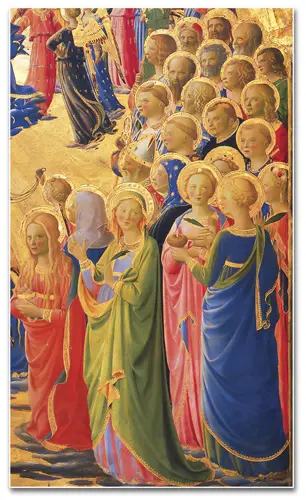
Another necessary consequence of our adoptive divine filiation is that we become heirs of God, as St. Paul writes in his Letter to the Romans (cf. Rom 8:17).
Returning to the metaphor of the Chinese couple, let us suppose that, in addition to the adopted German child, they had ten children. When the parents died, their possessions would be divided among the eleven, with a small and equal share remaining for each. Such is the division of inheritance among merely human or legal siblings.
The divine inheritance is distributed in a very different way: since God does not die, and since what He has to give us is infinite, we will possess with Him an inheritance so rich that, despite the immense number of His children, it will never decrease, for it is the same prize that God has reserved for Himself from all eternity: to see Him as He sees Himself, and to love Him as He loves Himself.
Therefore, having crossed the threshold of death, soon after the Judgment we will see the Lord face to face and enjoy the absolute happiness of being with God and in God, as He has the happiness of being in Himself and of being who He is.
We will then reach the consummation of the state of grace, for grace and glory are substantially the same life, with only a difference in degree: the first in the state of a seed – inchoative, as Theology calls it – and the second in fullness, just as a child is an adult in germ. In this sense, St. Thomas Aquinas affirms: “grace is nothing else than a beginning of glory in us.”4
Moreover, all our longings will be fulfilled, everything we desire and aspire to will be satisfied.
Brothers of Jesus Christ
There are many other effects of sanctifying grace, such as that of giving us supernatural life, making us righteous and pleasing to God, conferring upon us the capacity for supernatural merit, uniting us intimately to God, and making us living temples of the Blessed Trinity. But there is one to which St. Paul alludes several times in his epistles (cf. Rom 8:17, 29; Heb 2:11) and which would be enough to make us mad with love: we are brothers of Our Lord Jesus Christ!
Sanctifying grace unites us intimately with God, making us living temples of the Blessed Trinity and brothers and sisters of Our Lord Jesus Christ!
Imagine that someone introduced us to a prince of great elegance and charm. Certainly, we would be impressed and would greet him with great deference. However, much more is given to us, for we relate to each other as brothers of Our Lord Jesus Christ. How we should love one another and be willing to do everything for each other!
This would be enough for each of us, when meeting another and knowing that, by the mercy of God, this person remains in a state of grace, to treat him with profound respect and genuflect before him because divine life is present. To have genuine mutual love, we must love one another deeply, from the heart. (Cf. 1 Pt 1:22). ◊
Excerpts from oral expositions given between 1993 and 2006
Notes
1 Cf. ST. THOMAS AQUINAS. Summa Theologiæ. I-II, q.114, a.2.
2 Idem, q.112, a.1.
3 SCHEEBEN, Matthias Joseph. As maravilhas da graça divina. Petrópolis: Vozes, 1952, p.29.
4 ST. THOMAS AQUINAS, op. cit., II-II, q.24, a.3, ad 2.