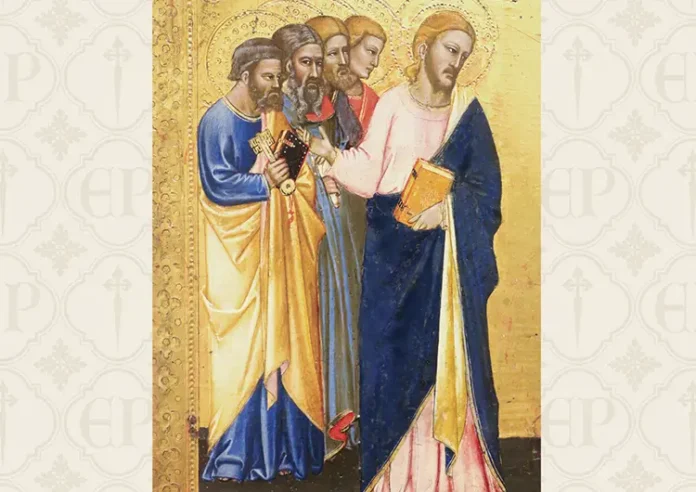
The fame of John the Baptist had marked the history of Israel, and public opinion was still under the influence of that unusual man, who ate locusts and wild honey, dressed in camel skin and a leather belt.
Providence had bestowed graces upon him, and countless comments circulated about him, among which the predominant idea was that he was the Messiah, or someone closely linked to Him and endowed with extraordinary powers.
But if John had caused such an impact, simply by baptizing and without performing any miracles, what enthusiasm did Our Lord arouse in the people? What were the words of the Precursor compared to those spoken by the Incarnate Word? Who could compare to Him?
A gesture of His was a gesture of God; a gaze of His was the very gaze of God; when He breathed – as when He breathed on the Apostles after the Resurrection (cf. Jn 20:22) – His breath infused the Holy Spirit into the depths of their hearts!
The power of the light that radiated from Jesus became very evident at the beginning of His public life, when John the Evangelist and Andrew accompanied Him to where He lived and spent that day there (cf. Jn 1:39).
Undoubtedly, both followed Him physically, but above all they were impelled by a movement of grace, like a ray of light in their souls, inviting them to follow Our Lord! For them, following Him meant learning His spiritual and doctrinal teachings, His customs and ways of being, in short, the increment to what they had learned from John the Baptist. If they already felt so awe-stricken by John, what more could this one bring, who was superior to him (Jn 1:30) and whom the former had been indicating?
Human judgement fails in the face of divine works
Jesus of Nazareth was stirring Israel and spreading around Him perplexity, questions and a great mystery … A mystery that, evidently, everyone wanted to interpret, for mankind always seeks to classify what it sees.
Now, how can we “classify” Our Lord without Revelation? How can we define Him without divine judgement, without heavenly criteria? It is impossible! People used their human intelligence, applied their natural qualities, but forgot to consider the supernatural elements to distinguish in Him the Only Begotten Son of God.
Therefore, while in Cæsarea Philippi, Our Lord asked the question: “Who do men say that the Son of Man is?” (Mt 16:13). He did so not only to make clear who He was, but also to separate the Apostles from the mistaken opinions that existed about Him.
The Creator of grace had been in constant communication with them for three years, illuminating their souls with His light, the lumen Christi, to introduce and nourish faith, hope, charity, and other virtues and gifts.
After they had listed the many different concepts that were circulating among the people about Him, the Divine Master then posed the crucial question: “But who do you say that I am?” (Mt 16:15).
It should be noted that in the first question Jesus called Himself “Son of Man,” and in the second He said “I am,” the name given by God to Himself: Yahweh. Thus, the answer to His question was already almost implied.
Peter then exclaimed, “You are the Christ, the Son of the living God” (Mt 16:16). Our Lord affirmed that it was not “flesh and blood” (Mt 16:17) that had revealed this to him, but rather a revelation from the Father. In other words, it was not mere nature, nor human perception or discernment.
At this point, we are led to draw an important conclusion: human judgement is flawed and therefore easily errs in considering divine works if it is not aided by grace.
Who would we suggest to be the ideal Pope?
Let us imagine that we were with the Apostles, and Our Lord were to turn to us and say: “I am going to found my Church and I want one of these twelve to be my first Vicar and sit on the chair of infallibility. However, I also want your opinion in choosing which one of them should be Pope.”
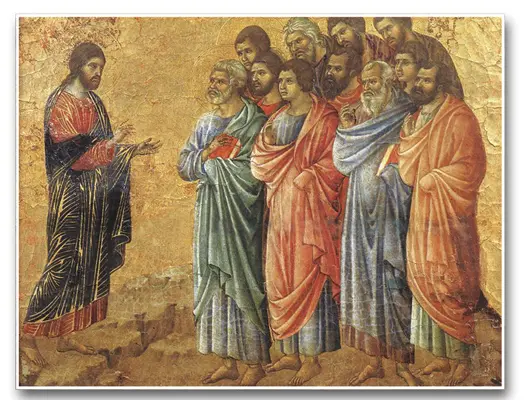
In what way would I contemplate the Apostles? What impression of contempt would I have in my spirit regarding the defects of those men? They were unrefined and ignorant men, devoid of any prestige or social importance, dressed in coarse clothing. Their language was that of a lower class, for they spoke with a Galilean accent, their hands were calloused, and their gait lacked elegance… Perhaps I would reply:
“But, Jesus, what are You thinking by choosing such assistants?! What do You expect from these fishermen?
“The first personage I encounter is of Simon Peter. Spontaneous, impetuous, explosive… He does not assess circumstances well, nor does he know how to reflect on what he should say, as happened that night when, in the midst of the darkness, You appeared walking on the water and he immediately cried out: ‘Lord, if it is You, bid me come to You on the water’ (Mt 14:28). How reckless! After walking on the waves with the power You gave him, he began to sink, putting himself in a ridiculous situation! This one, Lord, is too rash and superficial, he is not fit for the Papacy!
“My eyes turn to Thomas. He does not seem suitable for the position either: he is overly cautious, doubts everything, puts his own criteria first…
“Next, I meet James and John, the ‘sons of thunder’, who are related to you. John is your closest Apostle, but he is still too young! Both of them have a hot-tempered and combative nature, they do not understand what kindness is, they are always eager to destroy and resolve matters quickly, using force and violence. These two are not fit to govern your Church.”
And so, going through all the disciples, we would come to one on whom our gaze would linger:
“Ah, my Jesus, this one seems judicious and balanced! He is a quiet man who shows little of himself, for he thinks carefully before speaking. He has great practical and administrative skills, and he is the only one who has the good sense to remind others not to make unnecessary expenditures and to save money for the poor… Judas Iscariot, in my opinion, would be the ideal Pope!”
Human choices do not coincide with divine choices
We see, once again, how misguided our assessments are, not only regarding God, but also regarding others and ourselves, and how our choices do not coincide with those of Jesus!
“For as the heavens are higher than the earth, so are […] my thoughts than your thoughts” (Is 55:9), says the Lord.
In definitively separating the Twelve from the world and entrusting them with the apostolic mission to establish His Church, Our Lord did not do so only as God, but, as a true Man, using two elements as a basis.
On one hand, He used His practical and experiential knowledge, seeing them in the situation in which they found themselves, with all their shortcomings and deficiencies.
On the other hand, His spirit filled with grace and infused light, through which He penetrated their souls, recognized in them religiosity, dedication, and even a certain virtue, and knew how much they needed to be assisted by the breath of the Holy Spirit and sustained by the Eternal Father.
Moreover, in the highest part of His soul, Jesus contemplated them in God, through the beatific vision, as if they were already in the full perfection of eternal glory.
The divine choice
We can imagine that, in an attitude of humility and obedience, Our Lord wished to present this choice to the Father, speaking with deep consideration and affection about each one:
“O my Father, so revered and beloved, among my dear disciples I present to You, first of all, Simon, son of Jonah. It was You, O Father, who designated him as the foundation of the Church. I will therefore give him the name Peter. He is upright, frank, generous; everything can be expected of him, even heroism! He trusts too much in his own strength, I know well, but when he falters, he will not persist in his guilt and he will repent.
“Andrew, his brother, was the first to come to me near the Jordan, and immediately brought his brother to Me. He is also ardent, although he possesses a calmer and more serene temperament. I believe that his self-denial can reach admirable heights.
“James and John, along with them, are the very first labourers. They abandoned their aged father for Me. I am impressed by the way John listens to Me: he is pure, has an elevated spirit and a love for the sublime; everything I say is engraved in his memory, and a holy enthusiasm is read in his zealous visage. I see that he will teach My Gospel more profoundly than the others.
“Philip is zealous and speaks simply. As soon as he came to Me, he won over Nathanael. The latter is a sincere Israelite, who knows neither cunning nor duplicity of spirit. He raised objections to Me and submitted to My answers. It seems to Me that he can be counted on.
“Matthew is that Levi who followed Me at a simple nod in passing. Gathering many of his tax collector friends at a feast, he allowed Me to preach justice and repentance to them. He also pays close attention to all My words, however insignificant they may seem.”
And so, after reviewing all the Apostles, the Divine Master must also have spoken to God the Father about the “son of perdition” (Jn 17:12): “Judas! He is the one who will betray Me… How this man wounds My Heart! His hard and immovable soul – I see it – will be taken by Satan. However, I ask that you grant him all the graces necessary so that he may not follow those paths and may come to seek Me!”
In this tremendous contrast between divine and human opinions, we better comprehend the contempt that the adorable Jesus shows for the rules of the world and the high, grand, and wise design with which He chooses, to form the Apostolic College, these worthless and uncultured fishermen, whom He will later endow with superior wisdom, making them leaders of men, conquerors, heroes, great saints and incomparable martyrs.
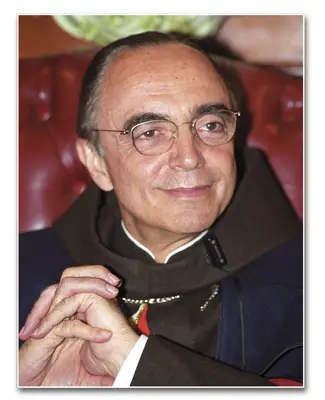
Msgr. João in August of 2003
More than a simple reparation
In the specific case of Peter, we know that he possessed a high degree of faith, to the point of throwing himself into the sea in search of Our Lord without considering the risks, proclaiming His divinity first. However, when the time came to affirm that he was His disciple, he denied it three times.
Why did he deny it? It was not for lack of faith, since his faith was robust, but because he still loved himself more than Our Lord and gave greater importance to the opinion of others than to that of Our Lord.
If his surrender had truly been absolute, perhaps he would have died along with the Master on that occasion, for perfect love overcomes the instinct for self-preservation. And thus, there would not only have been two thieves on Calvary, but also the first Pontiff, giving the example of how to follow Jesus Christ to the Cross.
However, Our Lady prayed for him. When the Apostle met Our Lord, after the threefold denial, that divine gaze brought about the conversion of the rock: perceiving as in a mirror the state of his soul, penetrated by pride, vanity, and human respect, Peter went away full of anguish and wept…
When Our Lord resurrected and appeared to him individually, a phase of hope began. But it was also during this period that the Redeemer interrogated him with three identical questions: “Do you love Me?” (cf. Jn 21:15-17). Peter was sad and insecure, believing that Jesus asked three times so that he could atone for his crime.
Indeed, He wanted reparation for the fault previously made by stating the opposite, but not only that. Much more important was to give Peter the opportunity to grow in love, even before the descent of the Holy Spirit.
Yes, at a certain moment a tongue of fire would rest on his head, and he would go out proclaiming what had previously seemed like imprudence to him. By his word, three thousand people would be baptized in a single day, and by his actions and miracles, the Messiah would illuminate the world and change history!
But first, he needed to make the firm resolution to love Our Lord more than himself, with a love greater than that of others: “Yes, Lord; You know that I love You.” Therefore, Jesus added: “Feed my lambs; feed my sheep!”
Love is the essence of the Papacy!
From the beginning, when Andrew led his brother to the Lord, Jesus had already chosen him to be the first Pope, saying: “So you are Simon the son of John? You shall be called Cephas (which means Peter)” (Jn 1:42). Why? Because he was the one who knew the most? No. Rather because, despite his weaknesses, he was the one who loved most!
We see, then, a criterion perhaps to be established in conclaves, or perhaps to be used in turbulent times, for the choice of a Pope: the one who loves most is the one who truly has the capacity to shepherd the flock. For he who knows, teaches; but he who loves, shepherds.
A Pope does not need to be the most prudent and skilful or the best diplomat. Nor does he need to be the most intellectually prepared; nor the most noble or distinguished. If not even faith was enough for the one upon whom the Church was built, how could it suffice for his successors?
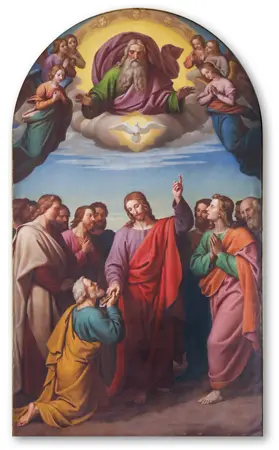
St. Peter receives the keys to the Kingdom of Heaven – Church of St. Peter and St. Paul, Kössen (Austria)
Love, yes, is the attribute for discernment, for in matters of merit it is above knowledge itself, as St. John of the Cross affirms: “In the twilight of this life, you will be judged according to love.”1
In fact, to sanctify, to make fervent, and to unite more closely to the source of grace, Our Lord Jesus Christ, and to Mary, Mother of Grace, it is necessary to love. Only those who are detached from themselves instil tranquillity, consolation, and joy, because peace flows from charity. St. Augustine affirms: “Dilige et quod vis fac – Love and do what you will”;2 and we can add that whoever loves is capable of everything, even of being Pope… The selfish person, on the contrary, creates an atmosphere of bitterness, friction, and disquiet around them.
God directs His work with an omnipotent hand.
Here is an impressive lesson, which leads us to the following conclusion: God’s works must be directed by His omnipotent hand, or no human quality will be able to make them endure.
Contemplating the Holy Church in the current situation, we must avoid any thought of discouragement, or perhaps even bitterness, regarding the deficiencies and imperfections existing in the visible element of this divine institution. We believe that the spirit that visibly presided over the foundation of this work continues to invisibly accompany its development throughout the centuries, to the present day.
Just as the Church was erected on such an insufficient foundation from a human point of view, but later took over the world, we believe that, if today it is going through difficulties, the apex of its history has not yet come; rather, it is about to arise in a marvellous and magnificent way! The current miseries or defections, as in times past, far from shaking our faith, are useful in making evident to all the ever-miraculous action of Him who with a simple act of will created the universe.
Let us have serious and firm confidence in the future of the Church: the Lord will bring this ship to safe harbour! ◊
Excerpts from oral expositions given
between 1992 and 2010
Notes
1 Cf. ST. JOHN OF THE CROSS. Dichos de luz y amor, n.59. In: Vida y obras. 5.ed. Madrid: BAC, 1964, p.963.
2 ST. AUGUSTINE. In Epistolam Ioannis ad Parthos tractatus decem. Tractatus VII, n.8. In: Obras. Madrid: BAC, 1959, v.XVIII, p.304.