Monday of the 28th Week in Ordinary Time
Mass Readings
First Reading – Gal 4:22-24, 26-27, 31–5:1
Brothers and sisters: It is written that Abraham had two sons, one by the slave woman and the other by the freeborn woman. The son of the slave woman was born naturally, the son of the freeborn through a promise. Now this is an allegory. These women represent two covenants. One was from Mount Sinai, bearing children for slavery; this is Hagar. But the Jerusalem above is freeborn, and she is our mother. For it is written: Rejoice, you barren one who bore no children; break forth and shout, you who were not in labor; for more numerous are the children of the deserted one than of her who has a husband. Therefore, brothers and sisters, we are children not of the slave woman but of the freeborn woman.
For freedom Christ set us free; so stand firm and do not submit again to the yoke of slavery.
Responsorial Psalm – Ps 113:1b-2, 3-4, 5a, 6-7(R. see2)
R. Blessed be the name of the Lord forever.
or:
R. Alleluia, alleluia.
Praise, you servants of the LORD,
praise the name of the LORD.
Blessed be the name of the LORD
both now and forever. R.
From the rising to the setting of the sun
is the name of the LORD to be praised.
High above all nations is the LORD;
above the heavens is his glory. R.
Who is like the LORD, our God,
who looks upon the heavens and the earth below?
He raises up the lowly from the dust;
from the dunghill he lifts up the poor. R.
Gospel – Lk 11:29-32
While still more people gathered in the crowd, Jesus said to them, “This generation is an evil generation; it seeks a sign, but no sign will be given it, except the sign of Jonah. Just as Jonah became a sign to the Ninevites, so will the Son of Man be to this generation. At the judgment the queen of the south will rise with the men of this generation and she will condemn them, because she came from the ends of the earth to hear the wisdom of Solomon, and there is something greater than Solomon here. At the judgment the men of Nineveh will arise with this generation and condemn it, because at the preaching of Jonah they repented, and there is something greater than Jonah here.”
Featured Saints and Commemorations
Our Lady of Aparecida – Patroness of Brazil
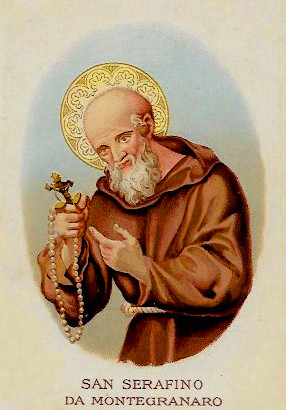
St. Seraphin of Montegranaro, religious (†1604). Capuchin from the convent of Ascoli Piceno, Italy, he learned from two main “books”: the crucifix and the Rosary.
St. Edwin of Northumbria, king (†633). Pagan king of Northumbria, who embraced Christianity under the influence of his Catholic wife, St. Ethelburga of Kent, and of St. Paulinus of York, by whom he was baptized in 627. Great-uncle of St. Hilda of Whitby, he contributed greatly to the evangelization of his domain, which rapidly adopted Christianity under his rule.
Blessed Thomas Bullaker, priest and martyr (†1642). Religious name: John the Baptist. English Friar Minor, having receiving his formation and ordination in Spain. He then laboured in the English mission for nearly 12 years among the poor Catholics in London before being seized during the celebration of the Holy Mass. He was hanged, drawn, and quartered at Tyburn, during the reign of Charles I.
St. Felix IV, Pope (†530). He condemned semi-pelagianism transformed two pagan temples from the Roman Forum into the Basilica dedicated to Sts. Cosmas and Damian.
St. Felix and Cyprian, bishops, and companions, martyrs (†483). Put to death along with approximately five thousand faithful Catholics by the Arian Vandal king, Hunneric.
St. Rotobald, bishop (†1254). He governed the Diocese of Pavia, Italy, dedicating himself especially to divine worship and gathering relics of the Saints.
Blessed Roman Sitko, priest and martyr (†1942). Rector of the Seminary of Tarnów, Poland, he was imprisoned and underwent severe torture in the Auschwitz concentration camp.
Blessed Pacifico Salcedo Puchades, religious and martyr (†1936). Capuchin lay brother shot during the anti-Catholic persecutions of the civil war in Massamagrell, near Valencia.
Image gallery