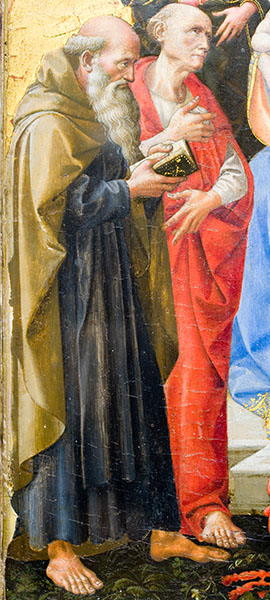
Memorial of St. Jerome, Priest and Doctor of the Church
St. Jerome, priest and Doctor of the Church (†420, Bethlehem). After a dissolute youth, he received Baptism in 366, abandoned pagan culture and led an ascetic life in a desert of Antioch. Ordained a priest at the age of 38, he participated in the Council of Rome in 382 and became the secretary of Pope St. Damasus, who commissioned him to revise the Latin translations of the Bible, a work which became known throughout the world as the Latin Vulgate. He vigorously fought the errors of his age, and stood out, together with his contemporary, St. Ambrose, for his exhortations in defence of virginity.
See also:
Mass Readings
First Reading – Job 9:1-12, 14-16
Job answered his friends and said: I know well that it is so; but how can a man be justified before God? Should one wish to contend with him, he could not answer him once in a thousand times. God is wise in heart and mighty in strength; who has withstood him and remained unscathed? He removes the mountains before they know it; he overturns them in his anger. He shakes the earth out of its place, and the pillars beneath it tremble. He commands the sun, and it rises not; he seals up the stars. He alone stretches out the heavens and treads upon the crests of the sea. He made the Bear and Orion, the Pleiades and the constellations of the south; He does great things past finding out, marvelous things beyond reckoning. Should he come near me, I see him not; should he pass by, I am not aware of him; Should he seize me forcibly, who can say him nay? Who can say to him, “What are you doing?” How much less shall I give him any answer, or choose out arguments against him! Even though I were right, I could not answer him, but should rather beg for what was due me. If I appealed to him and he answered my call, I could not believe that he would hearken to my words.
Responsorial Psalm – Ps 88:10bc-11, 12-13, 14-15 (R. 3)
R. Let my prayer come before you, Lord.
Daily I call upon you, O LORD;
to you I stretch out my hands.
Will you work wonders for the dead?
Will the shades arise to give you thanks? R.
Do they declare your mercy in the grave,
your faithfulness among those who have perished?
Are your wonders made known in the darkness,
or your justice in the land of oblivion? R.
But I, O LORD, cry out to you;
with my morning prayer I wait upon you.
Why, O LORD, do you reject me;
why hide from me your face? R.
Gospel – Lk 9:57-62
As Jesus and his disciples were proceeding on their journey, someone said to him, “I will follow you wherever you go.” Jesus answered him, “Foxes have dens and birds of the sky have nests, but the Son of Man has nowhere to rest his head.” And to another he said, “Follow me.” But he replied, “Lord, let me go first and bury my father.” But he answered him, “Let the dead bury their dead. But you, go and proclaim the Kingdom of God.” And another said, “I will follow you, Lord, but first let me say farewell to my family at home.” Jesus answered him, “No one who sets a hand to the plow and looks to what was left behind is fit for the Kingdom of God.”
Featured Saints
St. Francis Borgia, priest (†1572). Duke of Gandia and viceroy of Catalonia, he renounced the world after the death of his wife and entered the Company of Jesus, of which he became the third Superior General
St. Gregory, the Illuminator, bishop (†c.326). Apostle of Armenia; near the end of his life he retired to a grotto beside the Euphrates River.
St. Honorius of Canterbury, bishop (†653). One of the original group appointed as missionaries to England by Pope St. Gregory the Great, where he worked for the spreading of the Faith and the strengthening of the local churches. He succeeded St. Justus as head of the Archdiocese of Canterbury.
St. Simon, monk (†1082). While Count of Crépy, France, he renounced his homeland, marriage and wealth to lead a hermetic life in the Jura Massif.
Blessed Frederick Albert,priest (†1876). Founded the Congregation of the Vincentian Sisters of Mary Immaculate in the city of Lanzo, Italy, to care for indigents.
Blessed Felicia Meda, abbess (†1444). Clarist nun, superior of the monastery of St. Ursula, in Milan, and of the monastery Corpus Domini, of Pesaro, Italy.
Image gallery