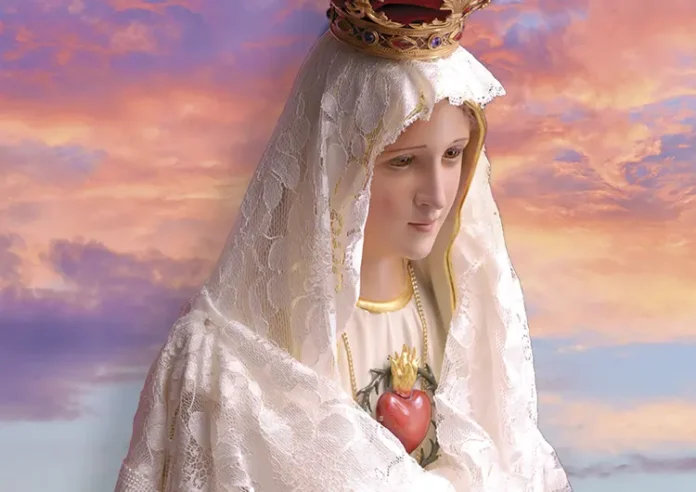
A masterpiece of creation, the Most Holy Virgin Mary was favoured by God with such sublime perfection and such exalted gifts that the Church, in its desire to honour her worthily, has been “inexhaustible” in proclaiming her praises, particularly through the words and writings of its saints and Doctors.
St. Thomas Aquinas states that “the Blessed Virgin from the fact that She is the mother of God [has] a certain infinite dignity, from the infinite good, which is God.”1
St. Louis-Marie Grignion de Montfort, for his part, calls Our Lady “the vast and divine world of God where unutterable marvels and beauties are to be found. She is the magnificence of the Almighty where He hid His only Son, as in His own bosom, and with Him everything that is most excellent and precious.” And in a rapture of devotion, the eminent Marian apostle continues: “the height of her merits rising up to the throne of the Godhead cannot be perceived; the breadth of her love which is wider than the earth cannot be measured; the greatness of the power which She wields over one who is God cannot be conceived; and the depths of her profound humility and all her virtues and graces cannot be sounded.”2
Upon hearing these and so many other accolades, our faith certainly exults with admiration and love for the Queen of the Universe. However, contemplating her boundless greatness may produce in our soul an understandable sense of smallness: “My Mother, how beautiful and admirable You are! And I, how poor and wretched… There is an abyss between You and me, and I can see you only as an inaccessible paradise, a sublime light which has, at best, but a distant and ethereal connection with me.”
However, no supposition could be more false!
A relationship that holds a sublime mystery
For souls who turn to Mary, one of the most striking aspects of her holiness is her compassion towards sinners. Far from despising us for our weakness, She looks upon us with pity, with a desire to do us good, with a mercy endowed with countless attributes: inexhaustible, most patient, most clement, tireless, unshakable…
Always solicitous and kind, Our Lady takes on our stature to favour us; and She does so not merely for the benefit of a few privileged souls, but for anyone and everyone, for all men, past and present, for the sinners who fill the streets; for all, this is exactly how She is.3
As if such goodness were not enough, the Queen of the Universe, who in Heaven enjoys the infinite bliss of the beatific vision, still cherishes this insatiable desire: to communicate more closely with us. And hidden in this relationship, through which we respond to her love, lies a most precious mystery, which St. Louis Grignion describes as “the great secret to becoming a saint”4 and, moreover, the indispensable means for the effective establishment of the Kingdom of Our Lord Jesus Christ on earth.5
An inexhaustible source of grace
When discussing the role of Our Lady in our sanctification, St. Louis is emphatic. Drawing on traditional doctrine, he maintains that the principal means of attaining superabundant divine grace is to cultivate an ardent Marian devotion and, thereby, to establish a deep spiritual bond with the Blessed Virgin. This thesis is corroborated by great theologians, such as St. Albert the Great,6 and more recent Mariologists, such as Roschini7 and Alastruey.8
Indeed, it was Mary alone who found favour with God, for herself and for all mankind, for She gave birth to the very Author of grace, which earned her the title of Mater Gratiæ.9
If we follow the splendid spiritual path of union with Our Lady, the most abundant graces that we shall receive will cause the practice of the traditional means of salvation to bear marvellous fruit. On this arduous path, the Virgin will enlighten us with her light, nourish us with her milk, guide us with her spirit, sustain us with her arm and keep us under her protection. She shall be the vital sap that propels each one of us toward union with the Sacred Heart of her Divine Son.10
Through Mary, all things can be restored
To assert, however, that Our Lady has full power to sanctify us from this moment on would not be enough. Her power is able, in a certain sense, to encompass even our past.
Dr. Plinio Corrêa de Oliveira,11 a most ardent devotee of Mary, in conversation with some of his spiritual sons, explained a most beautiful aspect of Our Lady’s holiness in relation to us, basing himself on the fact accepted by Mariology that She possesses, to the highest degree, all the general and special graces granted to all creatures.12
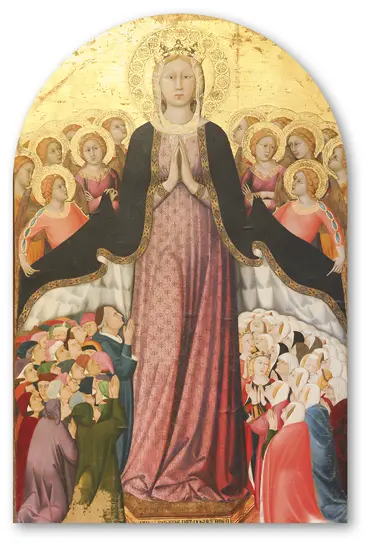
Madonna of Mercy, by Lippo Memmi – Cathedral of Orvieto (Italy)
Since Mary was free from any sin or imperfection, and always corresponded in the most perfect manner to every grace She received, we must regard her – concludes Dr. Plinio – as a sacred Ark containing all that is beautiful, good and true which men have rejected throughout history, in unimaginable proportions.
Within her, these splendours remain in a state of integrity and full acceptance, and it is certainly for this reason that humanity, having rejected God so callously and slipped into abysses of impiety, can still receive forgiveness and be restored.
Thus, when we feel remorse for our infidelities or long for the splendours of Christendom, let us imagine the past living on within Our Lady and take comfort in the thought that, through her intercession, everything may be restored. On a personal level, we may also ask Our Lady to offer to God on our behalf the integrity we lacked, for She represents in the highest degree what we ought to be, and thus to offer to Jesus Christ the honours we have failed to pay Him.
We may conclude, therefore, that the Most Holy Mary embodies in herself the perfect solution for each of us individually, as well as for the whole of history. Rightly, the Church has invoked her since time immemorial as “our life, our sweetness and our hope”, and St. Bernard implores her: “Mother of life and salvation, may thy integrity excuse in the presence of thy Son the guilt of our corruption.”13
The highest degree of union with God
This solution, which draws from a special devotion to Our Lady, will not, however, consist in a “common holiness” – if one may put it that way – but rather in a most exalted union with God, as is well expressed in the exclamation of St. John Eudes:
“Heroes, geniuses in the order of grace, and marvels of holiness have blossomed above all from devotion to the Most Holy Virgin, the Saint par excellence! It is precisely in her school that they learned the secrets of holiness and from which they drew the graces of light and love that raised them to the summit of perfection!”14
Hence St. Louis Grignion refers to the relationship with Mary as a secret, unknown to most men. Those who are initiated into this secret will be regenerated to the supernatural life, in a phenomenon similar to what occurred with the Child Jesus during His sacred gestation: Mary will sustain them with her existence and nourish them with her virtues;15 She will become the life of her children on the spiritual plane, and they will no longer think, will, or act without her, which constitutes the highest degree of union with God.16
The souls thus inserted into the very heart of Our Lady will become living copies of her to love, serve, and glorify Jesus Christ.17
Commenting on the effects of Marian devotion, Msgr. João Scognamiglio Clá Dias, EP,18 speculates that, since goodness is eminently diffusive, the Blessed Virgin will ensure that we participate in some way in the superabundance of grace that She possesses by virtue of her connection to the hypostatic union. The Mother of God will “pour out” her own will, as it were, into our souls, as a precious liquid poured into a crystal goblet; we shall thereby acquire her mentality and desire everything She desires, through free acceptance, like an Angel in Heaven.19
In this spiritual relationship with Our Lady, we can become Marian souls, by means of an easier, more serene and sure path to holiness. Through grace, great saints will be forged, who, compared to those of the past, will be like cedars of Lebanon in relation to shrubs.20

View of the Erlauf Valley, in the Ybbstal Alps (Áustria)
Consequently, Christ’s reign through Mary will be the historical era “in which her spirit will be present in every creature and her love will cover the whole earth like a delicate and pure mist. Just as in the current times the foul and pestilent breath [of the devil], characterized by revolt, by egalitarianism and by sensuality, is inhaled in all places, during the Reign of Mary the sweet aroma of the presence and the virtues of the Heavenly Queen will be breathed in both souls and in ambiences, as well as in customs and even in civilizations.”21
“My Mother, I am all thine!”
Now, in what does this fruitful relationship with Our Lady consist? And how does one attain it?
The answer to these questions is set out by the Apostle of Mary in his famous Treatise on True Devotion to the Blessed Virgin. In this work, St. Louis teaches a form of devotion that brings us into the closest possible union with her, namely, the slavery of love.
This sacred slavery consists in giving oneself completely to Our Lady so that, through her, we may belong entirely to Jesus Christ. We must offer her our body with all its members and senses; our soul with all its faculties; our interior and spiritual goods, which are our merits, our virtues and our good works past, present and future, as well as all our material goods; in short, everything we have and may have in the order of nature, grace and glory, without exception.22
Whoever opens their soul to the overflowing mercy of Our Lady will understand that the consecration proposed by St. Louis Grignion is but a consequence of such a relationship with the Mother of God; and furthermore, as Roschini comments,23 a necessity for every Christian worthy of the name.
Indeed, from the loving acceptance of mercy springs, spontaneously, the desire for this blessed slavery. It is as if Our Lady had said to us: “My child, above all else and despite any failings, I love you!”; and received from us the reply: “My Mother, I am all thine!”24
A soul thus consecrated will always be able to declare by virtue of this offering that everything it does, however insignificant, belongs to Jesus and Mary;25 and, by persevering in this grace, it will be able to freely enjoy the unfathomable benefits described in these pages, and many others that cannot be enumerated.
The righteous shall enter through this gate
“My grace is sufficient for you” (2 Cor 12:9), replied the Saviour to the Apostle of the Gentiles when he sought His help in temptation. This counsel, transcending the limits of the personal trial endured by St. Paul, applies to all of us who labour in this vale of tears.
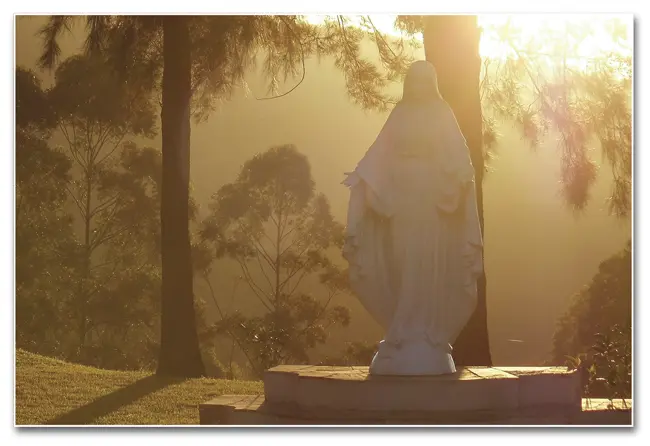
Our Lady of Grace – Private collection
Divine grace is the only thing we need, and upon it depends our salvation and that of the whole world. Let others devote themselves to accumulating merits by their own efforts; as for us, let us seek grace, and let us seek it in her who is and always will be “full of grace” (Lk 1:28): Mary!26
The Blessed Virgin is truly “the gate of the Lord” proclaimed in the Book of Psalms (cf. Ps 118:20): everyone who wishes to be righteous and to work effectively for the restoration of the world will enter through her! ◊
Notes
1 ST. THOMAS AQUINAS. Summa Theologiæ. I, q.25, a.6, ad 4.
2 ST. LOUIS-MARIE GRIGNION DE MONTFORT. True Devotion to Mary n.6-7.
3 Cf. CORRÊA DE OLIVEIRA, Plinio. Talk. São Paulo, 9/1/1982.
4 ST. LOUIS-MARIE GRIGNION DE MONTFORT. The Secret of Mary, n.1.
5 Cf. ST. LOUIS-MARIE GRIGNION DE MONTFORT. True Devotion to Mary, n.13.
6 Cf. ST. ALBERT THE GREAT. Mariale, q.164.
7 Cf. ROSCHINI, OSM, Gabriel. Instruções marianas. São Paulo: Paulinas, 1960, p.251-252.
8 Cf. ALASTRUEY, Gregório. Tratado de la Virgen Santísima. 4.ed. Madrid: BAC, 1956, p.626.
9 Cf. ALASTRUEY, Gregório. Tratado de la Virgen Santísima. 4.ed. Madrid: BAC, 1956, p.626.
10 Cf. CLÁ DIAS, EP, João Scognamiglio. Mary Most Holy: The Paradise of God Revealed to Men. Houston: Heralds of the Gospel, 2025, v.III, p.133.
11 Cf. CORRÊA DE OLIVEIRA, Plinio. Talk, 13/12/1977.
12 Cf. ST. ALBERT THE GREAT, op. cit., q.164.
13 ST. BERNARD OF CLAIRVAUX. Sermo tertius in Adventu Domini, n.5.
14 ST. JOHN EUDES. Maria. Meditaciones. Bilbao: Vizcaína, 1951, p.21.
15 Cf. ST. LOUIS-MARIE GRIGNION DE MONTFORT. True Devotion to Mary, n.206.
16 Cf. CLÁ DIAS, op. cit., p.140-141.
17 Cf. ST. LOUIS-MARIE GRIGNION DE MONTFORT. True Devotion to Mary, n.217.
18 Cf. CLÁ DIAS, EP, João Scognamiglio. Talk. Madrid, 17/4/1999.
19 Cf. CORRÊA DE OLIVEIRA, Plinio. Conference. São Paulo, 26/4/1974.
20 Cf. ST. LOUIS-MARIE GRIGNION DE MONTFORT. True Devotion to Mary, n.47; 152-182.
21 CLÁ DIAS, Mary Most Holy: The Paradise of God Revealed to Men, op. cit., p.123.
22 Cf. ST. LOUIS-MARIE GRIGNION DE MONTFORT. True Devotion to Mary, n.121.
23 Cf. ROSCHINI, op. cit., p.255.
24 Cf. CORRÊA DE OLIVEIRA, Plinio. Talk. São Paulo, 9/1/1982.
25 Cf. ST. LOUIS-MARIE GRIGNION DE MONTFORT. True Devotion to Mary, n.136.
26 Cf. ST. BERNARD OF CLAIRVAUX. Sermo in Nativitate Beatæ Mariæ Virginis, n.7-8.