


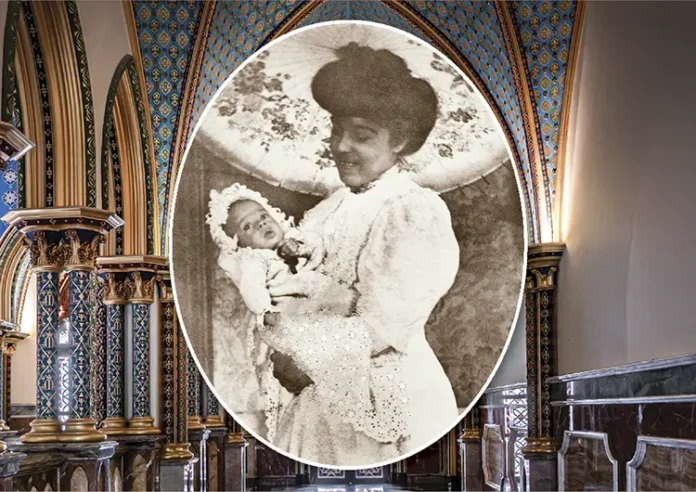
Frequently, the spiritual state of the mother conditions that of the son, for God takes into account the mother’s fidelity when giving to her offspring the graces necessary for the fulfilment of their mission. To properly discharge this duty, a wise mother must pray, have a sound interior life, frequent the Sacraments and, by doing so, benefit from grace and make progress in her spiritual life. In this way, she will ensure that her own holiness will be reflected in her children.
Our Lord says in the Gospel: “Blessed are those who hunger and thirst for righteousness, for they shall be satisfied” (Mt 5:6); a mother’s love for her child must be such that she hungers and thirsts for perfection and wishes to devote herself entirely to his sanctification so that, when she is with the child, she will delight him and inspire him to exclaim: “How beautiful it is to be holy!”
The privilege of having a good mother
This was the opinion of Dr. Plinio: “The best of universities cannot play the role of the mother: that of providing, within her perspective that she transmits to her son, a number of general notions, […] which will project themselves upon his entire life. After drawing from her the good influences that effectively prepare him for the Catholic Church and that impart to his soul a great avidity to embrace the Catholic Church, when this son reaches the end of his life’s course he will perceive that it is in accord with what he received from her at the outset.”
What a privilege it is to have a good mother, in whom shine the gifts of the Holy Spirit, who takes her son in her arms with true affection!
If we were to form a concrete idea of the privilege it is to have a good mother, one in whom shines the virtues and the gifts of the Holy Spirit, who takes her son in her arms with warmth, affection, and a way of being that gradually opens his eyes to reality and gives him the initial impetus along the right path, we would have a clear notion in mind of Dona Lucilia’s role in the spiritual ascension of Dr. Plinio.
He bore witness to this in the praise which he rendered her soon after she had breathed her last breath: “I observed her beautiful soul with unwavering attention, and that is why I so loved her. To such a point that even if she were not my mother, but someone else’s, I would have cared for her just the same and would have found a way to live close to her. Mother taught me to love Our Lord Jesus Christ; she taught me to love the Holy Catholic Church.”
A medieval soul, raised up for the future
God, in His infinite wisdom, prepared the blossoming of Dr. Plinio’s elevated vocation in advance, giving him Dona Lucilia for a mother. Her soul was adorned with the graces of the Middle Ages and with all that was best in the Ancien Régime1 and in the Belle Époque; in other words, what the era of the cathedrals and the Crusades produced “post mortem”, after the revolutionary decadence had set in. In reality, based on Dr. Plinio’s words and the Author’s personal experience, he considers that Dona Lucilia possessed something additional, which did not exist in any previous age.
Dona Lucilia’s great mission was to be a small and overlooked seed, but one that was full of iridescent hints of good things to come in the future
Indeed, a sound theological principle asserts that the Church, inasmuch as it is the Mystical Body of Our Lord Jesus Christ, does not remain inert throughout time but will grow constantly in grace and sanctity until the end of the world. As long as a baptized person exists on the face of the earth, the Church will be alive and progressing, because it is assured by the promise of immortality made by Our Lord.
Within the context of this growth, Dona Lucilia represented a golden and magnificent seed, full of iridescent hints of some good thing to come in the future.
A small, humble and overlooked seed of innocence
A comment made by Dr. Plinio in this respect in 1977 is illustrative:
“There was in her spirit a most elevated point, which was the domain of her innocence. What relation does this domain of innocence have with my innocence? And what relation does this domain of innocence have with her role in history? […] [She] retained, above all, the good aspects of the nineteenth century, which were the still-living medieval traditions; and her soul was a continuation of these. As such, I began to love the Middle Ages in her, and I often thought: ‘How like Mama they are.’
“However, Mama did not have an exact notion of what the Middle Ages had been. She had a great liking for Gothic things, but her soul was more Gothic than what she observed in the Gothic. She was a most faithful echo, albeit subconscious, of that glorious era of faith, and while the whole world was decaying and abandoning […] the spirit of the Middle Ages, she begot a son who was an enthusiast of Medieval Christianity.
“She is the hyphen, the bridge between all that formerly existed and the future. She represents the final lamentation of the past, weeping at its death. And her son was destined by Our Lady to found a family of souls which would be the dawning of the resurrected Middle Ages in the Reign of Mary. […] To be precise, the word hyphen says little: it is the last seed of a splendid tree that perishes, but from which will be born another, still greater tree. She was this seed: humble, small, overlooked, leaving behind her no vestige other than that one, but leaving that one. And such is her great role in history, her great mission.”
Given the extraordinary vocation of Dr. Plinio, was it not natural that he be born of an innocent mother, as was Dona Lucilia, who never committed a grave sin during the ninety-two years of her long life? Yes, this calling, according God’s plan from all eternity, would be founded on innocence, without which it would be impossible for Dr. Plinio to fulfil it. It is from this innocence that so many other privileges, gifts and benefits would arise, which Providence wished to bestow upon him.
For this reason he was entrusted to such a virtuous mother, a true wellspring, a flourishing garden of righteousness, with the objective of his having before him a point of analysis, of attraction and of sustenance for his own innocence. ◊
Taken, with slight adaptations, from:
CLÁ DIAS, EP, João Scognamiglio.
O dom de sabedoria na mente, vida e obra de
[The Gift of Wisdom in the Mind, Life and Work of]
Plinio Corrêa de Oliveira. Città del Vaticano-São Paulo: LEV;
Lumen Sapientiæ, 2016, v.I, p.109-114
Notes
1 From French: Old Regime. The expression was originally used by the Girondist and Jacobin agitators to describe in a pejorative manner the monarchical system of government of the Valois and the Bourbons prior to the French Revolution of 1789. In reality, this epoch stood out for the splendour of its ceremony in the life of the court and for the harmonious and hierarchical order which prevailed in society.


