


For centuries, when radar and other sophisticated devices available today did not exist, sailors relied on the stars as their main point of reference. The steersman had to orient himself by the position of the stars to keep the ship on course. Therefore, no one could take the helm and cross seas and oceans – at the mercy of the winds, which were often contrary – without first applying himself to a thorough study of astronomy.
Similarly, there is a fundamental requirement for any responsibility performed in society. A doctor, for example, has the obligation to know how diseases develop, what is the effect caused by viruses, what medicines are appropriate for curing which illnesses, and should further be aware of the discoveries of new substances to aid in the treatment of eventual ailments. If the doctor is remiss in this regard, his knowledge will become obsolete and he may proceed against the duties of his profession.
Similarly, a lawyer who is not interested in the study of law and does not seek to keep up to date with new or amended legislation will not be prepared to defend the as cases he should, and will cease to be a competent professional.
Our moral obligation to get to know God better
Now, much more important than the commitment we make with regards to our profession or role, such as medicine, law or the navy, are our duties to God.
We all began to exist at the moment we were conceived, when the process of gestation began in our mother’s womb. However, although our parents were at the origins of the corporal aspect of our being, we know that human conception does not take place solely in this purely natural sphere, but depends on God, who creates the soul, each one unique, and infuses it into the body at that moment.
This reality makes us indebted and obliged to strive increasingly to get to know the Being who created us, redeemed us, and still sustains us and helps us every step of the way! He can give us health, life, and happiness, in addition to all the graces we need!
But unfortunately, even though we are baptized and receive the Sacraments – especially attending Mass and receiving Communion – even though we know that Our Lord came to earth to save us, and we believe that Jesus is the Redeemer of the world, who took away the sins of humanity, we often lack a deeper knowledge of who He is!
It is a true moral obligation to endeavour to gradually penetrate the wonders that surround the principal mysteries of our Faith
It is therefore a moral obligation to endeavour to gradually penetrate the wonders that surround the principal mysteries of our Faith. And since the Church is continually enriched with new perspectives and explanations, it is incumbent upon us to constantly deepen our understanding, which will never be complete, since it concerns an infinite Being.
Even if we lived a billion years, we would be constantly learning, and eternity itself will be a continuous discovery of new aspects of God. For this reason, above the common concerns of life, our attention and our hearts must be applied to drinking deeply from Catholic doctrine and seeking to understand well the laws that govern our relationship with the Creator and the Creator’s relationship with us, so that we may turn to the One from whom we came. This is part of sanctity.
The example of the saints
The saints strove to increase in their knowledge of grace and the supernatural world, so as to be closer to God and to teach others
The saints are those whose primary concern is to know more about grace and the supernatural world, and to have a strong and substantial sense of the familiarity that exists between us and God, in order to live it more deeply. This is the axis of the way of thinking of every man who strives for perfection.
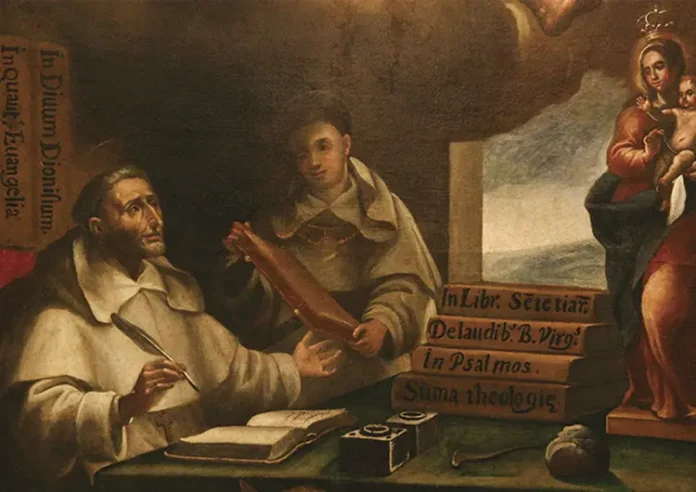
St. Odilon of Cluny, for example, who lived in the Middle Ages, had to make long journeys on horseback. One would think that he would spend his free time during those journeys contemplating the scenery and meditating; However, despite the discomforts of horseback riding – especially at a time when pocket books did not exist – he used to read the writings of classical authors, with the aim of expurgating anything that was not useful to the Catholic religion and taking advantage of everything that was useful for teaching others. And sometimes, if he came across a particularly interesting passage, he would make an effort to memorize it.
Shortly afterwards, we encounter the great St. Thomas Aquinas, who was sent at the age of five to the Benedictine monastery of Monte Cassino. It is a privileged place, both in terms of its location – as it is situated on an imposing, grandiose and lofty mountain, dominating the surrounding regions – and due to the blessing with which the virtue practised by St. Benedict marked that region.
The family of the Counts of Aquino had settled nearby as feudal lords. At that time, such was the fame of the Benedictine Order that noble families considered that to became an abbot would be an excellent career for one of their sons.
The boy, who had shown a profoundly pious and intellectual bent since childhood, was already a prodigy… Walking around the monastery, he would stop the monks and ask, “Who is God?” The religious replied, “God is an eternal Being,” “God is the omnipotent Being.”
And he, keeping this information in mind, later came to be the extraordinary author of 147 voluminous works, including the famous Summa Theologiæ, which explain the teachings of Catholic doctrine as no one else had done before.
Thus, we can easily conclude that St. Thomas’ life revolved around this single question: who is God?
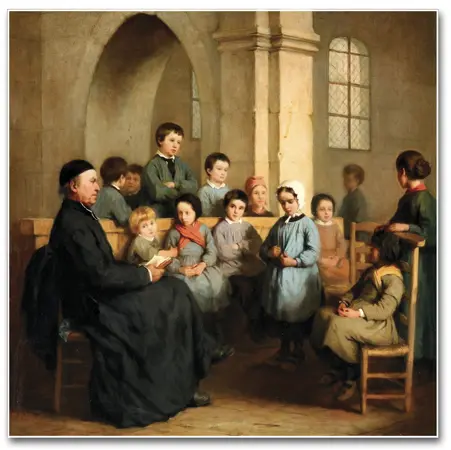
In the 20th century, Pope St. Pius X used to teach catechism every week to children who were preparing for their First Communion. He affirmed that he needed two hours of prior study in order to give a good class. This is, in fact, his recommendation to parish priests and catechists in the Encyclical Acerbo nimis: to prepare themselves through study and serious meditation.1

Finally, if we examine Dr. Plinio’s work closely, we will see that at its core is this search to know who God is and how our relationship with Him should be. That is why, whenever he could, he set aside some time each day for reading. And when, in the last years of his life, he was no longer able to do so because his eyesight had weakened, he asked some of his sons to make a recording of the book read aloud so that he could listen to it.
Grave carelessness in the teaching of doctrine
However, sometimes those responsible for the care of souls do not concern themselves with the religious education of those they direct and even, under the pretext of not wishing to frighten them, silence truths of Faith such as, for example, the notion of sin and the existence of hell.
I was once astonished to read in the famous Catechism, compiled by St. Pius X, a very strong warning, stated with great precision: “It certainly is necessary to learn the doctrine taught by Jesus Christ, and those who fail to do so are guilty of a grave breach of duty.”2
Those who are responsible for other souls have the obligation to teach them Christian doctrine, and will be blamed before God if they neglect this duty
And in the very next paragraph there is a statement which is less categorical : “Parents and employers are obliged to see that their children and dependents learn Christian doctrine; and they are guilty before God if they neglect this duty.”3
Therefore, if an employer who does not care to give Catholic instruction to his employees in industry or his company incurs sin, how much greater is the responsibility of those who, as religious superiors and pastors, do not devote themselves to explaining the doctrine to their subordinates and are consciously and voluntarily remiss in their moral formation! Thus, through the negligence of some, a greater number of souls are lost…
Let us recall the episode narrated by Mother Mariana de Jesus Torres, one of the founders of the Conceptionist Order in Quito, Ecuador. As often happens with founders, to whom God usually reveals future events concerning their work, she had a mystical vision in which she contemplated, amid the eternal torments of hell, many nuns from her convent who had served as novice mistresses during their lifetime. All had committed a single mortal sin: they had neglected their obligation to give their subordinates proper formation.4
The benefits of learning more about doctrine
Now, the opposite is also true: every baptized person who strives every day to progress in reading and understanding Catholic doctrine acquires a kind of “varnish” on their soul, easily perceptible in outward signs by an attentive observer. Furthermore, the teaching of this doctrine helps us in the practice of virtue and, as a work of spiritual mercy prescribed by the Church, can be considered a sacramental, through which grace is transmitted.
However, the study of theology can never be independent of the other subjects that make up the “universe” of the Church, restricting itself to only one specific aspect. It is essential to have an overview as a backdrop in order to better understand the parts.
The knowledge of principles and varied speculations full of unresolved hypotheses must be combined with a love for the Sacraments, analysis of Exegesis and History and a perfect understanding of the Liturgy. Everything is harmonized in a colossal, entirely monolithic edifice, which is the Church, from whose supernatural influence the distribution of graces comes.
How to teach doctrine effectively
A question arises here: how to effectively teach a course on Catholic doctrine?
In the early days of Christianity, those who believed in the Holy Trinity and the other articles of the Creed were quickly accepted into the baptismal waters and became members of Christ. Nowadays, with regard to preparation for Baptism, First Communion and Confirmation, catechesis must be serious, but it is not appropriate to delay a person’s admission into the Church for years. Therefore, once the main truths of the Faith have been discussed and explained, it is appropriate to guide the catechumen directly toward the necessary steps to receive the Sacraments.
But when it comes to providing a solid formation, study should continue until the hour of death. And no matter how well those who teach know Catholic doctrine, they need to make an effort beforehand to become thoroughly familiar with the subject matter through assiduous reading.
It is not a question, therefore, of creating a new doctrine, but of taking what is in the Gospel and transmitting it in a very clear, lively and attractive way, making the subject enjoyable. Each person can make use of the resources and gifts received from God, by being thorough in their descriptions, or by adapting to the students’ inclinations to apply what has been read in theory to a specific point, or combating the listeners’ indolence by encouraging them to contribute by explaining what they ha learned.
Show the world the true face of the Church
There is, however, one essential point in this formation that cannot be emphasised enough: in addition to the knowledge that must be transmitted, it is indispensable to present not only a doctrine, but also a human type, a lifestyle, a way of being. This is what the Angel of the Lord commanded the Apostles: “Go and stand in the temple and speak to the people all the words of this Life” (Acts 5:20).
Unfortunately, today’s generations have little interest in studying the doctrine of the Holy Church, and it is rare to see anyone reading a book of this kind. On the contrary, when considering the situation of humanity in our days, it breaks one’s heart to see the existence of a true conspiracy by the international press to dishonour and disfigure our Mother.
In a world that seeks to disfigure the Church’s physiognomy, we are called to show the true face of our Mother – holy, dignified and immortal
In this circumstance, Providence calls us to the supremely beautiful and honourable mission of showing the world the true face of the Church, in all its immortality, dignity and holiness.
Therefore, we must aim at the total formation of man, with a view to establishing models that can give society a true understanding of the Decalogue, of the love of God, of what it means to be a Roman Catholic, and of where the solution to today’s problems can be found.
Let us ask Our Lady, in our prayers, for very special graces so that there may be an authentic enthusiasm of the heart – and not only of the intellect – for learning Catholic doctrine, and that this study, carried out with mastery, competence and skill, may bring about the transformation of mentalities, so that earth may draw ever closer to Heaven! ◊
Excerpts from oral expositions given
between 2000 and 2007
Notes
1 Cf. ST. PIUS X. Acerbo nimis: AAS 37 (1904-1905), 624-625.
2 CATECISMO MAIOR DE SÃO PIO X. Rio de Janeiro: Permanência, 2018, p.27.
3 Idem, ibidem.
4 Cf. PEREIRA, OFM, Manuel Sousa. Vida admirable de la Madre Mariana de Jesús Torres y Berriochoa. Quito: Fundación Jesús de la Misericordia, 2008, t.II, p.98-99.
