…that the True Cross was hidden for centuries?
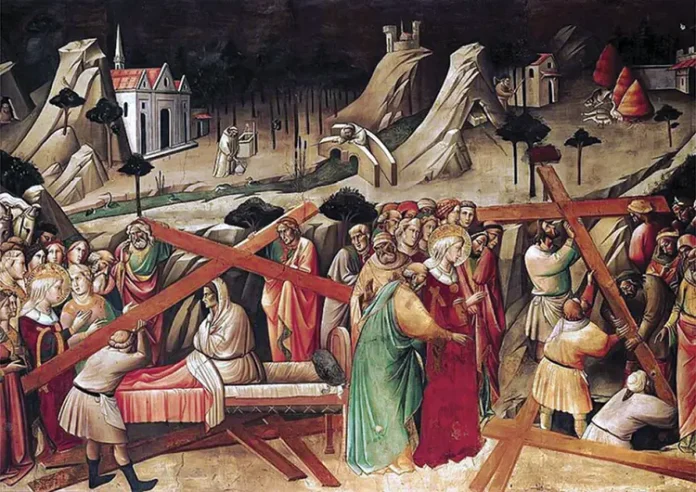
For centuries, Judea – a territory dominated by the Roman Empire – kept a profound secret: the whereabouts of the Cross of Christ. It was only in 326 that St. Helen, mother of Emperor Constantine and a fervent Christian, decided to undertake a pilgrimage to the Holy Land, along with an expedition in search of the most precious relic of Christendom.
The excavation was arduous. Mount Calvary had been buried and levelled by the Romans, transforming the sacred site into an esplanade.
Nevertheless, after weeks of labour, the team of workers finally revealed the original topography. Then came the surprise: in a deeper investigation, three crosses were found! It remained to be seen which one of them was the pledge of our salvation…
Amidst the general commotion, the Bishop of Jerusalem, St. Macarius, begged God to send a sign: “Grant us to know, Lord, in an evident way, which of these three crosses served for Thy glory!” Now, there was a sick woman in the city, whose case the doctors considered hopeless. When she was touched by the first two crosses, nothing happened. However, upon coming into contact with the third, the woman instantly recovered her health. The miracle left no room for doubt: the true Cross had been found!
St. Helen later divided the precious relic, with parts destined for Rome, Constantinople, and Jerusalem. Given the devotion of the faithful, these portions were later fragmented, allowing for the dissemination of relics of the true Cross throughout the Christian world. Symbolically, however, for the Cross continues to stand while the world turns: stat Crux dum volvitur orbis. ◊
…why we pray with our hands folded?
Hands folded, palm to palm, next to the chest of one who prays: this is one of the most common and expressive positions for Christian prayer. Whether a priest at the Sacrifice of the Mass, the anxious student before an exam, or the mother interceding for her children, this posture transcends generations and borders. And with good reason, given the origins of this tradition.
This position of supplication has its origins in the Middle Ages. It was the age of feudalism, when, in a pledge of mutual aid and complete loyalty, men were united within a hierarchical structure, not through cold, formal contracts that were mere empty words, but through a personal commitment.
A knight who offered himself to the service of a liege lord – whether a king or another noble – swore his oath of fidelity before the master with his hands together on his chest.
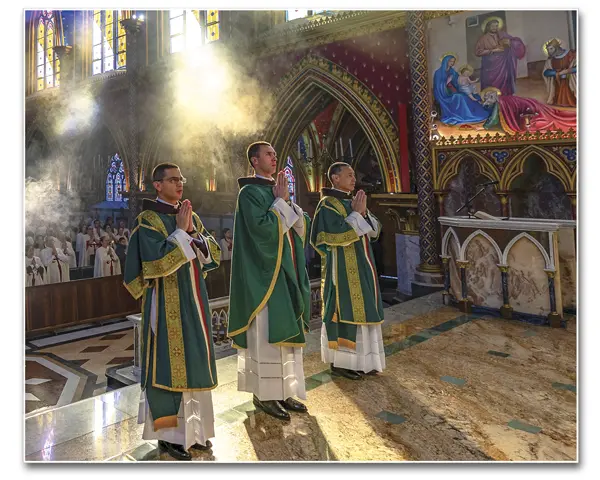
Even the soldiers of Christ – “miles Christi” (2 Tm 2:3) – began to address the Divine General in their prayers in this way, and the custom became prevalent from the 12th century onwards.
Along with the widespread movement in favour of this practice, the Church itself recommended it to its children: at the Synod of Oxford (1222), for example, Cardinal Langton instructed the faithful to have their hands folded during the elevation of the Host. Over time, the gesture gained prominence in sacred ceremonies and, through use, became the most common position for prayer in the Liturgy.
When we fold our hands to pray, let us remember the depth of this act: we declare to God that we are His vassals and warriors. May this habit inspire us to humbly ask for the strength necessary to serve Him with loyalty and courage. ◊