


In his first epistle, written when he was advanced in years, St. John the Evangelist exhorts his disciples to always remain in Our Lord Jesus Christ through the observance of the Commandments, particularly the love of God and of neighbour. He, who in the past was called the “son of thunder” (cf. Mk 3:17), due to his fiery temperament, seeks to encourage his “little children” (1 Jn 2:1) to do so by offering them a very simple argument: “Let us love God, because He first loved us” (1 Jn 4:19).
These few words express a sublime theological truth: though the greatest precept is to love the Lord with all one’s heart (cf. Mt 22:37-38), the most precious gift is to be loved by Him. Indeed, in relation to God, it is more important to be loved than to love because, as St. Thomas Aquinas affirms, divine love is so effective that it “infuses and creates goodness”1 in the beings to whom it is directed. Therefore, the good that is in us, and any act of virtue that we may practice, come from this love.
Maintaining the due proportions between Creator and creature, something analogous happens with Our Lady, whose outpouring of love towards us is an overflowing of the infinite Love that is God (cf. 1 Jn 4:8). The Blessed Virgin loves each one of us, her children, with ineffable sweetness, even before we turn to her, and She goes in anticipation to prepare our paths before us. She grants all of the necessary natural and supernatural gifts for the fulfilment of our vocation, and ever obtains torrents of grace for us.
In my specific case, I felt Mary’s protection, care and maternal affection from a very early age, almost as if my awestruck eyes had glimpsed indescribable scintillations of the countenance of the Queen of the Universe even as I lay carefree in my cradle, marking the dawn of a deep-seated relationship with her. Later, when I first came in contact with Our Lady after reaching the age of reason, I had the impression of encountering someone who already knew and loved me.
The awareness of being the receptacle of this Marian love, entirely gratuitous and intensely solicitous, prior to any act of love on my part, attracted me irresistibly throughout my life, making my heart overflow with affection and acknowledgment.
Mary has no limits in the largesse of her love. When her maternal care has already enchanted us, to the point where we suppose that only in eternity will we enjoy greater affection, She then surprises us with new gifts. And we would be inclined to forget the previous favours, if the present ones were not often their corollaries. This is the path reserved for those who, despite their miseries, trustingly allow themselves to be lulled in her arms, like frail children in the lap of their loving Mother.
This is the theme I wish to develop in these lines: the greatest demonstration of Our Lady’s love for me, which, it should be emphasized, I do not consider to have entailed any contribution of merit on my part.
During the Sacrament of mercy…
In July of 2008, the annual retreat would be held for the priests of the Society of Apostolic Life Virgo Flos Carmeli, of which I was both founder and Superior General. However, heeding the fervent requests of spiritual sons and daughters, I agreed to also allow the participation of all Heralds of the Gospel who so desired, from both the masculine and feminine branches. More than a thousand people confirmed their presence, which obliged us to hold this period of recollection within the then Church of Our Lady of the Rosary, today a minor basilica, located in the complex named Tabor.
This situation contravened the institution’s usual practice of organizing its retreats with a relatively small number of participants, and caused me some concern. However, with Our Lady’s help, the risky experiment proved successful, and Heralds of the most varied ages easily followed the meditations, dealing fundamentally with the virtue of humility.
Nevertheless, a problem presented itself: since the retreat was originally intended for the priests, it made no sense to take them from their recollection to attend the general Confessions of that multitude, which, according to the Ignatian outline, should occur within the first couple of days. Therefore, it was decided to recommend that everyone make their examination of conscience at the appropriate time, but keep it until the last day, which, after the concluding morning meditation, would be dedicated to administering the Sacrament of Penance to those who so desired.
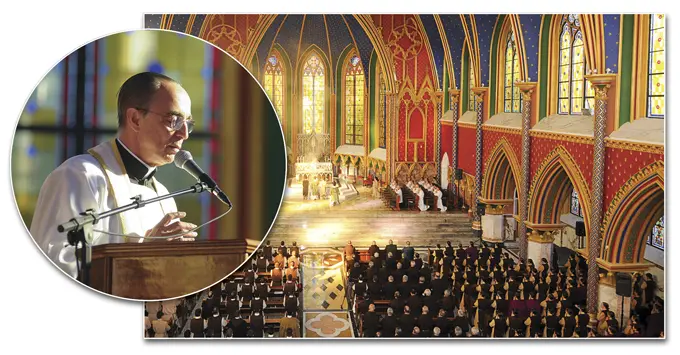
View of the retreat in the Basilica of Our Lady of the Rosary, in June of 2008, inset, Msgr. João while preaching during the same event
Thus, on the morning of July 12, 2008, the numerous priests in attendance occupied all the available confessionals, chapels and rooms in order to grant sacramental absolution to their brothers in the vocation. During the retreat, I had also received several requests from sons and daughters, for me to hear their Confessions. However, when I was ready to attend to them, there was no better place left, which was both public and discreet, than the space between the tabernacle and the altar of the church, where I placed a chair for myself and a kneeler for the penitents. Our Lady would avail herself of these circumstances to grant me the greatest grace of my life, in the realm of mystical experience.
…the greatest sensible manifestation of Mary’s mercy
The Basilica of Our Lady of the Rosary is presided over by an expressive statue of the Virgin of Fatima, with her Immaculate Heart exposed, as She appeared in one of her apparitions in the Cova da Iria. I was half a metre away from the tabernacle, and little more than a metre from the image.
The atmosphere created by the Confessions was conducive to an examination of conscience, and, while hearing one of the penitents, I felt keen regret in considering that I had perhaps not made sufficient reference to Mary Most Holy during the retreat conferences. At that moment, the strains of the Gregorian hymn Rosa Carmeli sounded from the church’s speakers, bringing my mind back to my first encounter with Dr. Plinio in the Basilica of Our Lady of Mount Carmel, in São Paulo.2
This remembrance was accompanied by the idea of the immeasurable love that the most tender of mothers had for the Child Jesus when holding Him in her arms. And I pondered how extraordinary it must be, not only for her Divine Son, but for whoever might be blessed with this grace, to thus repose in her arms. In spite of the consideration of my own miseries, I felt a great desire to raise my gaze to Our Lady, who was so close, but I initially chose to remain recollected during the Confession.
Finally, giving in to this filial impulse, I looked up to the image and suddenly became completely oblivious to concrete reality, as if I were outside of myself and separated from my surroundings. I then felt myself physically in the arms of Our Lady, with my forehead resting against her shoulder and cheek – and I affirm this with extreme respect, and without daring to make the least absurd comparison – as the Child Jesus appears in the statues of the invocation Sedes Sapientiæ. And Mary caressed me with her virginal hands. She said nothing to me, but… to be caressed and embraced by the Queen of Heaven and earth… What more could one desire?
The experience also involved the sense of sight, so that I saw Our Lady more or less as that Fatima statue represents her. However, the embrace was so physically sensible and cogent that I did not manage to accurately consign her facial features to memory. Absorbed in that “heaven,” I did nothing; I merely let myself be embraced by my Mother. A torrent of consolation overwhelmed me, as never before in my life, making me shed abundant tears.
Although the phenomenon occurred during the hearing of a Confession, the penitent failed to notice anything. Perhaps Providence thus disposed things, for I was obliged to control myself somewhat, fearing that the one confessing his faults in the Holy Tribunal of Penance might suppose that those tears were caused by the sins told. If I had been alone, what might have happened? Perhaps I would have died, for St. Thomas teaches3 that it is not possible for man to enjoy total bliss in this life.
Let us allow ourselves to be loved by Our Lady
The narration of these episodes calls to mind the meaning of the word mercy [misericordia], that is, love for the miserable. It entails a sublime mystery, diametrically opposed to the mystery of iniquity. When Our Lady loves someone with a gratuitous predilection of her Heart, the person need only allow himself to be taken up!
We must have absolute confidence in the Saviour and His Blessed Mother. Our Lord does not love us because of some good that might exist in us, but because, seeing our nothingness, He feels the need to instil there the Good that He is in essence. When He encounters a miserable person, the Heart of Jesus sighs with the desire to help him, as His Heart was created for this purpose, and He can only demonstrate the superabundance of His love in this way. Respecting due proportions, the same is true of the Blessed Virgin. How could it be different if, according to St. John Eudes’ happy expression,4 her Heart is one with the Heart of Jesus?
I was a “victim” of this love when I was embraced by Our Lady… Therefore, I speak as one acquainted with the subject matter. And I understood this reality better when, in 2010, I suffered a cerebrovascular accident that marked a tremendous turnabout in my life, and the onset of many long years of physical and moral suffering. Amid this veritable via crucis, I can affirm that the love Mary manifested in that embrace has always sustained me, even in the times of greatest aridity.
But how can one instil in souls an enthusiasm for this love, which comes so naturally for those who have experienced it? Observing those with whom I have contact, in the exercise of my ministry, the following thought often comes to my mind: “If each and every one only knew how much Our Lord and Our Lady love them, they would become great saints!” The problem lies in estimating Jesus and Mary’s love for us according to the human criteria to which we are accustomed, that is, revolving around personal correspondence and merit.
In reality, what does God expect in order to inundate us with His love? First of all, simplicity, a virtue too often ignored. When the Almighty deigns to allow Himself to be won over by someone, He does so by means of simplicity; that is how Our Lady “conquered” Him. Rendering ourselves small before the Most High and His Mother brings us this unsurpassed reward.
We often complain about spiritual aridity and lack of interior incentive for the practice of virtue. At these moments we should ask ourselves: “Am I making myself little?” Relations with our sovereign Queen, and comprehension of her will only blossom from this disposition of soul recommended by the Divine Master in the Gospel (cf. Mt 18:3).
Our Lady wishes to embrace humanity in the Reign of Mary
As a conclusion to these thoughts, I wish to express to the reader my desire that the embrace received in 2008 be extended to countless people, because I believe that it was the forerunner of others, and the pledge of a new regime of grace that Our Lady wants to obtain for humanity.
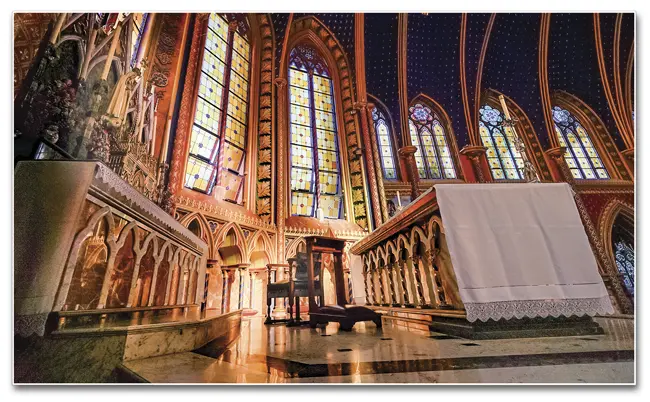
The place where Msgr. João heard Confessions during the retreat
For me, the embrace I received from Our Lady on July 12, 2008, signified exactly this: that the Queen of the Universe had opened the doors of the Reign of Mary to me. In what sense? It could be said that this Marian era, in its most sublime aspect, will consist of an embrace from her to all her children.
Yes, for mysticism is not a privilege of the great contemplatives or a few souls called to an exceptional path, as a certain warped concept of spirituality might have one believe. Though such a concept be entrenched in many souls and environments, the ordinary path of holiness actually includes both asceticism and mysticism. Asceticism is aided by cooperative graces, which demand our effort; and mysticism is characterized by efficacious and sensible graces, making us experience, deep within our souls, who God is.
Therefore, all those who have been chosen, out of gratuitous goodness, to contemplate the Reign of Mary, must be favoured with mystical graces of the highest calibre. Only thus will this glorious historical era bear the fruits prophesied by so many Saints, for the greater glory of God.
For this reason, I nurture in my heart the certainty that there will be a moment in which public opinion devoted to the Holy Church and thus, duly united to Mary Most Holy, will experience, by a special action of God, the gratuitous, enveloping and inexhaustible love of her who will be the effective Queen of future centuries. In a word, the day will come, and is not far off, when Mary will embrace her faithful children, as She was so good to have embraced me.
This is a promise, based upon what grace murmurs within my soul, and here made to those who read these lines: “If you are true children of Our Lady, that is, if you allow yourselves to be loved by her, you will be embraced as I once was!” And this embrace will prepare us for the eternal embrace that She will give us in Heaven when, not by our merits, but by her mercy, we arrive there.
Foolish are those who abandon Mary’s maternal mantle to wallow in the swine’s slop of today’s paganized and revolutionary world, which threatens imminent collapse. Foolish indeed, because it is a sign of predestination to be under the aegis of this sacred mantle, and a guarantee of many graces. Sheltered beneath it, let us await the great events that can already be detected on the horizon!
Such events will bring the blessed times in which humanity will, as no one has in all of history, with the exception of St. Joseph, advance in the loving comprehension of the Blessed Virgin’s person, her spirit, her mentality and her mission.
For our part, we must strive to enter this Hortus Conclusus, an enclosed garden that only She can open to us, and thus respond to our Mother’s desire to be known and loved with a perfect love. When this garden is opened, Heaven will unite with earth, hell will be defeated, and the Angels will join with mankind in singing: “Glory to Mary in her Reign, for her Immaculate Heart has triumphed!” ◊
Taken, with adaptations, from:
Mary Most Holy: The Paradise of
God Revealed to Men.
Houston: Heralds of the Gospel,
2020, v.I, p.31-33; 153-181
Notes
1 ST. THOMAS AQUINAS. Summa Theologiæ. I, q.20, a.2.
2 Editor’s note: a meeting that took place on July 7, 1956, marking a milestone in Msgr. João’s dedication to the service of the Holy Church.
3 Cf. ST. THOMAS AQUINAS, op. cit., I-II, q.5, a.3.
4 Cf. ST. JOHN EUDES. The Sacred Heart of Jesus. Fitzwilliam: Loreto, 2004, p.108-110.